
Abstract
Development refers to a process in which someone or something grows or changes and becomes more advanced. Development is very often seen as a double-edged sword as it has both its benefits and drawbacks—for instance, The Great Nicobar Development Project.
The project, on one side, developing Great Nicobar, promises economic growth, job creation, and improved infrastructure. However, this economic growth comes at the cost of environmental degradation. The project involves deforestation, habitat destruction, and plausible pollution, severely affecting the island.
This research paper will explore the various aspects of The Great Nicobar Island Development Project by focusing on its legal complexities and environmental implications. The paper will examine the project’s background, objectives, potential benefits, challenges to the ecological balance, and the legal frameworks governing such initiatives. Moreover, the paper provides recommendations for addressing the identified challenges.
Keywords
Development of the Andaman and Nicobar Islands, Strategic Importance, Biodiversity, Ecological Impact, Tribal Rights, Environmental Ethics, Inclusive Development
Introduction
The Andaman and Nicobar Islands are a union territory of India, located in the Indian Ocean, in the southern Bay of Bengal, near Indonesia and Thailand. These islands separate the Andaman Sea from the Indian Ocean, with the Ten Degree Channel dividing the two main island groups. The Andaman Islands lie to the north and the Nicobar Islands to the south. Port Blair serves as the capital of this archipelago. As of 2019, the population of the territory is 434,192, with a literacy rate of 86.27%. The total land area is approximately 8,249 km², with the Andaman Islands covering 6,408 km² and the Nicobar Islands about 1,841 km². Out of the 836 islands, islets, and rocky outcrops in the territory, only 31 are permanently inhabited.
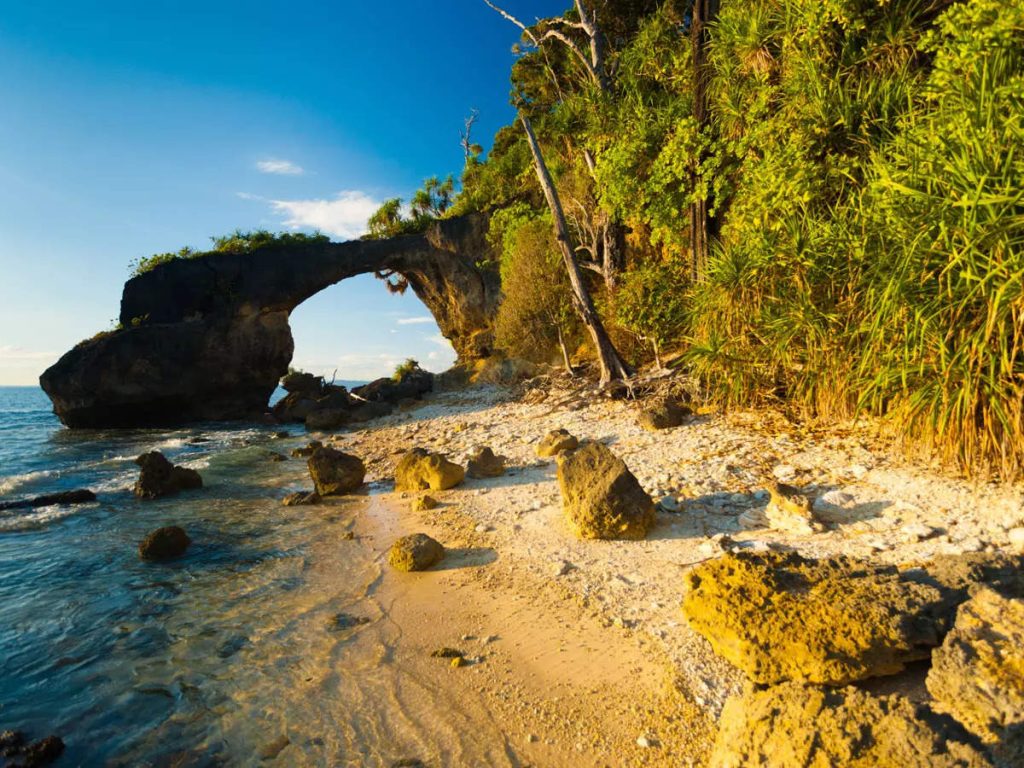
The Nicobar Islands are further divided into Small Nicobar and Great Nicobar, with Great Nicobar being the largest, covering 921 square kilometres. According to 2011 data, Great Nicobar has a population of 8,367. Indira Point, the southernmost point of India, is located on Great Nicobar Island. This island features unique and threatened forest ecosystems and a diverse range of flora and fauna. It is also home to indigenous tribes such as the Shompen and Nicobarese. The Great Nicobar Biosphere Reserve, established in 1992, includes Campbell Bay National Park and Galathea National Park. In 2013, it was added to UNESCO’s Man and Biosphere Program to promote sustainable development through local community efforts and scientific research.
Research Methodology
This paper is descriptive and analytical in nature. It describes the problems of the Great Nicobar Development Project, describes and analyses the compensatory provisions of the government, and provides specific recommendations to address the concerns. This paper utilizes secondary sources like newspapers, articles, and websites for an in-depth understanding and analysis of the legal complexities and environmental implications of The Great Nicobar Development Project.
Review of Literature
In the publication “Balancing Development and Environmental Ethics: The Andaman and Nicobar Islands Project Dilemma” by Ganesh Pandit (2024), the author examines the intricate issues associated with development initiatives in the Andaman and Nicobar Islands. Pandit underscores the strategic significance of the project for India’s security and economic advancement, while also addressing ethical concerns stemming from the islands’ distinctive environment and culture. He emphasizes the necessity for an approach that harmonizes development with environmental conservation. The author advocates for meticulous planning, transparent decision-making, and a commitment to environmental stewardship to achieve sustainable growth with minimal ecological impact.
In the piece “Who Is the Great Nicobar ‘Holistic Development’ Project Really For?” by M.G. Devasahayam (2023), the author provides a comprehensive critique of the Great Nicobar Island development project. Devasahayam identifies substantial environmental, social, and legal challenges linked to the project and questions the transparency and motivations behind its approvals. He suggests that the benefits of the project are disproportionately skewed towards a few large corporations. His work explores the tension between development and sustainability and examines the role of corporate influence on government policy and decision-making.
The Great Nicobar Project
The Great Nicobar Island Development Project is also known as The Holistic Development of the Great Nicobar Island Project. It is a mega project piloted by N.I.T.I. Aayog, the think-tank of the Government of India and implemented by the Andaman and Nicobar Islands Integrated Development Corporation (A.N.I.I.D.C.O.). The expected cost of the project is ₹72,000 crore. The main aim of the project is to leverage the islands’ strategic advantage on the international sea route to develop a sustainable, green, global hub for business, trade, and leisure. This initiative is expected to create many employment opportunities and economic growth. The project proposes constructing a “Greenfield City,” consisting of an international container transshipment terminal, an international airport, a township, and a 450 MVA gas and solar-based power plant on the island. The development activities began in the financial year 2022-23. The port is expected to be commissioned by 2027-28. The project will be implemented in 3 phases and is expected to be completed in the next 30 years.
Essential Components and Features of the Project
- International Container Transhipment Terminal (ICTT): The establishment of an International Container Transhipment Terminal (ICTT) with the capacity to handle 16 million TEUs (units of cargo capacity) is expected to position Great Nicobar as a significant player in the regional and global maritime economy, attracting existing traffic from ports along Bangladesh, and Myanmar. This is expected to boost trade.
- Greenfield International Airport: The Greenfield International Airport will be developed as a “joint military-civil, dual-use airport” under the operational control of the Indian Navy, accommodating both military and tourism needs.
- Development of Township: The township is intended to serve as a centralized hub for residential, commercial, and recreational activities, providing essential infrastructure such as housing, healthcare facilities, and educational institutions. It will enhance residents’ quality of life and support the influx of businesses and industries.
- Gas and Solar Power Plant: A 450-MVA gas and solar power plant will be spread over 16,610 hectares on Great Nicobar Island to ensure the region’s sustainable and reliable energy supply.
Significance of the Project
The project on the Andaman and Nicobar Islands is strategically significant for India, particularly due to the Great Nicobar Island’s proximity to the Strait of Malacca, located just 200 km to the south. The Strait of Malacca is a vital maritime route, handling 25% of global trade and 80% of the world’s crude oil supply. Establishing an International Container Transshipment Terminal (ICTT) on Great Nicobar Island will enhance India’s role in international trade and bolster its economic influence and security capabilities. This development allows India to adopt strategies like the ‘metal chain’ approach for security and a sea denial strategy in naval warfare scenarios.
Developing infrastructure on Great Nicobar Island will give India strategic control over crucial trade routes, particularly affecting China’s trade and oil supply routes to Europe, the Middle East, and Africa through the Malacca Strait. In a conflict scenario, India could disrupt China’s economic activities by leveraging control over this key passage, using advanced weaponry and maritime exclusivity zones. These advancements will enhance India’s geopolitical status in the Indian Ocean, challenging other regional powers.
The proposal to develop Great Nicobar Island as a transshipment hub has been considered since the 1970s due to its strategic location along the East-West international shipping corridor. Currently, India relies on Sri Lanka’s Colombo port for 43% of its transshipment cargo, highlighting the need for a domestic alternative. The ICTT on Great Nicobar aims to compete with ports in Sri Lanka and Singapore, serving as a vital hub for BIMSTEC countries and Indonesia. This initiative will improve regional connectivity and strengthen maritime security in response to China’s ‘string of pearls’ strategy to encircle India.
Environmental Impact of the Project
The Environmental Impact Assessment (EIA) report by VIMTA Lab of Hyderabad raises concerns regarding its credibility, as it began fieldwork in December 2020, seven months before the Environment Appraisal Committee (EAC) issued the Terms of Reference for the Expression of Interest.
Moreover, it also contains several significant flaws, gaps, and defects. They are as follows :
Banda Aceh in Indonesia, which was the epicentre of the December 2004 earthquake and tsunami that resulted in an unparalleled death toll and devastation, is not too far from the island. During the 2004 disaster, the Great Nicobar’s shoreline dropped by over four meters. However, no study has been conducted or risks assessed regarding the island’s placement in a seismically active zone where earthquakes frequently occur.
The government proposes to relocate coral reefs, which is an absurd idea. The coral reefs are sensitive ecosystems, and various activities like overfishing, mining, destructive fishing practices, tourism, and industrial runoff contribute to coral degradation. The development project will likely increase exposure to these harmful activities, and thus, to counter these damaging effects, the government proposes to relocate coral reefs as part of the Great Nicobar Development Project. This recommendation is bizarre due to several compelling reasons. Firstly, Coral reefs are highly complex, delicate, and sensitive ecosystems that require particular environmental conditions to thrive, like precise water temperature, salinity, accurate light, and suitable water quality, which is virtually impossible to achieve. Secondly, relocating them involves moving the corals and the multiple marine life (animals and microbes) that depend on them, which is difficult to achieve without causing significant damage.
Additionally, relocation stress can lead to coral bleaching and death, further exacerbating their fragile state. This undermines the very purpose of relocation, which is to preserve these ecosystems. Most coral reefs are already severely impacted by bleaching due to climate change, and additional disturbances from relocation can push them beyond recovery. Therefore, the government’s proposal is impractical.
The Great Nicobar Island covers 951 square kilometres. It is the largest island in the Nicobar group. The island experiences a tropical monsoon climate and an annual rainfall of 372 cm, which allows diverse vegetation, including evergreen hill forests, tropical rainforests, coastal forests, and mangroves, to thrive. It lies within the Alpine-Himalayan seismic belt, which is one of the world’s most seismically active areas. The weather, climate, geography, and topography provide excellent conditions for flora and fauna to survive. The island hosts unique and threatened tropical evergreen forest ecosystems with 650 species of angiosperms, ferns, gymnosperms, bryophytes, and over 1,800 species of fauna, many of which are endemic.
Great Nicobar’s rich biodiversity includes 11 species of mammals, 32 species of birds, seven species of reptiles, and four species of amphibians. Endemic and endangered species such as the Crab-eating Macaque, Nicobar Tree Shrew, and Nicobar Megapode are found here. The development project on Great Nicobar Island will harm the forests and wildlife. The diversion of large areas of forest land and the clearing of forests will destroy the natural habitat of many endemic species, which will, in turn, endanger them. It is estimated that the project will result in the felling of approximately 8.5 lakh trees, destroying the natural ecological balance of the island. Moreover, construction activities will cause habitat fragmentation, creating problems for animals in terms of finding food mates and migration. Additionally, increased human activity and infrastructure development will lead to pollution, further degrade the environment, and harm the species that rely on it.
The southernmost point, Galathea Bay, is an important nesting ground for the Leatherback Turtle. The construction and operation of the port will cause significant disturbances to the nesting grounds, which will severely impact the turtles’ ability to lay eggs and the hatchlings’ chances of survival. The heavy machinery, increased human activity, and potential pollution from port activities will disrupt the delicate nesting process, leading to a decline in Leatherback turtle species. Furthermore, the port’s artificial lighting and noise pollution will disorient the turtles, making navigating between the ocean and their nesting sites difficult.
Overall, the project will threaten the rich biodiversity and unique ecosystems of Great Nicobar Island, leading to potentially irreversible damage to its flora and fauna.
The Great Nicobar is also the home of indigenous people. The Shompen Tribe, with a population of around 200, inhabits the forests of the biosphere reserve, particularly along the rivers and streams. They move between the Core and Buffer Zones, maintaining their traditional lifestyle of hunting and gathering in harmony with the forest environment. In contrast, the settlers and Nicobarese Tribe (approximately 300) live in settlements spread along the coast in the Transition Zone. However, the devastating tsunami of 2004 forced them to relocate. They have moved to Afra Bay on the North Coast and Campbell Bay, adapting to new environments while continuing their cultural practices. The development project will lead to
the loss of approximately 8.5 lakh trees in pristine rainforests, a reduction of 12 to 20 hectares of mangrove cover, inevitably affecting their traditional lifestyle. Moreover, some members of these tribes have been very isolated. The project will bring more people to the island and increase their exposure to them, increasing their chances of contracting diseases. Thus, the government’s decision to implement this project is a death sentence for these tribals.
Legal Challenges
The Great Nicobar Development Project has sparked concerns regarding potential breaches of numerous national and international laws aimed at safeguarding the environment, indigenous rights, and biodiversity.
Wildlife Protection Act, 1972: This Act safeguards wild animals, birds, and plants and oversees related matters. It designates protected areas, including national parks and wildlife sanctuaries. The development project encompasses portions of the Campbell Bay National Park and Galathea National Park, both protected under this Act. Such development activities can disrupt habitats and endanger wildlife, thereby violating the protective measures established by this Act.
Environment (Protection) Act, 1986: This Act aims to protect and enhance the environment and addresses connected matters. It authorizes the central government to set environmental quality standards and regulate industrial activities. The development project could cause significant environmental harm, such as deforestation, pollution, and ecosystem disruption, which would contravene the objectives of this Act.
The Scheduled Tribes and Other Traditional Forest Dwellers (Recognition of Forest Rights) Act, 2006 (FRA), recognizes and grants forest rights to forest-dwelling scheduled tribes and other traditional forest dwellers. The proposed project threatens the rights of indigenous tribes, such as the Shompen and Nicobarese, who depend on the forest for their livelihoods and cultural practices. Displacement or habitat destruction without proper consent and compensation would violate this Act.
The UN Declaration on the Rights of Indigenous Peoples (UNDRIP) establishes global minimum standards for the survival, dignity, and well-being of indigenous peoples. Proceeding with the project without obtaining the free and informed consent of the indigenous communities, and causing their displacement or cultural disruption, would breach the principles of UNDRIP.
To address these concerns, the Indian government has proposed a compensatory afforestation plan, aiming to carry out afforestation activities on non-notified forest land in Haryana, with future plans to shift to Madhya Pradesh. The estimated cost of this initiative is ₹7,970 crores.
In response to environmental and tribal welfare concerns, the government has formed committees dedicated to ecology and environmental conservation, tribal and Shompen welfare, pollution control, and biodiversity. The commitment to allocate substantial funds to protect the Nicobar environment is acknowledged.
Suggestions
Forest Conservation and Reforestation
The government should implement stringent forest conservation policies. They should also engage in reforestation projects to compensate for forest land diverted for development. However, native tree species should be used in reforestation efforts to restore the original ecosystem. This will help maintain the ecological balance and support the diverse flora and fauna.
Pollution Control Measures
The government should introduce robust pollution control measures to manage industrial runoff, waste, and emissions. The government should make the installation of advanced waste treatment facilities mandatory. Most importantly, the government should enforce regulations to prevent the discharge of harmful substances into the environment. Controlling pollution is the most effective way to protect terrestrial and marine ecosystems.
Community Involvement and Livelihood Support
The government should involve local communities in decision-making processes and protect their livelihoods. The government should collaborate with NGOs and other organizations working for the welfare of tribal people to provide training and support for sustainable practices that can provide alternative income sources, such as eco-tourism and conservation efforts, to protect the tribals from exploitation and humiliation by outsiders. The government should engage local communities to ensure that development initiatives are inclusive and beneficial for all stakeholders.
Conclusion
In conclusion, the project under consideration holds immense significance for India’s development and security. Considering the current waves in international politics, moving forward with the development project seems warranted in light of the country’s security and economic interests. However, it is essential that environmental harm be minimized and some amount be allocated for ecological restoration, which should help solve the grassroots-level problem and not be used to fill the coffers of government officials and contractors. Ultimately, the decision involves carefully balancing the benefits of development with the imperative of environmental protection.