
Abstract:
This paper explores the necessity of legalizing same-sex marriage in India, examining the social, legal, and human rights aspects. It analyses the current legal framework, public opinion, and the potential benefits of recognizing same-sex unions. Through an analysis of cultural, social, and legal dimensions, this paper advocates for extending marriage rights to same-sex couples as a matter of justice and human rights.
KEYWORDS:
Same-sex, LGBTQ, human rights, Section 377, homosexuality, decriminalization
Introduction:
With the recent developments in LGBTQ rights in India, the need to extend their right to family, the right to adopt, and the right to self-determination have become the need of the moment.
LGBTQ+ community stands for a loose collection of Lesbian, Gay, Bisexual, Transgender, and Queer+ individuals. The extra “+” represents every other identity not covered by the abbreviated abbreviation. To promote and normalize the existence of this community, numerous nations have legalized same-sex marriage and enacted other regulations.
In the Naz Foundation vs Government NCT of Delhi case, the court declared Section 377 as unconstitutional. Because “discrimination based on orientation is grounded in stereotypical judgments and generalizations about the conduct of either sex,” the Naz Foundation court held that sexual orientation is included in the definition of sex as a ground.
In India though not extensively, the decriminalization of Section 377 of the Indian Penal Code in 2018, was a step in the fight for the LGBTQ community’s equal acceptance and normalization. The clause stated that “Whoever voluntarily has carnal intercourse against the order of nature with any man, woman or animal, shall be punished with [imprisonment for life], or with imprisonment of either description for a term which may extend to ten years, and shall also be liable to fine”. The Supreme Court of India ruled in Navtej Singh Johar’s case that Section 377 is unconstitutional since it infringes upon his right to privacy. The Court proceeded to determine that Section 377 violates fundamental rights because it appears to be discriminatory towards sexual minorities and the section was read down. This ruling aligned with Puttuswamy’s case by recognizing the right to live with dignity. The fundamental rights are enshrined in Articles ‘14, 15, and 21’, of the Indian Constitution.
The Transgender Persons (Protection of Rights) Bill, of 2019 was another step the government took to protect transgender persons from discrimination and ensure their right to residence, healthcare, employment, and education.
The LGBTQ community has endured cataclysm for a very long time. Even while the above-mentioned laws might not be enough to solve the problem, they are a step in the right direction toward normalizing at least the conversation about it.
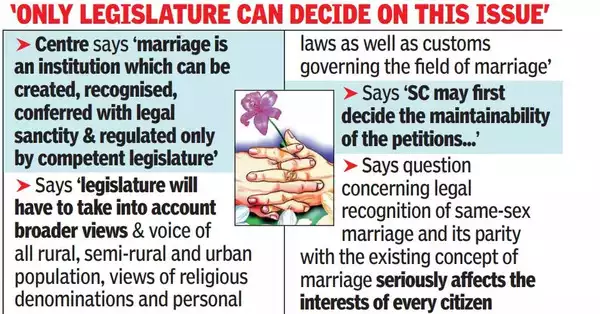
India has various laws to govern marriages like the Hindu Marriage Act of 1955, Muslim Personal law, Indian Christian Marriage Act of 1872, The Parsi Marriage Act, and the Special Marriage Act of 1954. The 5-bench judge of the Supreme Court recently gave its verdict on same-sex marriage and quashed the non-heterosexual couple’s plea. The bench has asked the Parliament to frame laws regarding the same. There was a general assumption that the five-judge Constitution Bench would interpret the Special Marriage Act (SMA) 1954, a law that permits marriage between any two individuals, in a way that is gender-neutral and would encompass individuals of the same sex, but it turned out to be the opposite. Same-sex couples are not entitled to guaranteed rights to marriage, reproduction, adoption, or maintenance.
According to various research on the topic, same-sex relationships and heterosexual relationships are similar in all important psychosocial aspects, marriage confers significant psychological, social, and health benefits, and same-sex couples and their kids stand to gain greatly from the legal recognition of their relationship as marriage. The straightforward argument in favor of same-sex marriage is that if two people want to commit marriage, they should be permitted to do so, and excluding one class of citizens from the benefits and dignity of that commitment demeans them and insults their dignity. It’s high time to adopt ideologies to satisfy the requirements of a progressive society.
Review of Literature:
In Saif Rasul Khan’s Same-Sex Relationships And Marriage In India: The Path Forward, the author examined the rich history of same-sex relationships in India. It addresses a critical and evolving issue within Indian society and legal frameworks. The literature surrounding this topic spans historical, sociological, legal, and comparative studies, providing a comprehensive understanding of same-sex relationships and the advocacy for marriage equality in India.By situating his arguments within this extensive scholarly context, Khan’s work contributes significantly to the ongoing dialogue on marriage equality and LGBTQ+ rights in India.
In Ananya Mishra’s Same-Sex Marriage in India: Its Legal Recognition and Impacts – A Bird’s Eye View, the author delves into significant strides in LGBTQ+ rights, including the decriminalization of homosexuality, the legal recognition of same-sex marriage. The elucidation of Analysis of key legal battles, including the Delhi High Court’s 2009 ruling and the Supreme Court’s 2018 decision to decriminalize consensual same-sex acts, and how these have paved the way for discussions on same-sex marriage may have been improved.
Research Methodology:
This research paper is a secondary source. The author collected and analyzed data from various documents, articles, legal texts, court rulings, law journals, and media reports while researching this topic.
Historical background
Though certain sections of people argue that homosexuality is a Western concept, history proves them wrong. Love was commemorated in all its forms. In Indian history, there are roots of queerness found in ancient epics and scriptures as well as in medieval prose, poetry, art, and architecture.
The story of King Bhagiratha was born out of two women. In Mahabharata, the tale of Shikhandi who was the daughter of Drupad shows the concept of homosexuality. She became a man in the later stage. The ‘Mohini’ avatar of Lord Maha Vishnu in Matsyapurana who fell in love with Lord Shiva and gave birth to Lord Ayyapa. In Rig Veda and Kamasutra, the same is visible. Kamasutra even classifies men who are attracted to men as ‘third nature’. The birth of Agni Deva is out of two mothers and is known as dvimatri. But in Manusmrithi, homosexuality was viewed as a terrible crime with associated penalties.
Not only in Hindu scriptures or mythology, some instances showcase the existence of homosexuality in Muslim literature and scriptures.
In Baburnama, the memoirs of Ẓahīr-ud-Dīn Muhammad Bābur (1483–1530), founder of the Mughal Empire he talks about how he fell in love with a boy in Kabul.
El-Rouayheb contends that while religious experts condemned sodomy as a heinous sin, the majority of them did not sincerely think that it was wrong to simply fall in love with a male or to use poetry to communicate this love.
Certain instances in Islam also show that the main prophet, Muhammad never prohibited homosexual relations even though he disapproved of the idea. Numerous references to homosexual behaviour may be found in the Quran, which has led to extensive exegetical and legal commentary over the ages. However, the Shariat law treats same-sex love as an evil practice.
After annexing India, the British came up with a legal framework with the enactment of the Indian Penal Code of 1860 drafted by Lord Macaulay. They criminalized homosexuality and made it an unnatural offense. Section 377 Criminalized “carnal intercourse against the order of nature,” targeting homosexual acts. These laws portrayed Victorian-era British moral values, which were prudish and repressive towards homosexuality.
The misconception that same-sex relationships are an imported disorder from abroad adds to the misinformation that many Indians find hazardous.
Status of LGBTQ rights internationally
Source: Our World data
By 2024, 37 countries will have legalized and acknowledged same-sex marriages. There are currently 36 countries where same-sex marriage is legal: Andorra, Argentina, Australia, Austria, Belgium, Brazil, Canada, Chile, Colombia, Costa Rica, Cuba, Denmark, Ecuador, Estonia, Finland, France, Germany, Greece, Iceland, Ireland, Luxembourg, Malta, Mexico, the Netherlands, New Zealand, Norway, Portugal, Slovenia, South Africa, Spain, Sweden, Switzerland, Taiwan, the United Kingdom, the United States of America and Uruguay.The first country to legalize same-sex marriage was the Netherlands in 2001 followed by Belgium (2003), Spain (2005), and Canada (2005). Men getting married is documented as early as the first century.
They formulated a committee in the Netherlands to see the possibility of same-sex marriages, and later, a law was passed by the ‘Senate’ that required either partner to have Dutch nationality. They even gave parenthood rights to homosexual couples. In the United Kingdom also same-sex marriage is legal. Civil partnerships, which offer most, but not all, of the rights and benefits of marriage, have been recognized since 2005. They have the Marriage Same-Sex Couples Act 2013 in their legislation. A Family Code that permitted same-sex marriages was passed by the Cuban people. The Canadian government passed the federal Civil Marriages Act in 2005 which legalized same-sex marriage throughout the country. The public supported civil unions and some rejected the same. These are a few examples different countries took to ensure the rights of the queer community.
There are efforts made by international organizations like the United Nations along with different NGOs and UNHCR for LGBTQ rights. One among them is the Yogyakarta principles which are international laws specially structured for sexual orientation and identities, but there is no specific UN convention for the same. Addressing this emerging issue is vital.
Suggestions:
Marriages and weddings are very important in India, both socially and in terms of religion and culture. India being a secular country, the opinions of different religious sections do have an impact while framing legislation regarding same-sex marriage. Understanding and incorporating different viewpoints is crucial. The country can make legislation through civil unions or partnerships like the way it is practiced in the US, UK, New Zealand, etc or it can adopt the Vermont model where the partners are provided with the same legal benefits as those who are joined. This can avoid opposition from religious sections. Otherwise amending all the personal laws is another option to recognize same-sex marriages but this will be a huge task. So, it is easier to amend the Special Marriage Act of 1954. It may not need massive change, revising Section 4(c) would be enough.
The upcoming Bharathiya Nyaya Sanhitha has achieved the goal of gender neutrality but it lacks the provision to ensure LGBTQ rights which demands specific statutes to make the queer community feel safer.
Conclusion:
It is evident that denying same-sex couples the option to marry perpetuates discrimination by treating them differently. Without any discrimination based on anything, including gender, every individual has the right to select their life mate. Same-sex unions are now allowed in several nations. Laws must evolve together with society. The purpose of law itself is to ensure justice and fairness. If we can’t amend it to satisfy the needs of society, then what is the point of having such legal frameworks? The legislation may make necessary modifications by taking the Yogyakarta 10 and Yogyakarta principles. Legislative provisions shall not remain in the ambit of marriage alone. It should widen its scope to adoption, inheritance, maintenance, economic rights, etc. Along with this, making society aware of the LGBTQ community and their active involvement in public is crucial to remove the pertaining social stigma. People should talk about sexuality and gender more freely inside their houses and surroundings. Personal space should be respected and protected. We should understand that they are also humans and they too deserve the right to live a dignified life. The author hereby urges the lawmakers, judiciary, and society to recognize and uphold the rights of same-sex couples.
-By Shreya A Nair
Vit School of Law, Chennai