
- Anoushka Saha, 2nd year, 4th sem BBA LLB (HONS)
- Christ University, Lavasa, Pune
1. Abstract
This paper deals with the significance of Bhartya Nyaya Sanhita, Bhartya Nagarik Suraksha Sanhita and Bhartiya Sakshya Adhiniyam. Along with how they have adopted through the evolution of society, even the criticisms have been included in this paper. It is important to emphasise that nothing can be perfect and there will be loopholes. These acts have improved the society as a whole, adopted along with the evolution of the society but certain sections contradict the points. Either way it will be interesting to see how the general public will be adhering to the acts and how the sections of these acts will be the part of the judgements in the present and the near future.
2.Key Words
Indian Penal code, Indian Evidence Act, Code of Criminal Procedure, Bhartya Nyaya Sanhita, Bhartiya Nagarik Suraksha Sanhita, Bhartiya Sakshya Adhiniyam .
3.Introduction
3.1 Evolution of law in reference to Sociological School of Jurisprudence and its connection with BNS,BNSS and BSA
Law evolves over time along with the society, the society is dynamic and the law is not made by itself rather the society creates law. Law exists because of society, law and society work hand in hand. The same way Indian Penal Code now Bhartya Nyaya Sanhita, Code of Criminal Procedure now Bhartiya Nagarik Suraksha Sanhita and Indian Evidence Act now Bhartya Sakshya Adhiniyam have evolved over time and have been more adaptable to the society. The evolution of these three acts can be connected with the Sociological school of Jurisprudence.
Roscoe Pound defines law as a “social institution to satisfy social wants.” If Roscoe Pound’s definition is interpreted then it can be stated that according to him law is not only a certain set of rules and regulations which are present in the books rather law is something which is created by the society.
Ihearing states that “law does not exist for particular individual but serves his interest with the society” . According to me this is beautifully coined especially when Ihearing emphasises upon that law is serving the person’s interest and along with that also serving the society’s interest.
Ehrlich states that “The centre of gravity of legal development lies not in legislation, not in juristic science, nor in judicial decisions but in society itself.” The interpretation of Ehrlich’s definition is that he distinguished and drew a clear line of difference between the law which is found in the books and law in the practical life also called the living law.
Josef Kohler’s postulate was that “Law is relative to civilization of the time and place.” When interpreted it can be seen that Kohler’s main contention is that law is not a static set of regulations or rules but evolution of law takes place along with the change in the society and also the societal perspectives.
Therefore, it can be contended that the Indian Penal Code now Bhartya Nyaya Sanhita, Code of Criminal Procedure now Bhartiya Nagarik Suraksha Sanhita and Indian Evidence Act now Bhartya Sakshya Adhiniyam evolved along with the change in the society.
3.2 History of Indian Penal Code 1860 , Indian Evidence Act 1872 and Code of Criminal Procedure 1973
3.2.1 Indian Penal code and its History
It is important to note that before arrival of the British, India followed the Mohammedan Criminal law consisting of firstly the foundation of Mohammedan criminal law being Koran later the Mohammedan Criminal law categorised various different offences and the punishments for those offences were given in four different categories such as Kisa, Hadd, Tazeer, Diya. It was followed over time but later did not serve the purpose of the society and became stagnant.
Indian Penal code’s draft was devised by the First law Commission which was led by Thomas Babington Macaulay during year of 1834 and was produced before the Governor General of India Council during 1835. Certain parts were taken from the Napoleonic Code and Edward Livingston’s Louisiana Civil code. The final draft was produced before the Governor General of India Council in 1837, but regardless of that it was again reviewed and revised. Later, the code was introduced in the Legislative Council during the year but was not present in the statute book. Barnes Peacock, the Chief Justice of the Calcutta High Court, later meticulously amended the original document and subsequently the code was passed during 6th October 1860 and the code came into effect during January 1st, 1862.
3.2.2 Code of Criminal Procedure and Its History
Similarly, the evolution of Code of Criminal Procedure traces back to its roots being the Vedas and Upanishads. It is to be emphasised upon that when the First War of Independence took place during 1857, the legal system in India changed drastically simultaneously establishing the Supreme Court replacing the Mayoral Courts along with that even the High Court came into existence accordingly codes and laws, regulations and legislations were created. It is to be emphasised upon that there was not even one criminal procedural law which was universally applied throughout India. There were certain acts but all of them were scattered and not consolidated. During the year 1852 the combined criminal procedure Supreme Court Act was created, later all the previous acts were absorbed by Criminal Procedure Code, during 1865 the High Court Criminal Procedure Act came into existence. It is important to note that these acts did not have uniform application throughout India Until the year 1882. During the year 1923 and 1955 there were major amendments which took place, during the year 1955 the law commission was set up and created a comprehensive code. Hence the Code of Criminal Procedure was enacted during the year 1973 and came into force during 1st April 1974.
3.2.3 Indian Evidence Act and its History
The evolution of Indian Evidence Act traces back to the Ancient Hindu Period where Vasistha validated evidence into certain types They were as follows, Lekhya which translates to documentary evidence, Sakshi which translates to Witnesses, Bukhti which translates to possession and Divya which translates to Ordeals. Evidence was dealt with differently for instance trial by ordeals was on the basis of who suffered injury, if a person’s hand was put on boiling water and if injury was suffered that meant that the person was guilty along with being impure. Regardless, this practice was abolished during the year 1817. The Indian Evidence Act came into existence by the Arrival of the Britishers. During the year 1837 an act was formulated where convicted persons could give evidence and were allowed for the same. It is to be emphasised that the law of evidence was brought up and addressed in eleven (11) acts during the years 1835-1855. Sir Henry Summer Maine drafted the Indian Evidence Act During the year 1856 but was deemed unfit and not suitable for India, later Sir James Fitzjames Stephen drafted a bill during the year 1871, later was accepted and came into effect on 1st September, 1872.
3.3 The Present Scenario
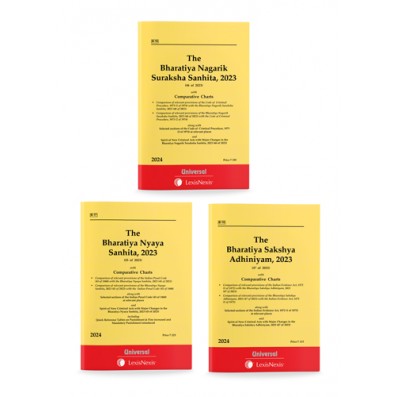
The Indian Penal code 1860, Indian Evidence Act 1872 and Code of Criminal procedure 1973 which were created during the British-era have been repealed by the new laws which are Bharatiya Nyaya Sanhita in place of the Indian Penal Code, Bhartiya Nagarik Suraksha Sanhita in place of the Code of Criminal Procedure and Bhartiya Sakshya Adhiniyam.
During the year 2020, the government of India sought to ameliorate the Criminal Justice system and it was found out that it was high time to make changes to the Criminal justice System which led the Ministry of Home Affairs to take views, suggestions and advices from the then Chief Justice of India along with the Chief Justice of High Courts and considered the views from the different Law Universities and also the Bar council. Later a committee was formed during the Month of March and the year 2020. The committee’s chair was the Vice Chancellor of National Law University, Delhi. The committee received a lot of backlashes and criticisms.
It was important to reform the Criminal Justice system regardless the past incidents and during 11th August 2023 the bills which were called Bhartiya Nyaya Sanhita Bill, Bharatiya Nagarik Suraksha Sanhita Bill and Bharatiya Sakshya Bill were introduced in the Lok Sabha by Shri Amit Shah. It is to be emphasised upon that the purpose of Indian Penal code, Indian Evidence Act and Code of Criminal Procedure which were made during the British-era was for punishing the people, protecting the British rule and was not to give justice. Accordingly, it was stated that these three new laws will strengthen our Nation along with protecting the citizens. It is important to note that 142 members of Parliament, 18 states, Supreme Court of India, 5 Judicial Academies, 270 Members of Legislative Assembly, 6 Union territories, 16 High Courts, 22 law universities and the public have given their suggestions on the new laws.
The Lok Sabha Passed the new criminal law bills during December 20th , then it was passed in the Rajya Sabha during December 21st, 2023. Finally, during 1st July 2024 three new bills became acts reforming the Criminal Justice system altogether, finally all the archaic condition of the acts has become modern and developed along with the societal needs. The main aim of these three acts is to “Decolonise” the criminal laws which were created during the British Era.
The three new acts (Bhartiya Nyaya Sanhita, Bhartiya Nagarik Suraksha Sanhita and Bhartiya Sakshya Adhiniyam) have a fair share of support and also criticisms.
4.Research Methodology and Method
This paper falls under the nature of descriptive research and secondary sources were used to find out about the history of the acts and the evolution of the same along with the significance and criticism. The secondary sources which were used can be classified into news articles, journals and websites.
The method of this research is more qualitative in nature.
5.Literature review
The three new acts’ (Bhartiya Nyaya Sanhita, Bhartiya Nagarik Suraksha Sanhita and Bhartiya Sakshya Adhiniyam) main purpose is to go hand in hand with the evolving society and also by introducing new laws and changes for an efficient Criminal Justice System along with strengthening the Criminal Justice system of India and keeping all of this in mind these acts came into effect on 1st July 2024.
The main purpose of Bhartiya Nyaya Sanhita,2023 is to serve justice along with repealing the laws which were archaic in nature and not only that but also removing many provisions which did not hold a rational ground rather the provisions which were repealed by Bhartiya Nyaya Sanhita were outdated and is hence rightfully repealed. The Bhartiya Nyaya Sanhita also introduced new provisions such as Section 2(3) talks about the definition of child, Section 48 which talks about Abetment outside India for offence in India, Section 69 talks about sexual intercourse by employing deceitful means, Section 95 talks about hiring, employing engaging a child to commit offence, Section 111 talks about organised crime along with that section 112 talks about petty organised crime , section 113 defines terrorist act, Section 117(3)(4) talks about voluntarily causing grievous hurt, Section 152 talks about Acts endangering sovereignty, unity and integrity of India along with that many other provisions were introduced in Bhartiya Nyaya Sanhita to adapt towards the societal changes, regardless the Bharatiya Nyaya Sanhita,2023 has faced criticisms.
The main purpose of Bharatiya Nagarik Sanhita, 2023 is firstly to repeal the Code of Criminal procedure, certain new changes in the Bharatiya Nagarik Sanhita, 2023 have been made keeping the dynamic environment in mind. Certain provisions which are included such as firstly forensic experts will have to visit the crime scene and then collect the evidence, even the electronic communication is allowed for the trial along with inquiry and investigation, even though signatures were always collected for examination now even fingerprints and samples of voice can be collected for the scrutinization. The most essential and key feature of Bharatiya Nagarik Sanhita, 2023 is that if the offender has disappeared and has not presented himself/herself in the trial proceedings then the trial can still be held in addition to continuing the proceedings and the judgement can be pronounced in his absence. The Bharatiya Nagarik Sanhita, 2023 has also faced criticisms.
The main purpose of Bhartiya Sakshya Adhiniyam is to repeal the Indian Evidence Act and change along with the society’s perspectives, the public’s needs and how the people actually behave in the society. New provisions has been introduced in the Bhartya Sakshya Adhiniyam such 2(1)(d) primary documentary evidence consists of video recordings and electronic records, Section 2(1)(e) permits to give oral evidence through electronic means where the witness, accused will be given to give their own testimony via electronic mechanisms. The scope of Bhartiya Sakshya Adhiniyam has been widened and the courts have also agreed to treat digital records equivalent to paper records. The Bhartiya Sakshya Adhiniyam has faced certain criticisms.
6.Key Highlights of Bhartiya Nyaya Sanhita, Bhartiya Sakshya Adhiniyam and Bharatiya Nagarik Suraksha Sanhita
6.1 Major Key Highlights of Bharatiya Nyaya Sanhita,2023
- The major key highlight of this act is that it has for the first time introduced a reformative method of punishment and that is ‘community service’ under section 4 of BNS. In my opinion this has been a very progressive step rather than only focusing on the death penalty or life imprisonment. Community service has been provided for 6 petty offences such as attempt to commit suicide, to compel or restraint public servant to carry out their duty, petty theft, causing public misconduct by being intoxicated/ drunk, defamation and non-appearance.
- The next highlight of this act is that the offences against women and children were all over the place and scattered but now have a separate chapter for the same and have been grouped together in chapter V of the BNS.
- Abetment, Conspiracy and attempt have been consolidated in one group, that is the chapter IV of the BNS.
- Section 69 also has been included which has never once been mentioned in the IPC. Section 69 deals with ‘Sexual intercourse on false promise of marriage, employment, promotion or by suppressing identity’ This section has come into existence to protect the rights of women.
- IPC did not ever have the provision with regard to the offence of snatching, but BNS has introduced the offence of snatching which has made the work of the police officials easier to treat it as a theft or robbery. Section 304 declares snatching as an offence in the country as whole.
- BNS has introduced section 48 which can also be considered one of the most essential highlights of the act. Section 48 ends up criminalising the acts which are done by the abetter who is outside India but abets a person to commit offence in India.
- BNS has removed the age-based comparison in relation to committing gang rape. The punishment is the same and section 70(2) deals with the same and sets the punishment of life imprisonment or death penalty when a minor girl has been subject to gang rape.
- Section 95 of the BNS makes the act of hiring, employing and engaging a child to commit an offence and hence made punishable for a term of 7 years minimum and can be extended.
- BNS introduces a provision specially for Hit and run cases as these cases were on the rise and introducing this can make people cautious about their actions. The main aspect of this is that if death is caused and not informed to a police officer and the person escapes then the punishment would extend to 10 years along with fine.
- The definition of terrorist act has been first time included after the introduction of BNS, present in section 113, along with that organised crime and petty organised crime are respectfully given in section 111 and 112 of the BNS.
- The offence of “Attempt to commit suicide” and is deleted in the new act (BNS),2023. Has been removed from BNS, and now corresponds with the Mental Healthcare Act 2017 but Section 226 has been added.
- New definitions such as definition of “child” and “transgender” are included in section 2 of the BNS, 2023.
- “Movable property” includes tangible and intangible.
6.2 Major Key Highlights Of Bharatiya Sakshya Adhiniyam, 2023
- The language as been more modernized for example ‘Vakil’, ‘Barrister’, ‘Pleader’ has been removed and rather been replaced with ‘Advocate’
- The essential highlight under BSA is that ‘Document’ under section 2(1)(d) has been elaborated and now includes digital records, electronic records, documents on laptop, computers and phone, locational evidence, voice messages, server logos. The main purpose of the update is because the society is evolving and along with paper-based documentation even electronic methods can be used for evidence. Under section 61 digital and electronic records will have similar legal effect and validity as other documents.
- Under section 22 of BSA now includes “coercion”
- There has also been a section 52 of BSA which has devoted itself to international law, consisting of international treaty, extra-territorial operations, agreement or convention made with other countries and international institutions.
- Even the purview of secondary evidence has been widened under the Section 58 of BSA. Secondary evidence also include oral admissions and also written admissions along with evidence given by a person who is skilled in analysing and examining certain voluminous documents.
- The section 138 of BNS has been modified and includes enabling an accomplice to testify in court against the person accused.
6.3 Major Key Highlights of Bharatiya Nagarik Suraksha Sanhita, 2023
- Section 2 of BNSS has been elaborated and also includes new definitions under the same and they are- ‘Bail petition’, ‘Bail Bond’, ‘Bond’, ‘Electronic communication’. These new definitions have considered the evolving society and the growing technology.
- Under section 20 of BNSS it establishes ‘Directorate of Prosecution’ and along with that defines eligibility , powers and functions of authorities under it.
- Under section 23, the authority of the Magistrate of the first class in relation to increasing fine has been from 10,000 to maximum 50,000 along with that the Magistrate for second class has the authority to increase the fine from 5000 to 10,000. They also can impose community service.
- Under Section 25 of BNSS the court is empowered to consider the gravity of the offence and then impose punishments.
- Section 187 emphasises upon police custody that according to it the initial period of police custody being 60 days.
- Under Section 50, it explicitly provides for ‘immediate seizure’ of offensive weapons.
- Under section 176(1), it provides protection to the victim and enforces transparency in investigation referring to an offence of rape where the statement of the victim will be recorded through an audio-visual means.
- Zero FIR has been introduced under section 173, here when information has been received by the police and that offence is outside the limits of a police station then it should be entered in the book and kept by the officer. Along with there is a provision in relation to E-FIR being introduced which states that information can be lodged through electronic communication.
- Under section 479, a provision for bail to undertrials have been liberalised and that leads to taking a sympathetic view towards them and are eligible to be released on bond by the court.
6.4 Criticisms
Justice Madan Lokur stated that “Provision on bail has been diluted by the recent Supreme Court judgment. I do not know what these new Bills would do.”
Section 43(3) of BNSS in simple words states that a police officer can handcuff the person firstly when they are arresting the person and secondly when they are producing them before the court and along with that not paying any heed to the decision made by Justice VR Krishna Iyer with regard to the granting of Bail that it should still be considered as a norma even under strict conditions under UAPA, but section 43(3) did not make the situation any better but ended up not giving any value to the judgement of Justice VR Krishna Iyer. Along with that sedition actually has not been removed, rather it has been modified into treason under section 152 of BNS. From certain sections like these it can be seen that it is hampering Article 19 of the constitution of India.
Section 69 of BNS is one of the sections which is heavily criticised, in my opinion it is portrayed as firstly victimising women, secondly it will be very difficult to prove the innocence of accused as it focuses on criminalising sexual intercourse by a false promise to marry through deceitful means. It will be very difficult to actually prove the innocence of the accused.
7.Conclusion and suggestions
These acts have their advantages and disadvantages as no act can actually be a perfect one, regardless of that there will still be criticisms, loopholes and a that can be fixed by various interpretations and judgements.
It is important to note that there is still scope for improvement and hopefully the criticism will be taken into consideration.
My suggestion is that the loopholes in these acts are looked upon and scrutinized once again and certain sections which actually do not benefit the public but worsen the conditions should be diluted, now that depends upon how it can be diluted with the help of the court’s interpretation and judgements.