
Abstract
This paper covers the evolution, execution, and issues surrounding Electronic Voting Machines (EVMs) in India. EVMs were first introduced in the early 1980s and saw widespread adoption in the 2004 General Election. The purpose of this change was to optimise the process of vote-counting and minimise instances of electoral malpractices but at the same time raised concerns about transparency and potential tampering. The history of EVMs dates back to inclusion of significant milestones such as the development by Electronics Corporation of India Ltd. (ECIL), legal verification, and later introduction of Voter Verifiable Paper Audit Trails (VVPAT) to enhance transparency. The Supreme Court judgments have shaped the legal framework governing EVMs and VVPATs. The paper also addresses the differing views of political parties on EVMs, influenced by election outcomes and other aspects. Although electronic voting machines (EVMs) prove advantageous for improving the smoothness of elections, challenges such as voter illiteracy and accusations of manipulation continue to exist. The paper concludes with a discussion on the implications of blaming EVMs for electoral defeats and the need for maintaining public trust in the electoral system.
Key Words – EVM, VVPAT, Elections, Political Parties, Election Commission of India (ECI).
Introduction
Millions of rural Indians who had never even seen the use of electricity, were introduced to technology for the first time by using electronic voting machines. For many years, a large number of Indians who were unable to read or write cast their votes by imprinting their thumbprints on voting cards. The use of electronic voting machines in India dates back to the early 1980s, but its extensive utilisation began in the 2004 General Election, when EVMs were employed in all 543 parliamentary seats. The transition from paper ballots to electronic voting was meant to improve the vote-counting procedure, but it also raised concerns over transparency and the possibility of manipulation. Before the introduction of electronic voting, elections depended on paper-based systems, sometimes referred to as “document ballot voting systems,” in which votes were manually cast and counted. The manual procedure was often laborious, requiring a significant amount of work, expensive, and consumed a substantial amount of time. The use of electronic voting has revolutionised the election process, resulting in a significant decrease in the government’s burden and enhancing overall efficiency. With all the advantages, revolutions in the voting system and shortcomings of the same, it had a major impact on the political environment of the country as well as had an effect of the voting system, further influencing the behaviour of the parties contesting the elections. This paper aims to give a broad view on the historical, political and societal understanding of the introduction of EVMs in India.
Research Methodology
This article utilises a descriptive technique and relies on secondary sources to provide a thorough examination of the legal rationale for Electronic Voting Machines (EVMs) and their adoption in India. The research uses a variety of secondary sources, including newspaper articles, academic journals, and websites, to give a detailed look of the subject. The paper aims to provide a thorough analysis of the legislative framework that regulates Electronic Voting Machines (EVMs), their implementation, and the contentious issues surrounding their use in Indian elections, using different kinds of reliable sources.
Review of Literature
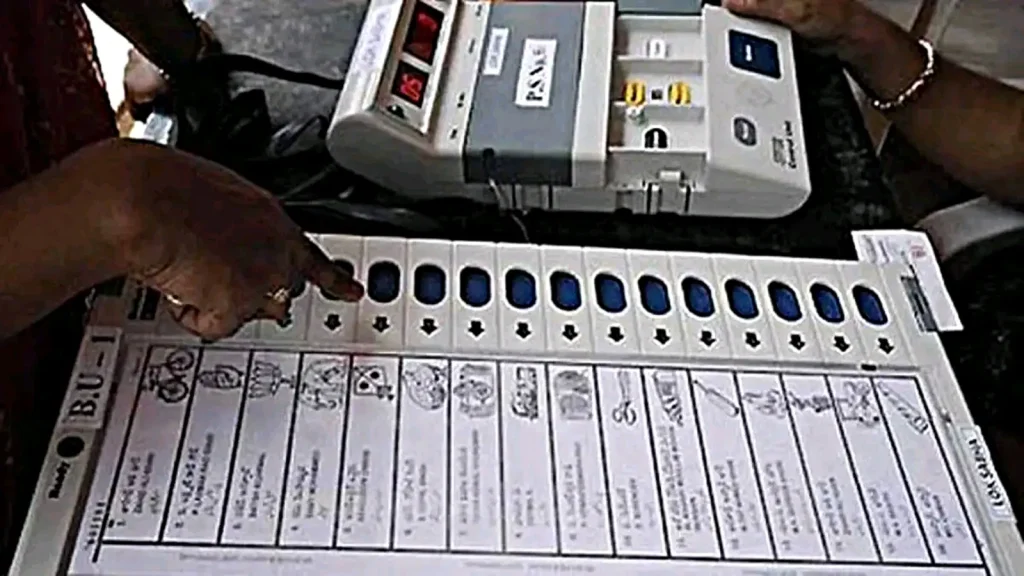
The article on The Scroll by Rohan Venkataramakrishnan examines the function of Electronic Voting Machines (EVMs) in Indian elections and raises concerns over their susceptibility to manipulation. The significant usage of Electronic Voting Machines (EVMs) in India is attributed to their effectiveness in mitigating voter fraud that was prevalent in the prior paper ballot system. The devices are simple and have three components: the control unit, the balloting unit, and the Voter Verifiable Paper Audit Trail (VVPAT). The control unit is responsible for recording votes, while the balloting unit is used to show the names and symbols of the candidates. The Voter-Verified Paper Audit Trail (VVPAT) enables voters to authenticate their vote prior to the slip being archived.
Although electronic voting machines (EVMs) are not connected to a network, there are ongoing worries about their security, especially when it comes to physical access to the devices. Recent concerns have been raised due to stories and videos depicting the transportation of EVMs without the necessary security measures. This has led to apprehensions about the possibility of EVM switching or manipulation. The Election Commission has provided assurance to the public that all used Electronic Voting Machines (EVMs) are safely stored under continuous 24-hour observation. The EVMs shown in these reports are designated as “reserve” units, which are maintained for emergency situation.
In another article by The India Forum by Kannan Gopinathan they emphasised that the use of VVPAT in India’s EVM system has generated apprehensions over the integrity and security of the voting procedure. VVPATs provide a printed record of the selected candidate’s name and symbol, despite the fact that EVMs are said to be independent devices without any external communication. The data for VVPATs is uploaded during the commissioning process after the candidate lists have been finalised, guaranteeing that the machines remain impartial towards any one candidate until that stage. Nevertheless, concerns emerge about the possibility of pre-programmed manipulation and the efficacy of physical and procedural protections. The inclusion of the VVPAT requires a reassessment of the system’s overall security and transparency, notwithstanding the importance of the two-stage randomisation and mock polls as crucial safeguards. The paper does not make any claims of manipulation, but it emphasises possible weaknesses and advocates for careful examination of the EVM-VVPAT process.
History of EVMs
The introduction of EVMs in India can perhaps be traced back to 1977, when the Electronics Corporation of India Ltd. (ECIL) produced a working model. The Election Commission of India (ECI) then presented this prototype in 1980. After reaching a general agreement on their use, EVMs were tested in 1982, which eventually resulted in a legislation reform in 1988 that granted the ECI, authority to utilise EVMs. Bharat Electronics Ltd. (BEL) and ECIL were chosen as the manufacturers of EVMs. In 1990, a panel of experts officially approved EVMs as both technically reliable and secure. EVMs were gradually used in elections starting from 1998, and reached their peak usage in the 2004 Lok Sabha elections, when they were utilised throughout the whole country. The introduction of M1, M2, and M3 EVMs, together with the implementation of Voter Verifiable Paper Audit Trail (VVPAT) in 2013, was a result of technological developments aimed at improving transparency.
The ECI introduced the EVM on May 19, 1982, at fifty polling stations for Number 70 Parur Assembly Constituency in Kerala. The winning candidate received a total of 30,450 votes, with 11,268 votes cast manually and 19,182 votes cast using EVMs. The use of EVMs was implemented in accordance with directives outlined in Article 324 of the Constitution, notwithstanding the initial reluctance of the Government of India. In 1984, the Supreme Court settled the dispute over the use of EVMs and the election outcome in the case of A.C. Jose v. Sivan Pillai. The Court determined that Article 324 grants the Election Commission of India the authority to oversee elections, but this authority must be consistent with Articles 325 to 329 and the current legislative requirements. The Court determined that the ECI lacks the authority to supersede established laws or regulations, emphasising that the Representation of the People Act, 1951, and its accompanying rules did not originally include provisions for voting by machine. As a consequence, the election results from the polling stations that used Electronic Voting Machines (EVMs) were declared illegal. The Court underscored the need of legislation and regulations to endorse novel voting techniques and refrained from expressing an opinion on the advantages of EVMs. The verdict had no impact on previous elections in which Electronic Voting Machines (EVMs) were used without any objections. Later with legislative reforms, EVMs were introduced making it legal for the ECI to implement with authority and also in accordance with the Constitution.
About EVMs and its use
Electronic voting machines have several benefits, such as a substantial decrease in election misconduct due to their restriction to one usage every 12 seconds and the need to reset them before the next vote, as well as their automatic shutdown after each vote. This guarantees that the machine stays under the stringent supervision of the polling officer, hence making electoral misconduct very improbable. In addition, electronic voting has further improved the efficiency and dependability of the polling process, resulting in significant savings in terms of time, finances, and human resources. The process of tallying votes has been significantly streamlined, as results now speedily obtained by just pushing a button, at the final stage of the polling process. Nevertheless, there are several drawbacks. Although there have been improvements in efficiency, there is still a possibility of unethical behaviour if polling staff are involved. Furthermore, the elevated illiteracy rate in India implies that individuals residing in rural regions may encounter difficulties while using EVMs and often need assistance. When voters need assistance from polling officials to cast their ballots, the cast vote cannot be confirmed or rechecked, posing a threat to the integrity of the voting process.
The legal framework regulating EVMs and VVPATs in India has been designed and strengthened over many years to ensure adherence to established legal norms and emerging legal principles. In response to concerns voiced by the Indian National Developmental Inclusive Alliance (INDIA) bloc over the integrity of Electronic Voting Machines (EVMs), the Election Commission subsequently confirmed its position. Congress leader Jairam Ramesh had addressed these issues. The Election Commission stressed that the EVMs used in Indian elections strictly conform to the legislative framework created by consecutive Union government and modified by the judiciary for over four decades. The EC acknowledged that any alterations beyond the current legislative framework and legal decisions are outside its exclusive jurisdiction.
The incorporation of VVPATs into the election process was a substantial modification to the Conduct of Elections Rules, 1961, with the objective of improving transparency and instilling trust in voters. This modification enabled the production of paper slips that voters could physically confirm, enhancing the transparency of the electronic voting system. The duration for which the VVPAT slip is shown was increased from five to seven seconds, after recommendations made at an All-Party Meeting in May 2013. The purpose of this change was to provide voters with adequate time to check their vote, a measure that was subsequently confirmed by the Calcutta High Court in a 2021 ruling as being enough for the human eye to see a significant glance.
The explanation from the EC emphasises its commitment to upholding the integrity of the democratic process within the confines of the existing legal framework. It emphasises the ongoing efforts to modify and improve election processes in order to guarantee openness and reliability. The legislative changes demonstrate a continuous dedication to maintaining the ideals of unrestricted and impartial elections in India. These changes aim to address concerns by implementing well considered and legally valid improvements to the voting system.
Landmark Judgements on EVMs and VVPATs
On April 26, 2024, a Division Bench of the Supreme Court in the case of Association for Democratic Reforms v Election Commission of India (2024) dismissed a plea requesting 100 percent verification of votes cast via Electronic Voting Machines (EVMs). Following this, a review petition was filed on May 10, 2024, against the Court’s decision. The decisions regarding legality of the EVMs dates back to when the Supreme Court first addressed these issues in Subramanian Swamy v Election Commission of India (2013), emphasizing the importance of vote verification for a transparent electoral process. The Court recommended integrating Voter Verified Paper Audit Trails (VVPATs) with EVMs to impove transparency and voter confidence. The Conduct of Elections Rules, 1961, were later amended to include VVPATs. In the 2019 General Election, VVPATs were fully implemented with EVMs.
A number of cases took place between Subramanian Swamy and Association for Democratic Reforms which sought greater transparency in the voting system, including some advocating a return to paper ballots. A few of those cases are:
- Subramanian Swamy v Election Commission of India (2013): The petitioner, Subramanian Swamy, in this case sought a system of “paper trail/paper receipt” in EVMs. The Supreme Court held that a paper trail is essential for free and fair elections and recommended the introduction of VVPATs should be done gradually, directing the government to provide financial support for the same.
- Kamal Nath v Election Commission of India (2018): In this case the Petitioners requested random VVPAT verification for 10 percent of votes in the 2018 Madhya Pradesh assembly elections. The Court herein rejected the plea, highlighting the ECI’s established reputation as an impartial body.
- Nyaya Bhoomi and Another v Election Commission of India (2018): Petitioners here, in the case sought a return to the paper ballot system for the 2019 elections. The Supreme Court dismissed the plea.
- N. Chandrababu Naidu and Others v Union of India (2019): Petitioners, including then Andhra Pradesh Chief Minister N. Chandrababu Naidu, requested increasing VVPAT verification to 50 percent of machines per constituency. The Supreme Court instead increased the mandatory VVPAT verification from one to five randomly selected stations per constituency.
- Tech for All v Election Commission of India (2019): Petitioners asked for 100 percent VVPAT verification. The Court dismissed the plea, citing the previous ruling in N. Chandrababu Naidu.
- C.R. Jaya Sukin v Election Commission of India (2021): Petitioners sought a return to paper ballots. The Supreme Court dismissed the plea due to a lack of evidence showing shortcomings in EVMs.
- Madhya Pradesh Jan Vikas Party v Election Commission of India (2022): Petitioners requested detailed information about EVMs and their software. The Court dismissed the plea, affirming EVMs’ longstanding use in elections.
- Sunil Ahya v Election Commission of India (2023): Petitioners sought an independent audit of EVM source codes. The Supreme Court dismissed the plea, considering it a policy issue within the ECI’s domain.
- Association for Democratic Reforms v Election Commission of India (2024): Petitioners in this case argued that the existing VVPAT verification system was insufficient and requested a return to paper ballots or 100 percent VVPAT verification. They suggested allowing voters to place VVPAT slips in sealed boxes themselves. The Supreme Court, during the second phase of the 18th Lok Sabha elections, rejected the plea on April 26, 2024. The judgment detailed the technology and safeguards in place for EVM-VVPATs and cautioned against unfounded suspicions of the ECI, concluding that reverting to paper ballots would not result in enhancing transparency.
Why is the lawfulness of EVMs questioned before every election?
The legality of the mechanism is only questioned in a few politically inclined circumstances. The party in power, the opposition party, the winning party and the losing party, all their perspective on Electronic Voting Machines (EVMs) and the voting procedure in India often shifts significantly pre- and post-elections, largely influenced by the election outcomes. Parties tend to view the electoral process through the lens of their success or failure, with their stances on EVMs and VVPATs fluctuating accordingly. Additionally, exit polls play a crucial role in shaping these perspectives, as they set expectations for the results.
Prior to elections, ruling parties often show confidence in the EVMs and the election procedure. Often, this confidence stems from their belief that the current system, which facilitated their rise to power, is strong and reliable. They contend that EVMs are highly secure, resilient to tampering, and have received judicial approval for being dependable. The ruling parties also stress the significance of VVPATs in enhancing transparency and strengthening voter confidence. Before 2024 assembly elections, the Bharatiya Janata Party (BJP), being the governing party in several states, reaffirmed its confidence in the Electronic Voting Machines (EVMs) and Voter Verified Paper Audit Trails (VVPATs). They emphasised the several protections used, such as the Supreme Court’s instructions for VVPAT verification, to affirm the fairness and transparency of the election process. On the other hand, opposition parties often voice doubt over the trustworthiness of Electronic Voting Machines (EVMs) prior to elections. They express apprehensions over the possibility of tampering, hacking, and manipulation, indicating that these fears may result in unjust election results. This scepticism often forms part of an overall strategy to challenge the integrity of the election process in the event of their loss.
In the 2024 assembly elections, opposition parties such as the Indian National Congress (INC) and the Aam Aadmi Party (AAP) expressed doubts on the dependability of EVMs. They insisted on a rise in VVPAT verifications and advocated for more transparency measures. The parties contended that safeguarding the integrity of the voting process was important in preserving public confidence in the democratic system.
Following elections, victorious parties often retain their trust in the Electronic Voting Machines (EVMs) and the electoral process. Their win is often mentioned as proof that the system is effective and that the outcomes accurately represent their aspirations. They refute accusations of tampering or manipulation as unfounded and driven by the opposition’s refusal to acknowledge their loss. After the 2024 assembly elections, the BJP and other successful parties persisted in advocating for the dependability of the EVMs. It was noted that the Election Commission of India (ECI) had implemented all essential safeguards to guarantee a fair procedure, and the court had consistently affirmed the integrity of the system. On the other hand, political parties that are defeated in elections sometimes magnify their pre-election fears over Electronic Voting Machines (EVMs). They assert that their loss might have been caused by manipulation or other abnormalities linked to the Electronic Voting Machines (EVMs). The purpose of this story is to provide a rationale for their defeat, maintain the morale of their followers, and exert pressure on election officials to solve their grievances.
Furthermore, exit polls play a crucial role in determining the assessment of the legitimacy of elections conducted using Electronic Voting Machines (EVMs). These exit polls, performed just after voters leave voting places, provide an initial indication of the potential winning party. Although exit polls may not always be entirely reliable, they provide the framework for discussions that take place after the election.
Political parties in India often use the tactic of attributing election losses to Electronic Voting Machines (EVMs) as a means to divert attention from their own inadequacies and to cast doubt on the credibility of the electoral system. This strategy functions as an easy scapegoat for losses, enabling parties to avoid self-reflection and the recognition of any shortcomings in their plans, leadership, or policies. The Bhartiya Janata Party’s (BJP) performance in the 2017 assembly and Lok Sabha elections in Odisha serves as a prominent example, however comparable occurrences have taken place in previous elections, such as those in 2014, 2019, and 2009. After a disappointing outcome in the 2004 assembly and Lok Sabha elections in Odisha, the BJP, which secured just six seats out of the 147-member assembly and none in the 21 Lok Sabha constituencies, attributed their failure on the Electronic Voting Machines (EVMs). Suresh Pujari, the State BJP president, advocated for the reintroduction of vote papers due to concerns about the accuracy of Electronic Voting Machines (EVMs). He justified this by highlighting the fact that EVMs had been discontinued in nations like the United States. Nevertheless, this assertion fails to acknowledge the party’s past history and deflects responsibility from its campaign tactics, candidate choices, or popular discontent with their government.
SUGGESTIONS and CONCLUSION
By increasing efficiency, reducing fraud, and simplifying vote counting, EVMs have greatly improved the Indian voting process. Still, issues with accessibility and tampering exist. Continuous technical development and strict security protocols are needed to address issues. Usability problems may be mitigated by improved voter education, especially in rural regions. Increasing the number of VVPAT audits may enhance confidence and transparency even further. Sustaining the integrity of India’s democratic system requires ongoing improvements that are motivated by stakeholder input and empirical study. India can guarantee the continued strength, transparency, and confidence of its democratic process among its populace by adopting these tactics.
Further blaming EVMs serves several purposes for political parties. Firstly, it provides an immediate and tangible explanation for defeat, which is easier for party members and supporters to accept than the notion of electoral rejection. Secondly, it maintains morale within the party by suggesting that external factors, rather than internal failures, led to the loss. Thirdly, it puts pressure on electoral authorities and the government, creating a narrative of potential fraud and pushing for changes that might favour the complaining party in future elections. This strategy, however, has significant drawbacks. It undermines public confidence in the electoral system, which is fundamental to democratic governance. Persistent allegations without substantial evidence can erode trust in the ECI and the judiciary, which have consistently upheld the integrity of EVMs. Moreover, it detracts from meaningful political discourse and the necessary introspection parties need to undertake to improve their performance and better serve the electorate.
Ananya Gupta
Jindal Global Law School