
ABSTRACT
Mental illness has been a very crucial topic in the society. Often people are unable to recognize their mental instability. This paper explores on the mental illness found among people and behavioral changes which leads to commission of crimes. The relationship between crime and the mental illness of the offender has been a highly debatable topic.
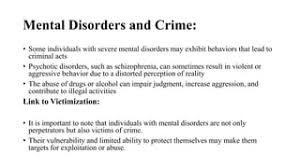
It is believed that people with mental illness are more prone to commit violent crimes. This is because the society considers the mentally ill individuals as problematic, dangerous and often treat them with hatred. But in real, people with the characteristics of mental illness are generally the victims and not perpetrators. Through the research, the paper also explores on how the various mental health disorders influences criminal behavior, what are the legal complications and immunities for such offenders and approaches towards punishing and rehabilitation of these offenders.
The study also looks into the application of Mc Naughten’s rule which is a test done in order to determine the responsibility of a person in a crime by identifying the mental state of the person at the time of commission of the crime and also the scope of section 84 of the Indian Penal Code and section 22 of the Bharatiya Nyaya Sanhita.
The study also identifies various kinds of mental health disorders which are commonly seen among offenders. Through the analysis of relevant case studies and literatures, this research focuses on the psychological aspects, social stigma and legality of treating offenders with mental health disorders.
The conclusion of the study from the research shows that defense of insanity has become a very debatable issue, not only in the criminal justice system but also for the social justice as the matter is relating to crimes against humanity.
KEYWORDS: Insanity, Criminal Behavior, Psychological Disorders, Legal Framework, Social Status, Punishment, Rehabilitation
INTRODUCTION
The human mind is a complex and versatile phenomenon with wide range of emotions and thoughts. Mental illness, which is often identified as disturbances that affects the behavior and emotion of the human mind. Anxiety and depression has become very common among people nowadays. Mental illness has been considered as a social stigma. People are afraid or even ashamed to consult a doctor if they found out something is wrong with their mind. People acknowledge they are feeling overwhelmed, depressed, anxious, etc., but aren’t ready to treat these in the right way.
We are in a society were mental illness are mostly found among teenagers whose slightest of the behavioral changes are often went unnoticed even by their parents. Most of the people who have committed crimes due to some psychological disorders might have a disturbing childhood, abandoned family, people who haven’t received the love, care and attention that they should have during their childhood. There could be certain events from their childhood that will trigger the inner criminal aspects of a person’s mind. Most of the people having mental illness doesn’t receive adequate help for their condition. They often delay in seeking treatments or are afraid of their social status, losing job, etc. This is due to the social stigma that causes bias and discrimination to people.
Criminal behaviors are influenced by various factors. The role of mental health in criminal behaviors in crucial and it is important to examine the interlinkage between mental illness and criminal behavior. The mens rea is an important aspect in every crime. The maxim “Actus Non Facit Reum Nisi Mens Sit Rea”, which means the act alone does not constitute a crime unless it accompanies with a guilty mind. What triggered or caused the offender to commit such a crime to such a person, his/her thoughts, emotions, feelings and actions, should be identified.
RESERCH METHODOLOGY
The research was conducted using secondary sources such as, websites and online articles. For the research, I have referred to legal issues and online databases like PubMed and Jstor.
REVIEW OF LITERATURE
The concept of insanity as a defense has dazzled the minds of various legal and mental health professionals and has been subjected to various debates. The complex relationship between mental disorders among the offenders has been discussed by various experts like Adriane Raine and Hervey M Cleckley. The Durham rule, also known as the Durham test, also talks about insanity as a defense to the mentally ill person.
METHOD
The research is purely doctrinal through reliable sources from online databases.
MENTAL ILLNESS AND CRIMINAL BEHAVIOR
Mental illness poses a significant impact on the behavioral patterns of individuals, influences the way they think and act upon, sometimes even leading to commission of crimes. These people are unable to understand the seriousness and consequences of the act they are committing. It is also equally important to understand that every individual with mental illness are not prone to commit criminal acts and not all individuals committing crimes are mentally ill. However, there are certain factors of mental illness that contribute in creating an intersection between these two aspects.
Crime is an intentional commission or omission of an act which is usually harmful and dangerous to the society. Crime is an act against the public, it is prohibited and punishable under the law.
Insanity has been a very crucial and highly debatable topic in the legal era. Competency of the offender while committing a crime is a fundamental aspect, ensuring that the person is aware of what he/she has done and the consequences they shall face. Section 84 of the Indian Penal Code and Section 22 of the Bharatiya Nyaya Sanhita talks about the “act of a person with unsound mind”. It states that, “nothing is an offence which is done by a person who, at the time of doing it, by reason of unsoundness of mind, is incapable of knowing the nature of the act, or that he is doing what is either wrong or contrary to law”.
By analyzing section 84 of Indian Penal Code and section 22 of Bharatiya Nyaya Sanhita, in order to get the insanity defense, the person should be suffering from mental illness and shall not have the reasoning power at the time of commission of the crime. It is clearly states under the act that the person should be unable to understand whether the act done by the person is right or wrong and shall be contrary to the law.
Mc Naughten’s Rule
The Mc Naughten’s rule or the Mc, Naughten’s test is a legal test originated from the famous landmark case R v. Mc Naughten in the year 1843. The test is used in order to determine the responsibility of a person in a crime by looking into the mental state of the person at the time of committing the offence. The rule draws the mental state of the person at the time of commission of the crime by looking into two factors:
- The person is unable to comprehend the nature of the action committed and the consequences that accompany with it.
- The person is unable to distinguish what is right or wrong due to their condition, therefore they believe their acts are moral and justifiable.
The Mc. Naughten rule has become a crucial precedent concerning the defense of insanity. In India, the test has been identified under section 84 of the Indian Penal Code and section 22 of the Bharatiya Nyaya Sanhita. The Mc Naughtons rule states that a person is presumed to be sane unless it is proven otherwise. The act shall be done with the defect of the mind which is caused due to the disease, that the person is unaware of the nature of the crime. It is important to prove that the person was mentally unstable at the time of the commission of the crime and not before or after the completion of the crime. In order to use defense of insanity, this shall be taken into consideration.
The Indian Penal Code or the Bharatiya Nyaya Sanhita does not prove any definition of “unsoundness of mind”, but it is considered equivalent to insanity. When it comes to insanity, it is considered in two contexts, which medical insanity and legal insanity. The courts shall consider the aspects of legal insanity. Medical insanity refers to any person who is suffering from mental illness. On the other hand, legal insanity is when the person suffering from mental illness have lost the reasoning power. The mental state of the person at the time of committing the crime is taken into consideration by the courts for granting the defense of insanity.
The Hon’ble Supreme Court of India in the case of State of Madhya Pradesh v. Hari Singh Gond, noted the legal standard of liability in circumstances which involves claims of mental disorders in section 84 of the Indian Penal Code. The court stated that the term “insanity” is not widely explained in the statute, it is just a phrase used to express the different stages in mental health illnesses. There is a difference between medical insanity and legal insanity and not all individuals who are mentally ill are free from criminal responsibility.
In State of Jharkhand v. Surendra Mishra, the court differentiated medical insanity with legal insanity. The court also stated that the accused must prove his insanity at the time of commission of the crime and the emphasis should be on legal insanity rather than medical insanity.
In Dulal Naik v. State (1987), the Mc Naughten’s rule has been interpreted along with section 105 of the Indian Evidence Act, 1872. The court stated it shall presume the person to be sane and in full control and consciousness of the act, unless it is proven otherwise. This section states that the burden of proof lies within the accused.
THE SOCIAL STIGMA
The society, even today, considers mental illness as a stigma. This arises out of lack of understanding. When the people with mental illness is struggling with disabilities, on the other hand the society treats them with various misconceptions and fear. It is true that people with mental illness shall be taken care and often handled with caution, but that does mean they shall be treated with disrespect, hatred and violence. The public stigma and self-stigma can contribute in worsening the condition and will negatively affect the recovery of these people.
Public stigma
The misconception that mentally sick people are generally dangerous and are being blamed for their disease. The lack of knowledge is the reason for this, which leads these people being marginalized and discriminated. For instance, they are denied jobs, dismissed from their works, employers may not hire them, landlords may not rent their place to them and inadequate treatment provided to certain people. Generally, the society considers people with severe mental illness should be feared and therefore kept out of communities and persons with mental illness are irresponsible so they are not capable of taking any life decisions. Living in such an environment will reduce the self-esteem and self-confidence of these individuals.
Self-stigma
This creates a thought in the minds of the persons that they are a threat to people, their loved ones and they blame themselves for their condition. This often leads person to negatively think and act upon. The above stated public stigma will be the reason for self-stigma which is caused in the minds of mentally ill individuals. Persons will become righteously angry because of the prejudice that they have experienced.
How the society should address these issues?
To begin with, this can be done by starting to educate and creating awareness about mental health by teaching about the different mental health diseases, various forms, how it may affect the individuals and how they can be managed. It is equally important to work on reducing and ultimately eliminating the social stigma. This can be done by not treating them differently because of their mental health condition and making them feel comfortable and included in the community by providing the support they need.
In addition to this, the medical institutions shall make sure that everyone has access to the mental health care like therapy and medication by making these services available and affordable to everyone. Peer supportive groups can be formed in order to create a sense of support for these individuals. Also, identifying the mental health condition at a very early stage can be crucial. Resources shall help people identify at the time of experiencing the symptoms.
Furthermore, providing training for law enforcement officers to recognize and respond to the mental health conditions can help in prevention of circumstances that may escalate to criminal incidents. Another important aspect is if any person has been found guilty for a crime and at the time of the commission of the crime the person was mentally sick, alternative dispute programs can be done. This focuses on identifying and providing rehabilitation rather than punishment for the mentally sick offenders. Such specialized treatments options shall be more in the criminal justice system.
DIFFERENT MENTAL ILLENESSES
Common mental health illnesses which are found in individuals committing crimes includes a wide variety of psychiatric disorders. All these disorders influence the behavioral patterns of the individuals and their decision making capacity. Some of the common mental health disorders found among individuals committing crimes includes:
- Schizophrenia
Schizophrenia is a form of chronic psychosis that may include bizarre behavior, paranoia, anxiety, delusions, withdrawal and suicidal tendencies. The exact reason for this disease is unknown. But there are researches which suggests that genetic, psychological and environmental factors are likely to be the reason to develop this condition. Economic deprivation, substance use, violent victimization, childhood traumas, perhaps childhood sexual abuse could be reasons for developing the disease. Schizophrenia raises the possibility of aggressive behavior and violent crimes. People schizophrenia poses hostile behavior, can have delusions and hallucinations, agitation, poor insights and often intoxicated. These people lose control and touch with reality.
- Antisocial Personality Disorder
People diagnosed with Antisocial Personality Disorder involves a pattern of ignorance for others rights and is associated with aggressive and manipulative behavioral patterns. Such people engage in anti-social activities without any guilt.
- Substance abuse
Substance usage is a very common factor in crimes and a critical threat for criminal behaviors. There are many researches which states that mental health illnesses and usage of substances heightens the risk of committing violent crimes.
- Depression
Commonly, depression is associated with self-harm. In some cases this might also contribute to criminal behavior and commission of crimes. People suffering from depression often does unlawful acts like theft or robbery due to financial desperation.
- Borderline personality disorder
Borderline personality disorder is caused by emotional instability and impulsive behavioral patterns which often lead to interpersonal conflicts and may end in violent actions.
LANDMARK CASES
Ratan Lal v. State of Madhya Pradesh (1975)
In the case, the Hon’ble Supreme Court of India acquitted Ratan Lal, who was charged with mischief by fire. The court identified that the accused was suffering from chronic maniac depression at the time of the commission of the act. Therefore, the court held that a person with an unsound mind cannot be held criminally liable for their actions.
Shatrughan Chauhan v. Union of India (2014)
The case addressed the issue of execution of individuals with mental illnesses. The court highlighted the need for mental health assessment before awarding capital punishments for the accused. The Hon’ble Supreme court of India also stated that execution of individuals with severe mental illness violates the protection which is provided by the Constitution of India.
Dayabhai Chhaganbhai Thakkar v. State of Gujrat (1964)
In this case, the accused had involved in the murder of his wife and pleaded defense of insanity under section 84 of the Indian Penal Code. But the accused couldn’t provide required evidence to prove his insanity. The court highlighted the importance of unsoundness of mind at the time of commission of the crime and must be evaluated based on the circumstances that surrounds the crime.
All these landmark cases show how the courts in India have engaged with the matters concerning mental disorders and criminal responsibility. It lays down the importance of taking into consideration of the individual’s state of mind at the time of commission of the offence and how it shall be handled within the purview of section 84 of the Indian Penal Code.
PUNISHMENT AND REHABILITTION
Awarding punishment and providing rehabilitation to mentally ill offenders in India has become a debatable and complex matter that has ethical, legal and social facet. The legal system in India have faced several challenges in providing justice which involved mentally ill offenders, especially concerning to imposition of penalties and punishing the offenders. It is essential under section 84 of the Indian Penal Code and section 22 of the Bharatiya Nyaya Sanhita that a person to be held criminally responsible for an act done by him/her, they shall have the knowledge and reasoning power of the act they have done and its consequences. The provision also prevents the punishment of individuals who are unable to comprehend the act they have committed due to their mental health condition.
The courts in India have had the approach of treating and providing rehabilitation facilities for mentally ill offenders. Such way, they are treated humanely and will get adequate medications. The National Human Rights Commission aims and advocates to treat mentally ill prisoners are treated with dignity and to protect their rights.
SUGGESTIONS
Despite the law, there is a lack of providing adequate mental health facilities in India. Often mentally ill offenders may be kept in prisons due to insufficient treatment. The social stigma plays a vital role in this. It affects the improvement of effective rehabilitation facilities which may in turn creates discrimination in the justice system.
This can overcome by establishing specialized mental health care centers to accommodate mentally ill offenders. Through this, proper treatment and care can be ensured. Proper assessment of these people by efficient medical professionals and other staffs can be done. Also, it is equally important to provide support for these individuals post treatment and release.
CONCLUSION
The relationship between mental illness and criminal behavior is a complex matter that requires legal, social and psychological understanding. Mentally ill individuals shall receive proper medications and care. Awareness programs and workshops can be conducted in order to spread knowledge about the seriousness and how to handle this to the general public. This was the existing social stigma can be removed. These will not only benefit the mentally ill persons, but also to the broader societal well-being.
REFERENCES
CASES
- R v. Mc Naughten, 1843, 10 Cl & Fin 200; 8 ER 718
- State of Madhya Pradesh v. Hari Singh Gond, 2008, 16 SCC 109
- Dulal Naik v. State, 1987, Cri. L.J. 1081
- Ratan Lal v. State of Madhya Pradesh, AIR 1975 SC 1596
- Shatrughnan Chauhan & Ors. v. Union of India, 2014, 3 SCC, 1
- Dayabhai Chhaganbhai Thakkar v. State of Gujarat, AIR 1964, SC 1563
- State of Jharkhand v. Surendra Mishra, 2011, 1 SCC 30
STATUTES
- The Indian Penal Code, 1860
- The Bharatiya Nyaya Sanhita, 2023
ONLINE SOURCES
- NATIONAL LIBRARY OF MEDICINE, https://pmc.ncbi.nlm.nih.gov/articles/PMC4381309/ , (last visited on 17/11/24)
- NATIONAL LIBRARY OF MEDICINE, https://www.ncbi.nlm.nih.gov/books/NBK537064/ , (last visited on 17/11/24)
- NATIONAL LIBRARY OF MEDICINE, https://pmc.ncbi.nlm.nih.gov/articles/PMC3160235/ , (last visited on 17/11/24)
- NATIONAL LIBRARY OF MEDICINE, https://pmc.ncbi.nlm.nih.gov/articles/PMC1489832/ , (last visited on 17/11/24)
- AMERICAN PSYCHIATRIC ASSOCIATION, https://pmc.ncbi.nlm.nih.gov/articles/PMC1489832/ , (last visited on 17/11/24)
- SLM LAW, https://www.silvalegal.com/mental-illness-and-criminal-behavior-a-comprehensive-analysis-of-how-it-relates-to-one-another/, (last visited on 17/11/24)
- IM=NTERNATION JOURNAL OF LEGAL SCIENCE AND INNOVATION, https://ijlsi.com/paper/the-impact-of-mental-health-on-criminal-behavior/#, (last visited on 17/11/24)
- JSTOR, https://www.jstor.org/stable/43949854, (last visited on 17/11/24)
- LAWBHOOMI, https://lawbhoomi.com/applicability-of-mcnaughtons-rules-in-ipc/#:~:text=subsequent%20criminal%20trials.-,What%20is%20Mc%20Naughton’s%20Rule%3F,McNaughton%20in%201843, (last visited on 17/11/24)
- NATIONAL HUMAN RIGHTS COMMISSION, https://nhrc.nic.in/press-release/nhrc-directs-states-ensure-mentally-ill-persons-are-not-jailed-under-any-circumstances , (last visited on 17/11/24)