
Equivalent citations: AIR 2020 SUPREME COURT 3717, AIRONLINE 2020 SC 676
Bench: M.R. Shah, S. Abdul Nazeer, Arun Mishra
INTRODUCTION:
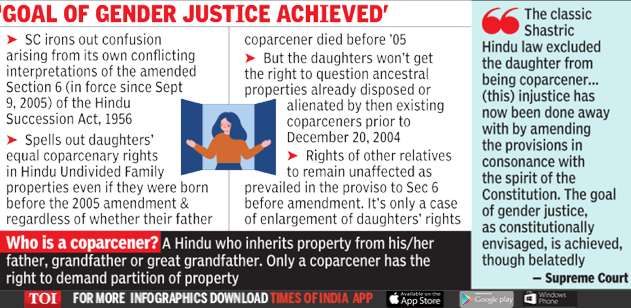
This case revolves around the issue of providing equal rights to daughters as coparceners. Prior to the 2005 Amendment, Hindu Succession Act did not provide daughters the right to become coparceners. However in the year 2005, Section 6 of the Hindu Succession Act was amended and daughters by birth were entitled to become coparceners in her own right. But this still did not lacuna and the question of whether daughters had the same coparcenary rights as the son arised and with a proviso that conferment of such right on a daughter shall not affect or invalidate any disposition or alienation, partition or testamentary disposition of property took place before 20.12.2004.
Background of the Case:
The Supreme Court has delivered 2 contradicting judgements in the 2 different cases; in that of Prakash & Ors v. Phulavati & Ors and Danamma Suman Supur & Another v. Amar & Ors. In the case of Prakash & Ors v. Phulavati & Ors, the Supreme Court held that held that the Act of 2005 is prospective in nature and that rights conferred on daughter, under Section 6 of the Act of 2005, is on the living daughter of a living coparcener, requiring the coparcener to be alive as on 09.09.2005 so as to enable the daughter to claim rights over the coparcenary property. Since the coparcener in the aforementioned case passed away before the 2005 amendment, it was determined that the daughter is not entitled to a share of the coparcenary property since she is not a coparcener’s child who is still alive. In the case of Danamma Suman Supur & Anothers v. Amar & Ors, the Supreme Court did not look specifically into the matter of a living daughter and a living coparcener. However the Court took a contradictory view from its decision in the Phulavati case and held that daughters have equal rights in the coparcenary property as that of son, even though the coparcener had died before the amendment of 2005. The case of Vineeta Sharma v. Rakesh Sharma, raised similar questions and the more clear view was granted by the Hon’ble Supreme Court and it filled the lacunas in the other two judgments. Keeping in mind the contradictory decisions by the Supreme Court in the Phulavati case and the Danamma Case, the case of Vineeta Sharma was referred to a larger bench comprising Justice Arun Misra, Justice M.R.Shah and S. Abdul Nazeer.
FACTS OF THE CASE:
- The case involves a combined Hindu family and the daughters’ coparcenary rights. The appellant, Vineeta Sharma initially filed a petition in the Delhi High Court against her family members including her brother Rakesh Sharma.
- The appellant’s father, late Mr. Dev Dutt Sharma had a property along with a house. He had 4 children (3 sons and 1 daughter) of which one son Dr Shailender Sharma was unmarried and he expired. The appellant’s family lived together and they had rented out a part of the house in the same property. The Plaintiff claimed that her father passed away intestate.
- She further claimed that Mr. Dev Dutt Sharma had created a Hindu Undivided Family (HUF). However after her marriage she ceased to be a member of that Hindu Undivided Family. Post retirement, Mr. Dev Dutt Sharma and his family shifted to the first floor of a property in the year 1974 and by 1980 they moved to the ground floor and they had rented out the remaining floors.
- The Plaintiff’s marriage had taken place on 18th January 1981 and it was said that her father and brothers together had contributed Rs.3,50,000/- for her marriage. Ms Vineeta Sharma filed suit against her two brothers, Rakesh Sharma and Satyendra Sharma and her mother Mrs Rameshwari Sharma. She claimed that she was entitled to get 1/4th share of the property and an amount of Rs 40 Lakhs.
ISSUES RAISED:
The following issues were in raised in the case:
1. Whether the father as a coparcener should be alive as on November 9th 2005
2. Whether equal rights and liabilities can be claimed by a daughter born before 9th November 2005 as that of the son
3. Whether the statutory fiction of partition created by proviso to section 6 of the Hindu Succession Act, 1956 as originally enacted brings about the actual partition or disruption of coparcenary?
4. Whether a plea of oral partition after 20 December 2004 can be accepted as the statutory recognised mode of partition?
ARGUMENTS ARGUMENTS ADVANCED ON BEHALF OF UOI BY SOLICITOR GENERAL OF INDIA:
Mr Tushar Mehta appearing on behalf of Union of India contended that the 2005 amendment act is not retrospective but it is retroactive in nature. He claimed that legitimate partitions implemented before December 20, 2004, when the Rajya Sabha announced the amended bill, should not be questioned since doing so would harm the position of the legislation. It was also contended that the phrase “daughter of coparcener” in Section 6 does not necessarily mean a coparcener’s surviving daughter. The coparcener need not have been alive on the day the Amended Act went into effect. He also argued that the death of the coparcener /father does not automatically lead to the end of coparcenary, which may continue with other coparcener alive and that the explanation to Section 6 (5) as regards requirement of registered partition deed is directory in nature and not mandatory.
ARGUMENTS ADVANCED BY SENIOR COUNSEL AND AMICUS CURIAE:
Mr R Venkatramani the senior counsel and amicus curiae argued that the rulings in the Phulavati case and the Danamma case do not conflict with one another, and both rulings hold that the provisions of Section 6 are prospective in nature. He contended that there would be no surviving coparcener from whom the daughter would inherit upon the death of a coparcener father because his interest would have merged with the surviving coparcener. The daughter can only be successful if the father is still alive. He also argued that even if the 2005 Amendment brought about equality, the prevalence of coparcener births prior to that year is irrelevant. It was also contended that Sections 6(1) and 6(5) are not meant to be used to reopen oral partition and family settlement.
ARGUMENTS BY SENIOR COUNSEL AND AMICUS CURIAE, MR VVS RAO:
He argued that the reasoning in the judgment of the Phulavati case was upheld in the case of Mangammal v. T B Raju & Ors and that a daughter born before or after 2005 can be considered as a coparcener. The Parliament intended, using the language used in Section 6(1)(b) & (c), to imply that the rights would be granted in the coparcenary after the change, not prior to it. A partition did not have to be registered in accordance with the law in effect. If an oral partition is acknowledged, it must be supported by adequate evidence. Parliament did not intend to retroactively grant a daughter rights to the coparcenary property. The phrase “on and from” in Section 6(1) denotes that the daughter becomes a coparcener as of the Act’s beginning. A daughter’s status as a coparcener cannot change an oral or written prior transaction of alienation, disposition, or partition. The Explanation protects all legitimate historical transactions, including the parties’ oral partition. There should be a living coparcener to whom the daughter can inherit to become a coparcener.
ARGUMENTS ADVANCED BY ADV SRIDHAR POTARAJU:
The counsel for the Respondent contended that If a notional partition has occurred, it needs to be acknowledged. He argued that a preliminary decree should be regarded as final because it indicates that the Hindu family’s jointness has ended with the simple filing of the complaint for partition. He argued and reaffirmed that the provisions are intended to be prospective in nature because such interpretation is not desired, which would take away the crystallized rights of the surviving coparcener and, as a result, result in settled affairs being unsettled. He noted, citing Uppaluri Hari Narayana & Ors., that since the provisions are not retroactive, liabilities can only be transferred to the daughter as of the amendment date. He went on to say that all previous transactions should be shielded from the amendment’s implications as on a statutory partition, the property becomes the self-acquired property and is no more a coparcenary property.
ARGUMENTS ADVANCED BY ADV AMIT PAI:
Section 6 has been replaced under the Amended Act since the Principal Act of 1956 first went into effect. The caveat in Section 6 does not apply to a Notional partition made to determine a coparcener’s shares after his death because it is not an actual partition. Decision in Phulavati cannot be said to laying down the correct law. The concept of living daughter of living coparcener is added to the text of the provisions of Section 6. No matter if their father is still living as of the day the act was amended, all daughters are covered by Section 6.
JUDGMENT:
Based on precedent and other rulings, the court concluded that combined Hindu family property is unhindered heritage. The right to partition in this sort of property is absolute and is granted to a person by virtue of his or her birth. In contrast, separate property is impeded heritage, in which the owner of the separate property’s death obstructs the right to ownership and divide. When a historical right is impeded, it is determined by the passing of the original owner of the separate property rather than by birth. Based on these facts, the Supreme Court determined that it does not matter whether the father of the cohabitant was alive or deceased because the right to divide is formed by the birth of the daughter (unobstructed heritage). Because of this, it reversed the judgment in Phulavati v. Prakash determined that the coparcenary rights transfer from the father to a living daughter rather than from a living coparcener to a living daughter. The court, overturning the Phulavati and Dannmma decision, determined that the implications of section 6’s provisions are retroactive in nature rather than prospective. The concept, as articulated by the Supreme Court, states that the daughter will be granted the same coparcenary status beginning on November 9, 2005, although it is founded on a previous occurrence, namely the daughter’s birth. The effects are retroactive since the rights would not have existed in the first place if the daughter had never given birth, which happened in the past. This court’s approach filled the legal gap regarding the impact these laws have in relation to time. The court further ruled that a conceptual split does not imply an actual one has taken place. As a legal fiction, notional partition should only be used to the extent necessary to accomplish the stated objectives. In this instance, a hypothetical division is made to determine each cohabitant’s share of the combined Hindu family. The court emphasized that the distribution of shares and fixation of the notional division are just estimates; the shares of the other co-owners may rise or decrease depending on whether a new co-owner is born or an existing co-owner passes away. It further concluded that a daughter might, consequently, claim a share of the joint family property even if a notional partition is completed before 9 November 2005 because it is not an actual partition and the coparcenary property does not end simply because of it. They emphasized the fact that the civil procedure code makes no mention of the impossibility of passing multiple preliminary decisions. The Supreme Court determined that even if a preliminary decree has been issued, the court must consider any changes to the law before issuing the final decree. As a result, a daughter may still assert her claim to coparcenary rights even after a preliminary decree has been issued on the subject. The court’s use of the phrase “preliminary decree is not final by metes and bounds” is the most important one in this context. The court further stated that an oral partition cannot be used as a defense if it was not implemented via the aforementioned steps. This is a general rule, according to the court, albeit some oral partitions may be genuine as well, in which case an exception may be made. However, the burden of proof will fall mostly on the defense to demonstrate the validity of the oral partition.
For that purpose, one or more of the following cases and evidence for the same must be produced before a court of justice:
- Possession of separate family
- Appropriation of income
- Entry in revenue records
- Other public documents
REASONING:
The Larger Bench of the Supreme Court came to the conclusion that the coparcener father need not have been alive as of September 9, 2005 in order for a daughter to inherit rights to the coparcenary property, in accordance with the coparcenary father’s will, in the aforementioned appeals by referring to various concepts of Hindu law, both codified and customary, including concepts such as Coparcenary and Joint Hindu Family and unobstructed and obstructed heritage. The Hon’ble Supreme Court explained blocked and unobstructed heritage, holding that obstructed heritage occurs after the owner’s death whereas unobstructed heritage occurs by birth. The Honourable Supreme Court went on to rule that because a right is granted by birth under Section 6 and is thus an unhindered inheritance, the coparcener father must still be living as of September 9, 2005, in order for the daughter to acquire rights to the coparcenary property. The Coparcenary Right is By Birth And It Is Not At All Necessary That The Father Of The Daughter Be Living As On The Date Of The Amendment Since She Had Not Been Conferred With The Rights Of Coparcener By Obstructed Heritage, The Court Also Added That The Concept Of Uncodified Hindu Law Of Unobstructed Heritage Has Been Given A Concrete Shape Under The Provisions Of Section 6(1)(a) And 6(1)(b). As a result, the Supreme Court did. As such, the Hon’ble Supreme Court did not consider the decision in the Phulavati case to be a good decision in so far as this aspect is concerned.
CONCLUSION:
The following questions were addressed by the Honourable Supreme Court in the aforementioned case, among others:
- The right to a daughter’s share of the coparcenary property is given to her at birth, therefore the father’s existence as of September 9, 2005 is not necessary. As a result, the Phulavati case decision is overturned, and the Danamma case decision is partially overturned because it stated that the coparcener’s father had to be alive as of September 9, 2005.
- The Act of 2005’s Section 6 has been modified retroactively by way of substitute.
The Hon’ble Supreme Court decided that the modified Section 6 is retroactive in nature when deciding whether it should be applied in a retrospective or prospective manner. The Supreme Court explained the terms of prospectively, retrospectively, and retroactively and held that the application of a retroactive statute is based on a feature or an event that occurred in the past or requirements that were derived from an antecedent event.
By
Nivedha k
CMR University
Bangalore