
ABSTRACT
Part III of the constitution of India provides fundamental rights to the citizens which are justiciable in nature. It means on the infringement of fundamental rights a individual can approach courts even directly Supreme Court of India for the enforcement of fundamental rights while Part IV of the constitution of India provides Directive Principle of State Policy though these principles are non1-justiciable in nature but are indispensable in the governance of the country. One of such directive principle is given under article 44 of the constitution which casts an obligation on the state to enact uniform civil code in the country. Over the years various directions has been issued by the Supreme Court2 of India towards the implementation of
U.C.C but its implementation still seems a distant dream. In the absence of a uniform civil code regarding the personal matters like marriage, adoption, divorce, etc, the principle of equality and liberty of individual and elimination of discrimination on grounds of sex, religion, cast etc has long way to go.
As the personal finds their source and authority3 from their religious4 text and customs which provides for gender discriminatory practices5. The main objective towards the implementation of UCC is to eliminate discriminatory practices prevalent among different religious community and treat every individual on equal principal of liberty and equality.
INTRODUCTION
We the people of India, gave to ourselves a constitution, constituting India a Sovereign, Socialist, Secular, Democratic and Republic6 state which guarantees fundamental7 rights to the individuals by providing justice, liberty, equality and fraternity. These fundamental rights are justiciable in nature. The constitution also embodies the governance principle of a state i.e. Directive Principle of State Policy, though these principles are not justiciable in nature but
1 Shantanu Panchauri, Uniform Civil Code in India: A Socio-Legal Perspective, vol.3, International Journal of Law and Legal Jurisprudence Studies,(IJLLJS), 341,341,(2016), www.researchgate.net
2 Shantanu Panchauri, Uniform Civil Code in India: A Socio-Legal Perspective, vol.3, International Journal of Law and Legal Jurisprudence Studies,(IJLLJS), 341,341,(2016), www.researchgate.net
3 Shantanu Panchauri, Uniform Civil Code in India: A Socio-Legal Perspective, vol.3, International Journal of Law and Legal Jurisprudence Studies,(IJLLJS), 341,341,(2016), www.researchgate.net
4Shantanu Panchauri, Uniform Civil Code in India: A Socio-Legal Perspective, vol.3, International Journal of Law and Legal Jurisprudence Studies,(IJLLJS), 341,341,(2016), www.researchgate.net
5 Shantanu Panchauri, Uniform Civil Code in India: A Socio-Legal Perspective, vol.3, International Journal of Law and Legal Jurisprudence Studies,(IJLLJS), 341,341,(2016), www.researchgate.net
6 Shantanu Panchauri, Uniform Civil Code in India: A Socio-Legal Perspective, vol.3, International Journal of Law and Legal Jurisprudence Studies,(IJLLJS), 341,341,(2016), www.researchgate.net
7 Shantanu Panchauri, Uniform Civil Code in India: A Socio-Legal Perspective, vol.3, International Journal of Law and Legal Jurisprudence Studies,(IJLLJS), 341,341,(2016), www.researchgate.net
essential to the governance of the country. And it is the duty of the state to8 implement these directives by making laws.
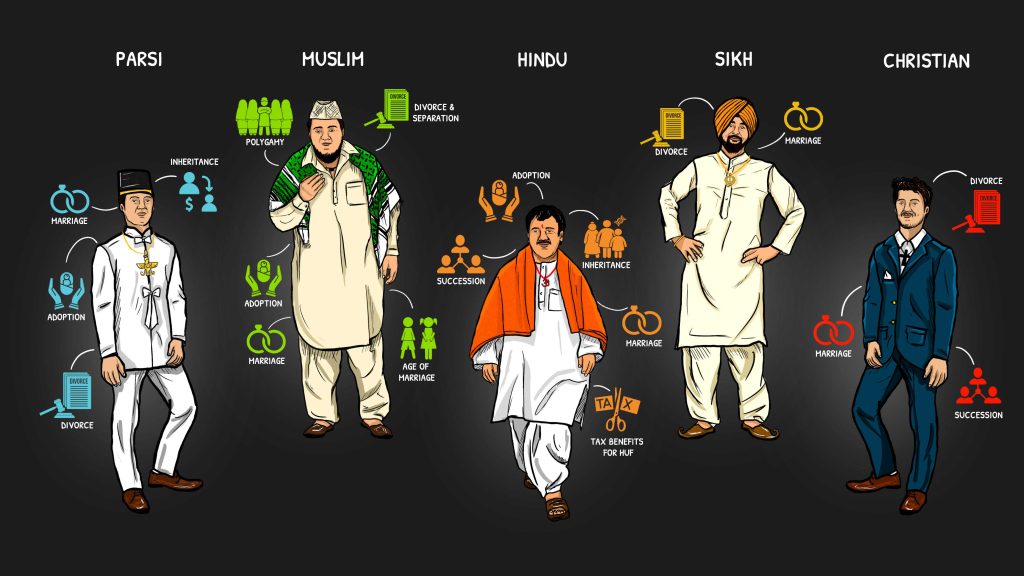
One of these directive principle is Uniform Civil Code which cast an obligation on the state to secure a uniform civil code throughout the India. Uniform civil code precisely and in lay man language’s mean one country one rule, legally the term means a set of rules which covers the entire body of laws governing personal matters such as marriage, adoption, succession, maintenance, divorce etc. UCC essentially means unifying all these ‘personal laws’ to have a one set of secular law which deals with all these personal aspects that will apply to all citizens of India irrespective of the community they belong.
In India, we have a criminal code that is equally applicable to all individuals irrespective of their cast, religion, sex, and gender. However , we don’t have a similar secular law to deal with the matter of adoption, divorce, succession and etc. these matters are still governed by individual’s personal law which sometimes creates discrimination among indivuals on various grounds.
The practice of providing unequal shares in coparcenary property to a brother and sister under Mitakshara Hindu9 Laws, other customs of burning a Hindu widow on her husband’s funeral pyre or the practice of giving unequal shares in property to male and female heirs after a Parsi man dies intestate, or indiscriminate polygamy by a man, or the practice of divorcing a lawful wedded wife by triple talaq or the refusal to maintain divorced wife after the period10 of iddat all these practices are derogatory to women. Therefore, if a member of religious community resorts to such practices or raises an objection to the implementation of Art.44 he becomes guilty of violation of the preamble11, and Art.51A and dies of the guaranteed fundamental rights in Art.14 and 15(1) of the constitution.
KEYWORDS:- constitutional assembly debate, uniform civil code ,common civil code, positive secularism.
Constitutional Assembly Debate
As we know that the provision of Uniform Civil Code is enshrined in the article 44 under heading Directive Principle of State Policy of the constitution of India. However, originally it
8 Shantanu Panchauri, Uniform Civil Code in India: A Socio-Legal Perspective, vol.3, International Journal of Law and Legal Jurisprudence Studies,(IJLLJS), 341,341,(2016), www.researchgate.net
9 Shantanu Panchauri, Uniform Civil Code in India: A Socio-Legal Perspective, vol.3, International Journal of Law and Legal Jurisprudence Studies,(IJLLJS), 341,341,(2016), www.researchgate.net
10 Shantanu Panchauri, Uniform Civil Code in India: A Socio-Legal Perspective, vol.3, International Journal of Law and Legal Jurisprudence Studies,(IJLLJS), 341,341,(2016), www.researchgate.net
11 Shantanu Panchauri, Uniform Civil Code in India: A Socio-Legal Perspective, vol.3, International Journal of Law and Legal Jurisprudence Studies,(IJLLJS), 341,341,(2016), www.researchgate.net
was incorporated in the article 35 of the draft constitution which reads follow: “The state shall endeavour to secure for citizens a Uniform Civil Code throughout the territory of India.”
The sub-committee of fundamental rights has included UCC as one of the Directive principle of state policy in the drafted constitution, however the motion was strongly contested by the Muslims Representatives ground that the implementation of this provision amount to infringement of their fundamental rights. Mohamed Ismail Shahid, Mahmood Ali Baig Shahib Bahadur and Naziruddin Ahmed proposed various amendments to article 35 of the draft constitution. One of the proposal was the “insertion of a proviso to the effect of nothing in this article shall affect the personal law of the citizens and on community shall be obliged to give up its personal law.”12
However, Dr. Ambedkar, the principal architect of Indian constitution, refused to accept the amendments which has been proposed. He was strongly in favour of the U.C.C and argued that “we have a uniform and complete criminal code operating throughout the country .this country has also practically a civil code, uniform in its content and applicable to the whole of the country.”13
UNIFORM VS COMMON CIVIL CODE
Article 44 of the constitution suggest a uniform civil code and not a common civil code. The terms ‘uniform’ and ‘common’ often used interchangeably. But both expressions have different meaning and connotation. The term ‘common’ means shared among several while the term ‘uniform’ means conforming to one rule, not different at different places14. It means it is applying alike to all within a class.
According to S.P Sathe15, the word uniform in article 44 means that all communities must be governed by uniform principles of social and gender justice16. A uniform civil code does not mean a civil law applicable to all but different personal laws based on uniform principles of equality of sexes and liberty of individuals considering the discrimination and inequality among different community.
The implementation of U.C.C doesn’t mean changing or infringing religious freedoms as guaranteed under part III of the Indian constitution but it simply means considering all individuals equal and taking reformative measures to eliminate social evils existing within different personal laws.
12 CA Debate 23 November 1948,Vol 7, 541
13 B. Shiva Rao. The Framing of India’s Cons tu on vol2
14 Shantanu Panchauri, Uniform Civil Code in India: A Socio-Legal Perspective, vol.3, International Journal of Law and Legal Jurisprudence Studies,(IJLLJS), 341,342,(2016), www.researchgate.net
15 Sathe (n41)
16 Shantanu Panchauri, Uniform Civil Code in India: A Socio-Legal Perspective, vol.3, International Journal of Law and Legal Jurisprudence Studies,(IJLLJS), 341,342,(2016), www.researchgate.net
SECULARISM AND UCC
The spine of controversy revolving around UCC has been secularism and the freedom of religion enumerated in the constitution of India 17 . The Preamble of Indian constitution enumerates India as ‘secular, democratic and republic’ it means that state has no religion. A secular state shall not discriminate anyone on the ground of religion and everyone is equal before the state irrespective of their religion. State can not profess and practice any particular religion. State must treat every religion equally. A state is only concerned with the relation of a man with a man. A state is not concerned with the relation of a man with God.
In S.R Bommai v. U.O.I18, as per justice Jeevan Reddy, it was held that religion is the matter of individual faith and cannot be mixed with secular activities. Secular activities can be regulated by the state by enacting a law.
In India there exist a concept of ‘positive secularism’ as distinguished from doctrine of secularism accepted by American and European states i.e. there is a wall of separation between religion and state19. However, In India, state must respect all religion and treat all religion equally. State should not discriminate any individual on the ground of his religion. In India, state can interfere with the religion of individual for the purpose of eliminating any discriminatory practices and any practices derogatory to women. State must take reformative measure to eliminate all types of discriminatory practices.
Art.25 and 26 guarantees the right to freedom of religion. Art.25 guarantees to every person freedom of conscience and the right to profess, practice and propagate religion20. But this freedom is not absolute in nature the constitution itself imposes certain restrictions on right to religion. The right of freedom of religion is subject to public order, morality, health and other fundamental rights guaranteed under part III of the constitution of India21.
UCC is not opposed to secularism or will not violate Art.25 and 26. Art.44 is based on the concept that there is no necessary connection between religion and personal law in a civilised society. Marriage, succession and divorce like matters are of secular nature and therefore, law can regulate them.22
17 Shantanu Panchauri, Uniform Civil Code in India: A Socio-Legal Perspective, vol.3, International Journal of Law and Legal Jurisprudence Studies,(IJLLJS), 341,341,(2016), www.researchgate.net
18 S.R Bommai v. U.O.I , 1994 AIR 1918, 1994 SCC (3)
19 Shantanu Panchauri, Uniform Civil Code in India: A Socio-Legal Perspective, vol.3, International Journal of Law and Legal Jurisprudence Studies,(IJLLJS), 341,341,(2016), www.researchgate.net
20 Shantanu Panchauri, Uniform Civil Code in India: A Socio-Legal Perspective, vol.3, International Journal of Law and Legal Jurisprudence Studies,(IJLLJS), 341,341,(2016), www.researchgate.net
21 Shantanu Panchauri, Uniform Civil Code in India: A Socio-Legal Perspective, vol.3, International Journal of Law and Legal Jurisprudence Studies,(IJLLJS), 341,341,(2016), www.researchgate.net
22 Shantanu Panchauri, Uniform Civil Code in India: A Socio-Legal Perspective, vol.3, International Journal of Law and Legal Jurisprudence Studies,(IJLLJS), 341,341,(2016), www.researchgate.net
JUDICIAL DEVELOPMENTS SO FAR
The issue of UCC was dormant23 before the Supreme Court until 198524, when the S.C passed the landmark judgement in the case of Mohd. Ahmed Khan v. Shah Bano Begum25 where Mr. Khan threw his wife and also refused to maintain her, she filed a petition under section 125 Code of Criminal Procedure, asking to provide monthly maintenance of Rs. 500. Her husband said he is obligated to pay her lumpsum of only Rs 5400, as per Islamic Law. The court held that the definition of wife in section 125 Cr.p.c includes a divorced wife and Muslim women and held her to be entitled for maintenance26 under section 125 of Crpc. As section 125 Crpc is a secular law which applies to all individual equally irrespective of their religion. In respect of UCC the court went on saying that UCC will help national integration by removing disparity among personal laws.
After ten long years, in 1955 , in Sarla Mudgal v. U.O.I27 when Hindu male converted his religion for the only purpose of solemnizing his second marriage without dissolving his first marriage. The judgement saw strong statements in favour of UCC by stating that when 80% of the citizens have been brought under the codified laws there is no justification whatsoever to keep in abeyance the introduction of a28 UCC.
Just after a year another interesting judgement came before the Apex court i.e. Pannalal Bansilal Pitti v. St. of Andhra Pradesh29 , this judgement recognised the pluralist nature of Indian society having different religion, beliefs, culture and ideologies and tenets. The court said that the
D.P.S.P visualise diversity and attempt to foster uniformity among people of different faith. A uniform law, though is highly desirable, enacting it in one go perhaps may be counter productive to unity and integrity of the nation.30
In 2003, in the case of John Vallamattom & Anr v. U.O.I31 John Vallamattom , Christian priest challenged the constitutional validity of section 118 of Indian Succession Act claiming that it was discriminatory against Christian by placing restriction on their ability to will away land for charitable purposes. The court said that marriage , succession and similar matters of a secular nature can not be brought within the freedom of religion.
In 2011, in ABC v. State32, the question was whether an unwed mother must inform the father of the child about her petition to be appointed as the guardian of the child. The court noted that Christian unwed mothers in India are disadvantaged when compared to their Hindu counterparts, who are the natural guardian of their children by virtue of their maternity alone.33
23 Centre for Law & Policy Research, https://clpr.org.in (last visited March 13 2024) 24 Centre for Law & Policy Research, https://clpr.org.in (last visited March 13 2024) 25 Mohd. Ahmed khan v. Shah Bano Begum, AIR 1985 SC 945
26 Centre for Law & Policy Research, https://clpr.org.in (last visited March 13 2024)
27 Sarla Mudgal v. U.O.I, AIR 1995 SC 1531
28Centre for Law & Policy Research, https://clpr.org.in (last visited March 13 2024)
29 Pannalal Bansilal Pitti v. St. of Andhra Pradesh, 1996 SCC (2)
30 Centre for Law & Policy Research, https://clpr.org.in (last visited March 13 2024)
31John Vallamattom & Anr v. U.O.I, (2003) 6 SCC 611
32ABC v. State, 2015 SCC ONLINE SC 609
33 Centre for Law & Policy Research, https://clpr.org.in (last visited March 13 2024)
In the most recent judgement of Sharyara Bano v. U.O.I34, the question raised before the S.C regarding the constitutional validity of triple talaq and this again reinitiated the conversation of religion, personal law, and uniform civil code. in this case the S.C held the practice of triple talaq unconstitutional as it infringes the equality right of the Muslim females. What is interesting to note it her that Apex court refused to hear the UCC issue along with triple talaq
issue and went on saying that triple talaq is a matter of violation of human rights, so we would deal with it. In this very case the apex court leaves the golden opportunity to deal with the UCC and making aware the citizens of the need of UCC in modern India. And also leaves the opportunity to take reformative measures and play the role of judicial activists.
ARGUMENTS IN ‘FAVOUR’
- The implementation of uniform civil code will bring the all secular matters, such as marriage, divorce, adoption, inheritance, succession and maintenance which are still governed by personal laws creating discrimination and gender inequality, under the same roof and create a space for the practices in a just manner and integrate the values and ideas of humanism35.
- With the non-implementation of article 44 of the constitution, the right to equality as enshrined under article 14 to 18 still has a long way to go. Many personal laws relating to marriage, divorce, inheritance and succession are unjust and unfair especially to women.
- The implementation of uniform civil code will further preach and re-establish the ideology of secularism.
- The argument that the implementation of uniform civil code infringes the freedom of religion as guaranteed under article 25i.e. freedom of concise, profess, practice and propagate. The counter argument I would like to put that the constitution itself restrict the freedom of religion on ground of public order, health , morality and other provision of Part III of the constitution. As per the this provision the state can legislate laws for the purpose of curbing discriminatory practices.
- The ambiguity created by different personal laws governing social institution such as marriage, particularly in case of polygamy and divorce 36 . And also the Muslim promoting child marriage will be curbed.
- The issue of gender inequality as preached by different personal laws particularly aiming the females will be curbed.
- Much misapprehension prevails about bigamy in Islam, ironically Islamic countries like Syria, Tunisia, Morocco, Iran etc have codified the personal law where in the practice
34 Sharyara Bano v. U.O.I ,(2017) 9 SCC 1
35 Shabbeer Ahmed and Shabbeer Ahmed, Uniform Civil Code (Article 44 of The Constitution A Dead Letter), Vol 67. No. 3 The Indian Journal of Political Science, 549
36 Shabbeer Ahmed and Shabbeer Ahmed, Uniform Civil Code (Article 44 of The Constitution A Dead Letter), Vol 67. No. 3 The Indian Journal of Political Science, 549
of polygamy has been either totally prohibited or severely curtailed to check the misuse and abuse of this obnoxious practice.37
- Implementation of different personal laws creates an uneasy division on the basis of religion where certain people are given special status38
ARGUMENTS ‘AGAINST’
- All personal laws have unjust laws pertaining to women and children. These disparities can not simply be removed by the sudden implementation of uniform civil code. If all communities can sit together and remove 39 the injustice in their personal laws, uniformity will eventually come about. These changes can be done on the principle of equality by not ignoring the downtrodden.
- UCC, though highly desirable enacting it in one go perhaps may be counter productive to unity and integrity of the nation40 and could destroy the essential fabric of India i.e. diversity.41
- UCC might be drafted keeping in mind the majority population in the state in such circumstances the rights of minority can be ignored.
- Now, the matter of UCC has been politicised and become a medium to raise vote by political party without in actually considering the impact and true needs of uniform civil code.
- Muslims are educationally and economically backward, if the government is really concerned about the equality then they should work on these fields rather than touching the emotional42 issues of uniform civil code.
The rate of literacy of the population computed for 2001 census after excluding the population less than 7 years of age is found to be 64.8% for the whole country43. Except Muslims and other religion all the rest of the major religion have literacy rates higher than the national average44. The pattern of the total literacy rates emerged among the major religious communities is as followed:-
| 45Name of Religion | Literacy Rate(total) | Literacy Rate(male) | Literacy Rate(female) |
37 Shabbeer Ahmed and Shabbeer Ahmed, Uniform Civil Code (Article 44 of The Constitution A Dead Letter), Vol 67. No. 3 The Indian Journal of Political Science, 549
38 Shabbeer Ahmed and Shabbeer Ahmed, Uniform Civil Code (Article 44 of The Constitution A Dead Letter), Vol 67. No. 3 The Indian Journal of Political Science, 549
39 Shabbeer Ahmed and Shabbeer Ahmed, Uniform Civil Code (Article 44 of The Constitution A Dead Letter), Vol 67. No. 3 The Indian Journal of Political Science,549
40
41 1996 SCC (2)
42 Shabbeer Ahmed and Shabbeer Ahmed, Uniform Civil Code (Article 44 of The Constitution A Dead Letter), Vol 67. No. 3 The Indian Journal of Political Science,550
43 Census of India, https://censusindia.gov.in (last visited March 15 2024) 44 Census of India, https://censusindis.gov.in (last visited March 15 2024) 45Census of India, https://censusindia.gov.in (last visited March 15 2024)
Hindus | 65.1 | 76.2 | 53.2 |
Muslims | 59.1 | 67.6 | 50.2 |
Christian | 80.3 | 84.4 | 76.2 |
Sikhs | 69.4 | 75.2 | 63.1 |
Buddhist | 72.7 | 83.1 | 61.7 |
Jain | 94.1 | 97.4 | 90.6 |
Others | 47.0 | 60.8 | 33.2 |
UCC IN UTTRAKHAND
Uttrakhand has now become 1st state to have a UCC in the independent India. The bill was one of the poll promise of the BJP during assembly election in Uttrakhand in 2022. After the assent of the President Droupadi Murmu, now the bill has become an act.
This act is divided into 4 parts containing in each part different personal matters. Part I consists Marriage and Divorce, Part II consists Succession, Part III contains the provisions regarding live-in relationship, and Part IV contains Miscellaneous provisions. The act also consist 7 schedules which enumerates additional provisions regarding these matters.
The act kept tribals out of its ambit and has a complete ban on practice like halala, iddat, and triple talaq. The act was enacted with the objective to reduce discriminatory practices and gender inequality against women on ground of sex and gender.
Although it is a good step to curb these discriminatory practices still there are some loopholes in the law:-
- The minimum age for marriage is still the same i.e. 18 years for female and 21 years for male.
- Mandatory requirement of registration of a live-in relationship and its criminalisation if certain conditions are not complied with.46
- With this mandate the law will confer disproportionate power on the state to penalise consensual relations and violate individual autonomy.47
- As the bill requires the live-in partners to submit a ‘statement’ to the registrar concerned. The registrar has the power to examine the statement and conduct inquiry into the relationship.48
- In case of failure to file statement criminal penalty either imprisonment which may extend to 6 months or fine not exceeding 25000rs. Or both.
- It also prescribes one month limit ,whoever is in live in relationship for more than two months from the date of entering into such a relationship, without submitting statement49 shall be punished with imprisonment for the term which may extend to 3 months or with fine not exceeding 10000rs or both.
By incorporating these provision in the act it directly affect the right of dignified life which is an aspect of article 21 of the constitution. Individuals of live-in relationship is affected by the provision of this act which impedes the ability to make the deepest personal choices.
SUGGETIONS
As we know India is a diverse country where culture, beliefs, tenets, idelogy and religion changes with each step we take. For Indians the matter of UCC is a emotional issue and political party uses this issue as their medium to gain votes rather than actually concerned about the citizens. The core objective of UCC is to eliminate gender inequality and discriminatory practices against women and provides equality to all individuals irrespective of their religion. The purpose of implementing UCC is to deal all social institution and secular matters by a uniform law and to put every individual on equal footing. Regarding the UCC there is lack of awareness among people especially in the minorities. They do not know the actual meaning and extent of the code. they think that if UCC will be enacted they have to follow the religious practice of majority and hence they will lose their identity. So the first step is to make the people aware of the actual meaning and scope of UCC. Before touching the emotional issue of uniform civil code government should first try to remove other issues such as unemployment within the country. And try their best to provide quality education to citizens, as it is clear from the above mentioned data that Muslims and other religion are socially and economically backward. When education reach them they will accept the UCC with broad mindset and also understand the need of UCC. A uniform law is highly desirable, enacting it in one go perhaps may be counter- productive to unity and integrity of the nation.
46 Analysing Uttarakhand’s UCC Bill, https://www.dristiias.com (last visited date March 24 2024) 47 Analysing Uttarakhand’s UCC Bill, https://www.dristiias.com (last visited date March 24 2024) 48 Analysing Uttarakhand’s UCC Bill, https://www.dristiias.com (last visited date March 24 2024) 49 Analysing Uttarakhand’s UCC Bill, https://www.dristiias.com (last visited date March 24 2024)
CONCLUSION
There is a fear within the minority community that with the implementation of UCC there rights will be infringed and they will be compelled to follow the religious practices of majority, leaving their own identity and practices. In order to assure them, the government should organize awareness programmes to make them understand the concept and true meaning of UCC and its working as well. The enactment of UCC in one go may endanger the unity and integrity of nation. The biggest obstacle in implementing the UCC, apart from obtaining consensus, is the drafting. The parliament should enact a draft code specifying the contents. It needs to segregate the essential religious practice and the secular practices related to religion. While drafting UCC its main objective and the intention of the founding fathers should be kept in mind. The draft should be available to public opinion and nationwide campaigns and discussion should be held.
Name:- Sweta Prakash
College:- Vinoba Bhave University