

ABSTRACT
One of the most prominent accomplishments in the 21st century has been the invention of Artificial Intelligence (AI). AI is simulated human intelligence through machines such as computer systems. The emergence of this impeccable technology has had an extensive impact on not just the sectors of the economy but also on every aspect of the society. With the continuous and drastic efforts to make the system perfect, the scope for utilization of AI today is not just restricted to the general sector but has been expanded to the professional sector such as healthcare as well. Healthcare is one of the most indispensable sectors in the Indian economy with an expenditure constituting 6.5% of the GDP in the financial year of 2023-2024. Currently this sector is undergoing a period of unprecedented transformation driven by technological advancements. The potential implications of AI is expected to play a significant role in dealing with processing healthcare data, diagnosing and early detection of diseases, etc. However this transformation is still at the nascent stage of development as the incorporation of AI into the healthcare sector is perceived with a lot of scepticism due to various reasons for instance data breach, privacy infringement, deterioration of doctor-patient relationship, transparency, etc.
Since application of AI in the healthcare sector is the major topic of this research, the study will first examine the varying technologies currently utilized and their benefits in India, application of AI in global healthcare sectors, the latent risks involved and a plausible solution while dealing with these technological advancements in this field.
Keywords- Artificial Intelligence, Healthcare, Personal Sensitive Data, Privacy Infringement, Ethical Guidelines
INTRODUCTION
The term Artificial Intelligence (AI) was first coined by an American computer scientist named John McCarthy in the year 1955. The word “Artificial” means something which is not natural and ‘Intelligence” means the ability to understand and collect information and make decisions with benefitting outcomes. The integration of these two words in a single frame has resulted in the origin of a remarkable technological advancement that the mankind has ever witnessed. Therefore, AI is the simulation of human intelligence by machines. Due to its exceptional abilities to solve complex problems and suggest plausible solutions it has become an indispensable part of everyone’s life in the contemporary world and hence the idea of incorporating AI into every sector is considered to be the need of the hour.
From automobiles to e-commerce, the roots of AI can be found in any industry due to its ever growing development and upgradation. However, due to multiple impediments, its growth is still stuck at the nascent stage because of which its usage is restricted in several critical fields, for instance the healthcare sector.
The healthcare sector, which is considered as an imperative for every country’s progress, as of 2024, is one of the largest employers in India, employing a total of 7.5 million people. Owing to the fact that the demand for professionals in this sector is expected to double nationally by 2030, the recent budget for the financial year 2024-25 highlighted the significance of transforming the the healthcare sector by expanding the digital infrastructure through the National Digital Health Mission to create an open digital ecosystem which aims to improve the efficiency and transparency, thereby, augmenting its accessibility in providing healthcare services. Therefore, the integration of this technological framework into the sector requires a comprehensive study and perusal.
RESEARCH METHODOLOGY
This research adopts a doctrinal and qualitative approach to examine the implications, limitations and the regulatory aspects of integration of Artificial Intelligence in the Indian healthcare sector. The study primarily relies on secondary data sources such as academic articles, journal publications, statistical data, government reports, policy papers and case laws which are consulted for a holistic perspective. The methodology draws out its findings from various interdisciplinary areas such as law, bioethics and healthcare to provide a holistic overview of the subject-matter.
REVIEW OF LITERATURE
The study consist of existing literature on the growing of role of Artificial Intelligence in the Indian healthcare sector such as Davenport & Kalakota (2019) which examines the transformational impact of AI on healthcare efficiency and specifically focuses on the patient engagement aspect, Topol (2019) examines the ability of AI to improve patient related outcome when integrated into the clinical workforce, Pumplun et al. (2021) conducts qualitative interviews to explain the lack of interpretability and trust as the reason for hesitancy in the adoption of AI in the healthcare sector and Indian Council of Medical Research’s (2023) ethical guidelines for biomedical AI application in India gives an overview about data protection, accountability, etc. Overall, the literature reflects a continuous evolution in understanding the increasing role of AI in the Indian healthcare sector from a legal perspective.
HIGHLIGHTS AND CHALLENGES OF ARTIFICIAL INTELLIGENCE
Lately, the AI has been on the cutting edge of each and every nation’s path to development because of its incredible achievements in various areas such as increasing the accuracy by reducing the human error with the help of certain set of algorithms, making precise and rational decisions, its round the clock availability, detecting fraudulent activities by analyzing the transaction pattern, proposing streamlining operations and so on. There is even an anticipated possibility of generative AI ending the incumbent firm’s unjust dominance which will mark the beginning of an unprecedented breakthrough in the saga of alleged monopoly of dominant firms in the relevant market. Nevertheless, regardless of the different beneficial outcomes it presents there are numerous shortcomings which are associated with AI, for instance, job displacement due to automation, high upfront implementation cost, excessive dependence which can increase the chances of susceptibility in case of glitches or cyber threats, data privacy and security challenges, etc. One of the most prominent concerns among them is uncertainty in accountability, for instance, in cases of any glitches which can lead to heinous accidents, who would bear the responsibility? Thus, answering these questions and tackling these challenges before implementing it into the mainstream sectors becomes a prerequisite to reap its full benefit.
THE ROLE OF ARTIFICIAL INTELLIGENCE IN HEALTHCARE SECTOR
Recently, billionaire Elon Musk emphasized using AI chatbot Grok for submitting X-rays, MRI’s and CT scans for diagnosing medical conditions after it accurately identified a brain tumor. This is one such instance of AI making its way to one of the most critical sectors because of its exceptional abilities to surpass human capabilities. Another study conducted in 2020 revealed that AI Clinical decision support system’s accuracy in diagnosing a heart failure was higher when compared to that of a physician which is demonstrated below:-
Its application in healthcare includes:
- Assisting professionals to obtain early and accurate patient diagnosis with the aid of various digital health records available. In 2023, National Library of Medicine conducted a survey in which it found that the evaluators preferred chatbot responses in comparison to a physician regarding medical queries.
- Identifying the potential patterns for conducting standardized tests for drug-drug interactions and its possible side effects.
- Improving telemedical services by monitoring patients and alerting professions in case any issue arises with the help of their algorithms.
- Significantly reducing the workload by automating administrative tasks and prioritizing requirements of the patients by facilitating hassle-free communications.
- Detecting infectious diseases by analysing the behaviour of the viruses. In 2021, one of the AI tools accurately predicted the complications in treatment of Hepatitis B and C during a clinical trial.
Hence, with these sorts of advantages AI is projected to grow at a rate of 38.5% annually every year till 2030 and change the landscape of the healthcare sector in the near future.
THE INTEGRATION OF ARTIFICIAL INTELLIGENCE IN INDIAN HEALTHCARE SYSTEM
A year ago in march certain guidelines were released by the Indian Council of Medical Research in a document titled “The Ethical Guidelines for Application of AI in Biomedical Research and Healthcare” which outlined 10 pivotal patient centric rules that were vital for integration of AI into the healthcare sector. These included systematic audits to ensure accountability, obtaining consent of the patient before initiating the process, protecting personal data, encouraging international collaborations to get views of various stakeholders, conduct benefit risk assessment, ensuring data optimization and providing accurate as well as reliable analysis of health data. In addition, India has multiple frameworks regarding technological evolution in healthcare for instance, the Digital Health Authority for Leveraging Digital Health Technologies which comes under the National Health Policy (2017), Digital Information Security in Healthcare Act and Medical Device Rules (2018). Recently in September, a Memorandum of Understanding was signed by National Health Authority and IIT Kanpur for integration of AI in healthcare research and offering numerous benefits like Trustworthy Models, improved data access and statistical quality preservation under the flagship of Ayushman Bharat Digital Mission. In spite of these schemes the Indian Healthcare sector is still grappling with plenty of challenges like scanty resources, limited availability of professionals, disproportionate access to quality care and there is also no strict regulatory framework to oversee these technologies which in turn can jeopardize the fundamental need of the citizens. The introduction of these schemes have been considered to be a step in the right direction but without effective implementation it would turn into another lofty failure for the country.
THE FOUNDATION OF AUTOMATED HEALTHCARE SYSTEM
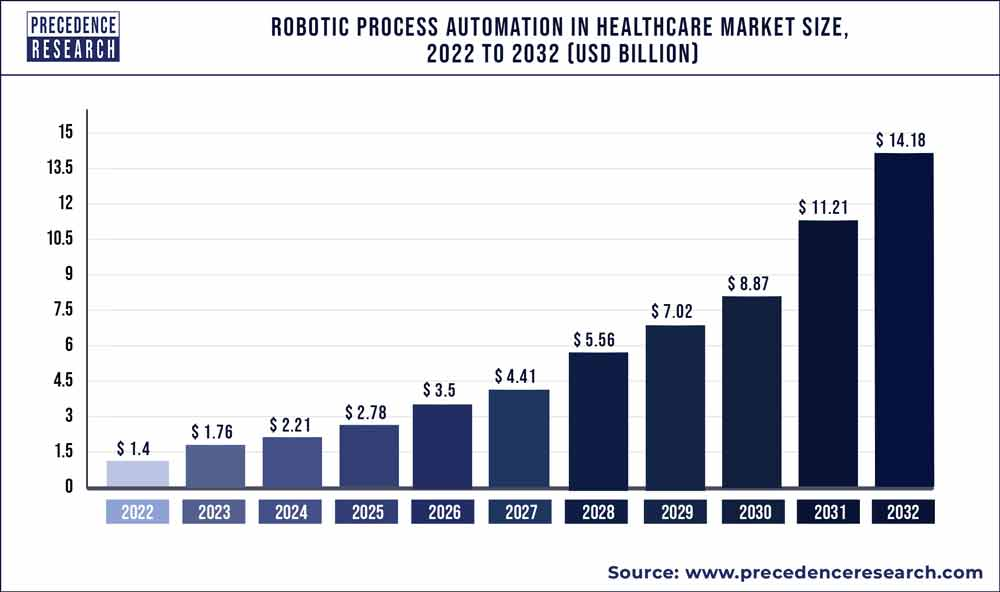
One of the most anticipated technological advancements in AI has been the advent of Automated Healthcare systems. Even though it is still at the nascent stage of development and is an ongoing process, the experts have on numerous occasions signaled its potential to ameliorate the healthcare sector as demonstrated by its potential growth in market size from $1.4 billion in 2022 to $14.8 by 2032 as exhibited below:-
In layman’s language an automated healthcare system means a system that uses various elements of AI to minimize human intervention in healthcare which includes robotic systems, virtual reality, prescription dispensing systems and virtual health assistance. The prime area of automation is performing administrative tasks, namely, scheduling appointments, giving timely reminders, generating reports, and conducting lab tests. Furthermore, data extraction softwares can be used to process data from documents and intake forms that are filled by patients. These are not just regular systems but technological solutions that would aid in making the sector more efficient, accessible and systematic. It is no longer a futuristic vision but a transforming reality that will shape the landscape of global healthcare sectors in the coming days.
IMPLEMENTATION OF ARTIFICIAL INTELLIGENCE AT GLOBAL LEVEL
Today multiple industries are focused on the implementation of AI by exploring the numerous possibilities for data incorporation using various methods like storage, assessment and analysis of healthcare data to grab the various market opportunities and achieve the profit making targets. In 2016, Microsoft in collaboration with Oregon Health & Science University’s Knight Cancer Institute devised a strategic plan called Hanover project to predict the most effective cancer drug treatment option available for patients using AI by analyzing the medical data at hand. In the same year, Intel Capital made an investment of $10 million in a startup called Lumiata which used AI to identify at-risk patients. At present the UK’s National Health Service is utilizing the Deepmind platform developed by Google to detect certain health risks through a mobile app. Tencent is developing AI Medical Innovation System to provide accurate diagnostic medical imaging services. Whereas companies such as Tesla, Volvo and Toyota have embraced research to obtain driver’s vital statistics to ensure driver’s full attention and to avoid the chances of a mishap. Therefore, these were some of the global initiatives taken by a few large companies around the world to boost the business ecosystem by implementation of AI into the healthcare sector.
ETHICAL CONCERNS
A study conducted in 2023 showed public skepticism encircling the notion of empathetic care provided by AI. Majority of the stakeholders which included medical professionals, patients and general public showed hesitancy in respect of implementation of AI in the sector owing to the displacement of jobs and chances of deterioration of doctor-patient relation. Another concern was that the patients did not have access to the complete information of how predictive algorithms were gauged therefore, these algorithms could be unfairly coded and used in favour of affluent individuals thereby prioritizing profits over ethics. These prejudices can result in aggravating the inadvertent social and health inequalities. Limited availability of data on minorities can lead to erroneous predictions which can result in worse medical outcomes that can further exacerbate their problems and put them in a susceptible position. For instance, HIV is a virus that is highly prevalent among the minorities which may lead to certain biases that may emerge on account of different sample selections and clinical trials that would be used for collection of data. Moreover, practices such as contrasting positioning of patients for radiography can significantly affect the results and make the process more perplexing. Whereas the last derivation of bias arises when algorithms are trained to adopt certain measures which can create bias against a particular category of people. Consequently, despite numerous efforts made by multiple governments, ethically harnessing AI’s maximum potential and grappling with these challenges remains the bigger issue for enforcement of AI in the healthcare sector.
THE KEY ISSUE OF BREACH OF DATA PRIVACY
One of the most contentious issues has been regarding the protection of patient’s data that is collected during medical procedures. While there is no doubt that AI has been adjudged as one the greatest inventions of all times yet infringement of data privacy is the leading drawback surrounding the implementation of AI in the healthcare sector. Data security primarily includes preserving patient’s confidential information that is collected and stored by the relevant authority. These sets of data are stored electronically (Electronic Health Record) but not all the systems with EHRs are equipped with data protection mechanisms because of which they can be easily accessed by third party applications thus exacerbating the breach. The concept of privacy breach first came to the light in the year 1998 in the case of Mr. X v Hospital Z in which a doctor disclosed the patient’s confidential information of being HIV positive because of which his marriage was called off. This case basically dealt with two different aspects of Right to Privacy and Right to confidentiality. In October last year a report was released by an American Cyber Security firm called Rescurity which revealed how the personal data, particularly Aadhar number and passport details of about 815 millions of Indians was being sold on the dark web which had been illicitly obtained from the Indian Council of Medical Research. Regardless of the fact that the right to privacy has been regarded as a fundamental right under Article 21 of the Indian Constitution, violations like these have become part and parcel in the tech-driven world. This is one such example of data leakage which was widely reported; however, there are countless data breaches in the sector that largely goes unreported everyday. With the integration of AI the apprehension related to data security could be further aggravated owing to the fact that algorithms could be manipulated to disclose the sensitive information. To deal with these questions certain laws have been framed by numerous governments around the world such as the Health Insurance Portability and Accountability Act introduced by the US in the year 1996 in order to create specific standards to protect and prevent the identifiable health information from being used without the patient’s consent, then is European Union’s General Data Protection Regulation introduced with the aim of regulating the security practices and in case of any violations imposing massive penalties on the perpetrator. In addition to the above regulations, the US added another legislation namely the Health Information Technology for Economic and Clinical Health Act in 2009 for encouraging health establishments to adopt EHR technologies with strict digital security measures. Moreover, there are a number of technical solutions recommended by experts like proper implementation of privacy algorithms, breach risk analysis, employee training and compliance with statutory regulations to manage the data infringement issue. While these measures are the stepping stone for achieving integration of AI, the utmost requirement that still persists is the effective implementation which will decide the likely future of the healthcare sector in protecting personal data of its consumers.
RECOMMENDATIONS
Some credible suggestions for the effective implementation of AI in the healthcare sector are;-
- Reinforcing the National Health Resource Repository with AI-ready data protocols
- Developing India specific AI Models which will specifically cater to the needs of the general Indian populace by collaborating with tech companies and academic institutions that should be devised on Indian dataset considering factors such as genetic diversity, regional specific disease patterns, etc.
- Integrating AI into the medical and nursing education curriculum which would include mandatory training with AI tool’s and internships with relevant health-tech companies. For the already practising professionals the government could introduce Certified courses on the use of AI.
- Establishment of comprehensive ethical guidelines covering a wide range of issues such as data privacy, biased algorithms, etc and an AI ethics committee could be devised on the lines of European Union’s framework on Ethical Guidelines for Trustworthy AI.
- Launching campaigns to spread public awareness about the use of AI in the healthcare sector especially at the grassroot level would also play a paramount role.
Therefore, proper implementation of these suggestions is a prerequisite for reaping the maximum benefits of AI in healthcare.
CONCLUSION
The picture that emerges from the above discussion is that AI has the capabilities to revolutionize the complete landscape of healthcare but this would be possible only if its full potential is tapped. With its ever increasing advantages of accurate predictive analysis, cost efficient diagnosis and risk assessment it has become a pressing priority. However for its successful implementation the above listed limitations of data breach, ethics and bias needs to be carefully addressed. Most importantly a proper regulatory framework with stern compliances needs to be established which would ensure minimum ethical standards are fixed and big tech companies do not make profit by manipulating algorithms. It is also important to consider that while framing laws public consultation regarding the same should be given paramount value in order to bridge the gap of trust deficiency between healthcare professionals and patients. Thus a collaboration between various stakeholders for continued innovation would be crucial for embracing its potential and ensuring a brighter future for the healthcare sector.
REFERENCES
Thomas Davenport & Ravi Kalakota, The Potential for Artificial Intelligence in Healthcare, 6 FUTURE HEALTHCARE J. 94, 94–98 (2019), https://doi.org/10.7861/futurehosp.6-2-94.
Eric J. Topol, High-Performance Medicine: The Convergence of Human and Artificial Intelligence, 25 NATURE MED. 44, 44–56 (2019), https://doi.org/10.1038/s41591-018-0300-7.
Md. Mostafa Ahsan, Saira A. Luna & Zubair Siddique, Machine-Learning-Based Disease Diagnosis: A Comprehensive Review, 10 HEALTHCARE 541, 541 (2022), https://doi.org/10.3390/healthcare10030541.
T.R. Undru et al., Integrating Artificial Intelligence for Clinical and Laboratory Diagnosis—A Review, 17 MAEDICA (BUCUREȘTI) 420, 420–26 (2022), https://doi.org/10.26574/maedica.2022.17.2.420.
K.P. Smith & J.E. Kirby, Image Analysis and Artificial Intelligence in Infectious Disease Diagnostics, 26 CLINICAL MICROBIOLOGY & INFECTION 1318, 1318–23 (2020), https://doi.org/10.1016/j.cmi.2020.03.012.
Trishan Panch, Peter Szolovits & Rifat Atun, Artificial Intelligence, Machine Learning and Health Systems, 8 J. GLOBAL HEALTH 020303 (2018), https://doi.org/10.7189/jogh.08.020303.
Feng Jiang et al., Artificial Intelligence in Healthcare: Past, Present and Future, 2 STROKE & VASCULAR NEUROLOGY 230, 230–43 (2017), https://doi.org/10.1136/svn-2017-000101.
AUTHOR:
Vanshika Arora
B.M.S College of Law
Affiliated to Karnataka State Law University