

Decoding the PCA’s Ruling on the Indus Waters Dispute”
BY SUHANI TOMAR
ABSTRACT
The 1960 Indus Waters Treaty (IWT) is a significant example of cross-border water governance, striking a balance between state sovereignty and treaty obligations. This paper delves into the Permanent Court of Arbitration’s (PCA) recent ruling concerning India’s hydroelectric projects on the western rivers, highlighting the legal implications for both India and Pakistan. Comparative analyses with Ethiopia’s Grand Ethiopian Renaissance Dam dispute and the U.S. Supreme Court’s decision in Arizona v. Navajo Nation offer insights into how nations navigate sovereignty and international commitments. The study underscores India’s strategic compliance with the IWT, emphasizing transparency, diplomatic engagement, and adherence to treaty mechanisms. The findings suggest that responsible treaty compliance not only reinforces sovereignty but also fosters regional stability and sustainable resource management.
KEYWORDS
State sovereignty, Indus Water Treaty, Permanent Court of Arbitration, Arizona v Navajo Nation, diplomatic engagement, treaty obligations, hydroelectric project, sustainable resource management, comparative analysis, Indus Water Dispute
INTRODUCTION
According to Ismail Serageldin, former Vice President of the World Bank, “The wars of the next century will be about water”. This prophetic statement reflects the growing anxieties over freshwater scarcity, which the United Nations World Water Development Report has also highlighted. By 2050, nearly 52% of the global population is projected to live under conditions of water stress . The growing competition over access to rivers, lakes, and aquifers has already fueled transboundary disputes, making water not merely a resource but a potential catalyst for conflict. Prominent examples include the contestations between India and Pakistan over the Indus River system, between China, India, and Bangladesh over the Brahmaputra, and among Egypt, Ethiopia, and Sudan concerning the Nile . Water, therefore, has emerged as one of the most critical drivers of geopolitical tensions in the 21st century. The historical significance of water is evident from the fact that the earliest human civilizations—including the Indus Valley in South Asia, the Nile basin in Africa, and the Yellow River region in China—developed and thrived along riverbanks. These civilizations underscore that water has always been central to human survival, economic development, and state formation . Against this background, this research paper focuses on the Indo-Pak dispute over the Indus Waters Treaty (IWT), brokered by the World Bank in 1960, and examines the broader question: Do treaty obligations outweigh state sovereignty? The partition of British India under the Indian Independence Act, 1947, gave birth to two sovereign nations—India and Pakistan. The boundary lines were drawn by the Radcliffe Commission, chaired by Sir Cyril Radcliffe, a British lawyer who had neither prior experience in India nor expertise in water management. This lack of familiarity meant that the partition failed to provide a systematic plan for dividing transboundary rivers, leaving the Indus system in a state of uncertainty . This omission became a long-standing point of contention between the two countries. To resolve the escalating tensions, the World Bank mediated the Indus Waters Treaty in 1960. Under the agreement, Pakistan obtained nearly unrestricted use of the western rivers—Indus, Jhelum, and Chenab—while India retained control over the eastern rivers—Ravi, Beas, and Sutlej. India was also granted certain non-consumptive rights on the western rivers, such as generating hydroelectric power and irrigation within prescribed limits . Despite hostilities in 1965, 1971, and during the 1999 Kargil 1999 Kargil conflict, both nations continued to adhere to the Treaty’s provisions, often cited as evidence of the treaty’s extraordinary resilience compared to other international agreements . Yet, the durability of the IWT has been increasingly tested due to Pakistan’s persistent support for cross-border terrorism and its political opposition to Indian hydropower projects. The turning point came after the April 2025 Pahalgam attack, where 26 Indian civilians were killed in a terrorist strike carried out by The Resistance Front (TRF), a Pakistan-based proxy of Lashkar-e-Taiba . The United Nations Security Council Sanctions Committee confirmed TRF’s claim of responsibility, linking the attack directly to Pakistan-sponsored groups [9]. In response, on 23 April 2025, India’s Cabinet Committee on Security announced that the Indus Waters Treaty would be held “in abeyance with immediate effect” until Pakistan “credibly and irrevocably abjures its support for cross-border terrorism” . Pakistan, however, condemned India’s decision, calling it an “act of war” and arguing that the suspension was both illegal and unilateral . The dispute soon reached the Permanent Court of Arbitration (PCA). On 27 June 2025, the PCA delivered its Supplemental Award on Competence, reaffirming its authority to adjudicate disputes under the IWT. The tribunal clarified that India’s unilateral suspension of the treaty did not alter the Court’s jurisdictional mandate . While Pakistan welcomed the ruling as a vindication of international law , India rejected the tribunal’s competence, dismissing the decision as “illegal and void” . This research paper critically examines the Indus Waters Treaty in the context of these contemporary developments. It seeks to analyze whether binding treaty obligations can and should supersede the sovereign right of a state to act unilaterally in matters of national security. By evaluating the legal, political, and strategic dimensions of the dispute, the study seeks to contribute to the broader debate on the balance between international treaty commitments and state sovereignty in an era where water is increasingly becoming a geopolitical tool.
RESEARCH METHODOLOGY
This study employs the doctrinal method of research to examine the Indus Waters Treaty, primarily through the analysis of legal reports, international documents, and official statements released by both India and Pakistan. While the research briefly situates the issue within its historical background, its central objective is to address the fundamental question of whether treaty obligations can outweigh the sovereignty of a state.
The research relies on both primary sources, such as treaty texts, arbitral rulings, and government communications, and secondary sources, including scholarly articles, international reports, and policy analyses. This dual approach provides a comprehensive framework for examining the dispute. To enhance credibility. The method is library- and desktop-based, and does not involve surveys or interviews. A comparative analysis is also undertaken, considering how other states have approached their treaty obligations in situations analogous to India’s position.
The scope of the research is confined to the contemporary context, including present developments. Additionally, the paper explores the treaty from an environmental perspective and offers policy suggestions aimed at de-escalating tensions between the two countries.
This research paper will incorporate geographical maps and locational data to provide a pragmatic understanding of the geographical setting of the disputed canals between India and Pakistan. The inclusion of such visual material is intended to strengthen the clarity and credibility of the analysis.
LITERATURE REVIEW
- Philosophical stance on the debate
The question of whether treaty obligations should ever outweigh the sovereignty of a state is not a new one. Writers and philosophers have wrestled with it for centuries, often reaching very different answers. Two names usually stand out in this debate: Thomas Hobbes and Hans Kelsen. Their positions could not be further apart, and putting them side by side helps to frame the issue.
Hobbes, writing in the seventeenth century, believed that sovereignty was the glue that held society together. He imagined life without government as a “state of nature,” where fear, conflict, and insecurity ruled everyday life. To escape that chaos, people, according to Hobbes, gave up certain freedoms and handed authority to a sovereign ruler who would guarantee peace. Once that sovereign was created, its authority was final. No other state, institution, or treaty could sit above it. In practical terms, Hobbes treated treaties as useful agreements, but he would never see them as more important than the survival of the state itself. This way of thinking explains why strong countries, even today, often claim sovereignty when they are asked to follow international rules. Kelsen’s perspective was very different. He approached the problem as a lawyer and jurist rather than a political thinker. His “Pure Theory of Law” described legal systems as a ladder, where each rule depends on a higher one, all the way up to a basic norm, or grundnorm.In this view, international law is not an optional extra but a higher framework that binds states as part of a global legal order. For Kelsen, treaties had to be respected, not just because they were promises, but because they gave the international system its predictability and stability.
Putting Hobbes and Kelsen next to each other makes the contrast easy to see. Hobbes insists on security and survival, while Kelsen emphasizes law and obligation. Both ideas still echo in the way states act. And this tension—between protecting sovereignty and honoring treaties—is exactly what makes the Indus Waters Treaty such an interesting case for study.
- Chronological Background of the Indus Waters Treaty
(a) 1947 – Partition and Initial Arrangements
Following the partition of British India, the Radcliffe Commission divided territorial boundaries, but left unresolved the question of water distribution from the Indus basin. To avoid immediate disruption, India and Pakistan concluded a standstill agreement that temporarily allowed the waters to continue flowing into Pakistan.
(b) 1948 – Termination of Agreement and Interim Accord
When the standstill agreement expired in April 1948, India suspended water supplies to certain canals flowing into Pakistan. Tensions rose until May, when the two governments signed the Inter-Dominion Agreement. Under this arrangement, India agreed to resume supplies in return for annual payments from Pakistan.
(c) 1951 – Internationalization of the Dispute
By 1951, Pakistan had brought the issue before the United Nations, accusing India of deliberately restricting flows to Pakistani villages. Around this time, David E. Lilienthal—former head of the Tennessee Valley Authority and U.S. Atomic Energy Commission—proposed World Bank–sponsored mediation as a durable solution.
(d) 1952 – Bilateral Technical Talks
Engineers from both countries met in 1952 in an attempt to resolve technical differences and move towards a workable settlement.
(e) 1954 – World Bank Proposal
In 1954, the World Bank formally advanced a mediation proposal, emphasizing cooperative management of the basin and joint technical studies.
(f) 1960 – The Indus Waters Treaty
After years of negotiations, Prime Minister Jawaharlal Nehru of India and President Ayub Khan of Pakistan signed the Indus Waters Treaty in September 1960. The treaty allocated the three western rivers (Indus, Jhelum, Chenab) to Pakistan and the three eastern rivers (Ravi, Beas, Sutlej) to India. It also created a standing Indus Commission to resolve disputes.
(g) 2017 – Kishenganga and Ratle Projects
Tensions resurfaced when India advanced construction of the Kishenganga hydroelectric project near the Line of Control, alongside the Ratle project. Pakistan objected, alleging that these projects would adversely affect downstream flows into its territory.
(h) 2022 – Dual Appointment of Forums
In 2022, the World Bank appointed both a Neutral Expert and a Court of Arbitration to address Pakistan’s objections. India opposed this parallel process, insisting that only the Neutral Expert was appropriate under the Treaty.
(i) 2023 – Treaty Modification Dispute
In 2023, India proposed modifications to the Treaty framework. Pakistan rejected these changes, while India refused to accept the Court of Arbitration’s jurisdiction. The Court, however, affirmed its authority to proceed.
(j) April 2025 – India’s Abeyance Decision
Following a militant attack in Pahalgam, India announced that it was placing its obligations under the Treaty “in abeyance.” The Court of Arbitration subsequently invited both parties to submit arguments on whether India’s unilateral suspension affected its jurisdiction. Pakistan filed a submission affirming the Court’s competence, while India abstained, reiterating its preference for the Neutral Expert process.
(k) June 2025 – Court of Arbitration’s Jurisdiction Ruling
In June 2025, the Court of Arbitration held India’s unilateral abeyance to be unlawful and reaffirmed its jurisdiction over the dispute. India dismissed the ruling as invalid and reiterated its rejection of the Court’s authority.
Main Provisions of the Indus Waters Treaty (1960)
1. Allocation of Waters
Article II of the Indus Waters Treaty clearly defines the division of the six major rivers of the Indus Basin between India and Pakistan. The three eastern rivers—Ravi, Beas, and Sutlej—are allocated to India, allowing it unrestricted use of their waters. In contrast, the three western rivers—Indus, Jhelum, and Chenab—are assigned to Pakistan for unrestricted use. This allocation results in India receiving roughly 33.8 million acre-feet (MAF) of water annually, while Pakistan receives about 135.6 MAF, effectively establishing a 30:70 ratio favoring Pakistan.
2. Obligations Under the Treaty
Under Article III, India has a clear obligation to allow the flow of water from the western rivers into Pakistan, ensuring that Pakistan can use its allocated waters without restrictions. However, India is granted specific exceptions. Annexure C permits India to use water from the western rivers for agricultural purposes, while Annexure D allows the generation of hydroelectric power through run-of-the-river projects. These provisions ensure that India can utilize the waters within its territory, but only in a manner that does not interfere with Pakistan’s rights, balancing both nations’ interests.
3. Dispute Resolution Mechanism
The treaty establishes a three-tiered dispute resolution mechanism under Article IX, designed to manage conflicts while maintaining cooperation.
Permanent Indus Commission (PIC): According to Article IX, paragraph 1, the PIC serves as the initial forum for resolving disputes. It consists of two commissioners, one from each country, who work collaboratively to address issues concerning water flows, river constructions, or any disagreements. The PIC follows a consultative approach, aiming to resolve disputes within six months. Annexure F provides detailed guidance on timelines, communication procedures, and steps to be followed for dispute resolution.
Neutral Expert: If the PIC cannot resolve the dispute within six months, Article IX, paragraph 2 allows for the appointment of a Neutral Expert. This expert, selected jointly by both countries—or by the World Bank if consensus cannot be reached—handles technical or non-legal matters, such as issues related to dam design or hydroelectric projects. Annexure G outlines the procedures for appointing the Neutral Expert and the scope of their authority, ensuring that technical disputes are addressed fairly and impartially.
Court of Arbitration: For complex, legal, or highly contentious disputes that remain unresolved, Article IX, paragraph 3 provides for a Court of Arbitration. As per Annexure G, the Court consists of seven members: one appointed by India, one by Pakistan, one by the World Bank, and four appointed jointly by the parties or by the Chief Justice of the International Court of Justice. This body has the authority to issue binding decisions, ensuring that unresolved conflicts are definitively settled.
Finally, Article X guarantees that decisions by either the Neutral Expert or the Court of Arbitration are binding on both parties, while Annexure H specifies timelines, procedural rules, communication protocols, and the World Bank’s facilitative role. Together, these provisions create a clear, hierarchical, and transparent system for resolving disputes, reflecting the treaty’s careful balance between cooperation and sovereignty.
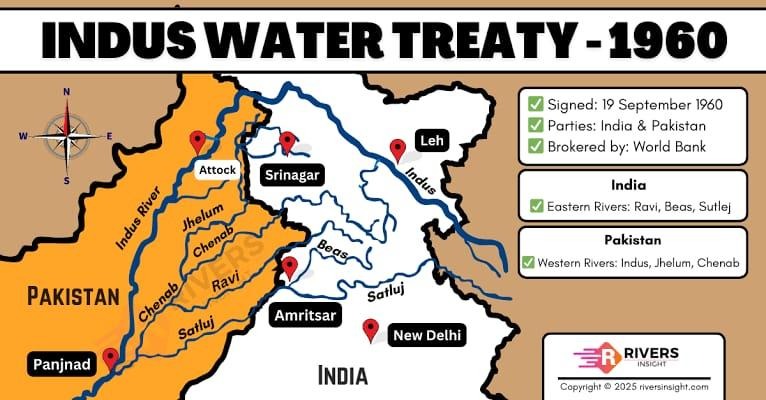
SOURCE: https://riversinsight.com/indus-water-treaty/
INDIA AND PAKISTAN’S STANCE ON THE JURISDICTION OF THE COURT
India and Pakistan have long held contrasting views on how disputes under the Indus Waters Treaty (IWT) should be handled. India insists that disagreements should first be addressed through bilateral consultations via the Permanent Indus Commission or, when technical issues arise, by a Neutral Expert as outlined in Article IX of the treaty. From India’s perspective, taking such matters to the Permanent Court of Arbitration (PCA) bypasses the treaty’s intended dispute resolution mechanism, which they argue preserves both countries’ sovereign rights over river management. Pakistan, however, views the PCA as a legitimate forum to ensure that its water rights are fully protected, particularly when it believes India’s projects on the western rivers affect downstream flow. The global community, including the World Bank, has historically encouraged both countries to respect the treaty’s provisions, emphasizing that neutral and legal arbitration is crucial for maintaining stability in this highly sensitive transboundary water system. Recent tensions, including India’s suspension of certain treaty provisions after security concerns, have highlighted how fragile cooperation can be, prompting international calls for dialogue and adherence to the IWT. This complex mix of national interests and international oversight underscores just how challenging it is to manage shared resources in a politically tense region.
THE ARGUMENT: TREATY OBLIGATIONS V. STATE SOVEREIGNTY
The goal of this section of the research paper is to provide an answer to the question of whether a nation’s obligations under a treaty supersede its sovereignty. The answer to this question will depend on current geopolitics and global trends in international politics. We shall analyze the trends with the aid of a few case studies.
1. Egypt – Grand Ethiopian Renaissance Dam (GERD)
Egypt has expressed concerns over the Grand Ethiopian Renaissance Dam (GERD), citing its reliance on the Nile River for approximately 95% of its freshwater needs. The 1929 Nile Waters Agreement, which Egypt inherited, allocated the majority of the Nile’s water to Egypt and Sudan, granting Egypt veto power over upstream projects. However, Ethiopia, not being a signatory to this agreement, has asserted its sovereign right to utilize the Nile’s resources for development, including the construction of the GERD. This unilateral decision by Ethiopia has led to tensions, as Egypt perceives the project as a potential threat to its water security
.
2. United States – Arizona v. Navajo Nation (2023)
In 2023, the U.S. Supreme Court ruled in Arizona v. Navajo Nation that the federal government is not obligated under the 1868 treaty to take affirmative steps to secure water for the Navajo Nation from the Colorado River. The Court emphasized that while the treaty reserved necessary water for the Tribe, it did not impose a duty on the federal government to actively secure water resources for the Tribe.
SUGGESTIONS
- Strategically, Pakistan should have first approached the Neutral Expert as prescribed under the Indus Waters Treaty before escalating the matter to the Permanent Court of Arbitration. The treaty’s Article IX lays out a stepwise mechanism: disputes are first handled by the Permanent Indus Commission, then referred to a Neutral Expert for technical or non-legal issues, and only unresolved, complex disputes move to the PCA. Adhering to this sequence not only respects the treaty framework but also ensures faster, more specialized resolution, reducing unnecessary international tensions and strengthening a state’s credibility if the case reaches arbitration.
- India should carefully follow the technical rules set out in Annexure D of the Indus Waters Treaty when developing hydropower projects on the Western Rivers. Sharing detailed project designs and water flow information with the Permanent Indus Commission helps maintain transparency and ensures that India’s use of the rivers for energy remains within treaty limits. This proactive approach reduces the chances of disputes escalating, demonstrates responsible management of shared water resources, and strategically strengthens India’s position if disagreements reach the PCA.
- Strategically, India should consider the broader implications of altering water flow to Pakistan. Such actions could set a precedent, encouraging other upstream nations, like China, to exercise similar control over shared water resources. China’s significant infrastructure projects on transboundary rivers, such as the Brahmaputra, have raised concerns in downstream countries about potential alterations in water availability. While India has sovereign rights under the Indus Waters Treaty, unilateral decisions could provoke similar measures from other nations, potentially escalating regional tensions. Maintaining consistent and cooperative water-sharing practices not only upholds India’s legal obligations but also fosters regional stability and discourages the normalization of unilateral water control..
4. India can strategically use the Indus Waters Treaty not just as a framework for water management, but also as a way to encourage Pakistan to address broader security concerns, such as cross-border terrorism. By consistently honoring its treaty obligations and releasing water as agreed, India demonstrates responsibility and commitment to cooperative transboundary management. At the same time, India can engage diplomatically to encourage Pakistan to take tangible action against terrorist activities that threaten Indian security. This approach frames water cooperation and regional stability as interconnected, giving India leverage without breaking treaty commitments. It also promotes a climate of trust and predictability, reducing the likelihood of disputes escalating unnecessarily while reinforcing India’s position as a responsible and strategic partner.
CONCLUSION
The Indus Waters Treaty demonstrates the delicate balance between state sovereignty and treaty obligations. While India retains sovereign rights over its rivers, the PCA ruling underscores the importance of adhering to the treaty’s mechanisms, including the Permanent Indus Commission and the Neutral Expert process, to maintain both legal legitimacy and international credibility.
Looking at global examples offers a perspective on the challenges of balancing sovereignty with treaty commitments. Egypt’s dispute with Ethiopia over the Grand Ethiopian Renaissance Dam illustrates how unilateral upstream development, without treaty alignment, can heighten tensions. Similarly, the U.S. Supreme Court’s decision in Arizona v. Navajo Nation highlights how domestic priorities can limit treaty obligations. These cases show that prioritizing sovereignty over obligations can escalate both regional and international conflicts.
In essence, the PCA ruling confirms that sovereignty and treaty obligations are not mutually exclusive. Following established treaty procedures enhances sovereignty by promoting credibility, reducing conflict, and fostering a cooperative framework for transboundary water management. India’s experience under the Indus Waters Treaty provides an important lesson for global water governance: responsible compliance with treaty obligations benefits both national interests and regional stability, setting a precedent for fair and sustainable transboundary river management.
By Suhani Tomar
Amity university, madhya pradesh