

- Abstract………………………………………………………….….….2
- Chapter 1
2.1-> Introduction………………………………………………………3
2.2-> Literature Review…………………………………………………3
2.3-> Objectives of Research……………………………………………5
2.4-> Scope and Limitations……………………………………………6
2.5-> Research Methodology……………………………………………8
2.6-> Sources of Data……………………………………………………8
- Chapter 2
3.1-> ADR framework in India………………………….……………10
3.2-> ADR framework in Singapore………………………………….12
3.3-> ADR framework in the UK……………………………………..13
3.4-> ADR framework in the USA……………………………………14
3.5-> Suggestions………………………………………………………15
3.6-> Conclusion………………………………………………………16
- Abstract
The evolution of the Alternative Dispute Resolution (hereinafter referred to as ‘ADR’) system gained its footing due to the judicial backlog and delays in the conventional litigation system. The traditional systems became highly inefficient, motivating the nations to look for other methods that could lessen these delays and give prompt solutions to disputes. This led to the evolution of the ADR system. Some of the common methods of ADR are:- arbitration, mediation, conciliation, negotiation, judicial settlements (including Lok Adalats), etc. Alternative Dispute Resolution (ADR) systems are a quicker, versatile, and more cost-effective way to settle conflicts, especially in the civil and business domains. The ADR frameworks in Singapore, the United States of America (USA), the United Kingdom (UK), and India reflect different legal traditions and sociopolitical realities. The study’s objective is to evaluate these four countries’ ADR systems’ development, application, usability, and efficacy.
This research highlights the efficiency of ADR systems and the bureaucratic support received by them in their respective domains. Currently, it’s one of the most sought-after methods and is used as an alternative for traditional litigation, though arbitral awards can be challenged. India is yet to give absolute autonomy to the ADR system prevalent in India. This autonomy is visible in other jurisdictions. The cost-effective and efficient way in which ADR systems deal with cases is remarkable. It is a booming field gaining a lot of popularity and attention. Every country has its own arbitration and mediation guidelines, and they have been somewhat aligned according to the UNICTRAL model of law. The evolution of ADR in these four jurisdictions, namely India, Singapore, the United Kingdom (hereinafter referred to as ‘UK’), and the United States of America (hereinafter referred to as ‘USA’), has been explained in detail.
- Chapter 1
2.1-> Introduction
The first contemporary Alternative Dispute Resolution laws to be implemented were the Arbitration Act of 1697 in the United Kingdom. Later on, came the Federal Arbitration Act, 1925 in the USA.
The presence of the ADR mechanism has been since 1800 BC. The Mari kingdom (present-day Syria) made use of arbitration and conciliation techniques for addressing disagreements amongst adjoining kingdoms. This marks the first ever documented use of Alternative Dispute Redressal mechanisms.
In ancient Egypt (1400 BC), formal diplomatic discussions and negotiations took place via proper delegations. In ancient India, methods such as Panchayats or village councils, where elders presided over the meetings to solve disputes, were used. These diplomatic negotiations to bring peace have been evident since the epics of Ramayana and Mahabharata.
Alternative Dispute Resolution (ADR) includes mechanisms like arbitration, mediation, conciliation, and negotiation, which have acted as a crucial substitute to conventional court procedures. These methods offer secrecy, flexibility, confidentiality, party autonomy, and faster solving of disputes, primarily in commercial and civil disputes where time and costs are important.
In the report, a proper background has been provided with respect to these four jurisdictions, how they evolved, and how they continue to evolve. It is an integral part of today’s legal system. Hence, the concept of ADR has been detailed in this article.
2.2-> Literature Review
In the article “A Comparative Analysis of Mediation Acts in Singapore and India- by Akash Gupta and Tejaswini Sahoo[1]“, emphasis has been laid upon the mediation systems in Singapore and India that have been implemented recently. The article has explained the situation post the implementation of these legislations thoroughly. It has further linked it to global agreements such as the Singapore Convention on Mediation (2019), a significant UNCITRAL treaty designed to facilitate cross-border enforcement of Mediated Settlement Agreements (MSAs). The article has primarily prioritized the Singapore Convention on Mediation (2019), Singapore’s Mediation Act, 2017, India’s Mediation Act, 2023, and compared with the New York Convention (1958). The Singapore Convention on Mediation (2019) has not been ratified by India, which is even looked upon as a major loss. The Mediation Act, 2023, lacks the capacity for cross-border commercial mediation in India. The Act struggles to include digital/virtual mediation systems that are becoming increasingly common in worldwide business. There is a lack of legislative brevity. The article has further proposed recommendations and suggestions. In this way, the article has contributed to this report.
From the article ” Comparative Analysis of the Efficacy of ADR in India and the UK- by Prashant Arbune and Dr. Priti Vijaynarayan Yadav[2] “, the ADR systems in India and the UK have been analysed in depth. In this, the research is motivated by the growing recognition of ADR and providing it as an advantageous solution for the overburdened traditional litigation systems in both countries. ADR has been effectively implemented in the UK’s civil court system, while India is experiencing certain challenges in implementing the same. The ADR system in the UK is a mature, successful, and integrated one, while in India, it is still emerging but erratic. In this literature, an in-depth review of the ADR system in both nations has been done. The approach of the UK with respect to ADR mechanisms is quite broad-minded, hence raising this awareness via various public awareness campaigns. It is viewed as a mainstream and primary approach. While in India, the approach is quite narrow-minded, and there is restricted public awareness. It is often seen as a second option. This has been broadly elaborated in this literature. Adding on to it, India, being under British rule, has led to the adoption of the basic legal structure of India being based upon the UK. Hence, there are various similarities in the laws and statutes of India and the UK.
In the article “ADR in Commercial Disputes: Effectiveness and Challenges- by Nausheen Siddiqui[3] “, there has been anextensive study of ADR techniques conducted. It has even mentioned the history and evolution of ADR, mentioning arbitration in Greek and Roman societies, and mediation in Confucian China. It has even put forth the evolution from medieval to modern times, thereby showing amendments in the ADR statutes across the globe over the period of time. This literature has primarily done a comparative analysis of ADR regulations in Singapore, the USA, and India. It has properly explained the introduction of ADR systems in India, which have existed since ancient times and have been relevant and put to use in some or other manner. It was even visible in the Panchayati Raj system prevalent before the application of ADR statutes in India. It has even discussed India’s approach to commercial problems. This literature is very useful, providing a competitive analysis and, most importantly, explaining the importance and evolution of ADR systems in India.
From the article ” Alternative Dispute Resolution & Its Comparative Study with India and USA- by Vaibhav Sangam Mishra and Janmejay Singh[4]“, an examination of ADR studies in India and the USA has been completed. The evolution of the ADR system in India and a walkthrough of its ancient, medieval, and modern times have been provided. From the epics to the Mughal era to the enactment of the Arbitration and Conciliation Act, 1996[5], to the Mediation Act, 2023[6], has been covered. While culture over here is a little restricted, where the conventional litigation method is given preference over faster and quicker ADR methods. The USA also has a background to its ADR laws, commencing from the Federal Arbitration Act (1925)to having private and institutional arbitration centres. The culture in the USA is quite open-minded, leading to quick adaptation of ADR statutes. The trust of the common man is high, especially in commercial dispute cases. This literature has analysed in-depth ADR mechanisms in India and the USA, hence providing useful information.
2.3-> Objectives of Research
Below is a list provided of the objectives of research:-
- To realize how ADR procedures have evolved historically amongst various territories
- Evaluating the shortcomings in the conventional litigation system, resulting in a surge in judicial pendency, thereby resulting in the emergence of ADR.
- Monitor the transformation of arbitration, mediation, and conciliation from an unofficial neighbourhood-based system to official and formal contemporaneous legislations.
- To analyze India’s institutional architecture and legislative framework towards ADR
- Examine the statutory framework of ADR in India.
- Exploring pre-mediation litigation, Lok-Adalats’ functions, and the operation of administrative organisations like Mumbai Centre for International Arbitration (MCIA) or Delhi International Arbitration Centre (DIAC).
- Assessing ADR networks in the USA, UK, and Singapore
- Figuring out to what extent every state has incorporated ADR into its legislative regime.
- To analyze and figure out the regimes in the USA and the UK according to the current laws applicable and amendments, if necessary.
- Carrying out a Comparative Assessment through jurisdictions
- Analyzing and comparing ADR legislation in India with that implemented in the UK, USA, and Singapore based upon regulatory techniques, legal assistance, price effectiveness and affordability, time-effectiveness, inclusivity, and accessibility.
- Finding out every system’s strengths and weaknesses and further determining how legal, institutional, and cultural concerns affect the usefulness of ADR.
- To Determine problems and recommend changes for India’s ADR system
- Raise awareness of various hurdles such as implementation gaps, indifference and ignorance, and constrained global applicability.
- Proposing feasible solutions like boosting ADR skills, online and technological infrastructure, judicial assistance, worldwide uniformity, and consistency of ADR laws.
- To point out ADR’s benefits and enhance access to justice
- Examining how ADR promotes productive dispute resolution, minimizes the administrative workload of judges, and offers straightforward procedures, particularly for disagreements involving neighbourhoods, business enterprises, and families.
2.4-> Scope and Limitations
Listed below are the scope and limitations of this research:-
- SCOPE
- Comparative Assessment of ADR laws across 4 jurisdictions
- This report focuses on the statutory provisions, administrative assistance, and execution strategies of different ADR regimes in India, Singapore, the USA, and the UK.
- Concentrating on Advanced ADR protocols.
- Emphasizing present ADR methods like arbitration, mediation, negotiation, and conciliation in comparison to conventional dispute resolution.
- Prioritizing commercial and civil concerns
- The subject matter is fundamentally concerned with civil, commercial, and regulatory issues as opposed to criminal prosecutions, extremely confidential disputes coming under family or employment law.
- Covering legal and political guidelines
- Assessing the key arbitration statutes of the countries. Further examination of the rationale behind the enactment of these statutes and the commencement of ADR systems in the respective countries.
- Some of the important arbitration laws include:- India’s Arbitration and Conciliation Act, 1996, Mediation Act, 2023, UK’s Civil Procedure Rules, USA’s Federal Arbitration Act (1925), and Singapore’s Mediation Act, 2017
- Comparative Enforcement Techniques
- Study examines the enforcement of mediated and arbitral settlements both domestically and globally
- Proposals that are Legislative-Oriented
- Recommending modifications and substantiating ADR laws in India while taking down certain aspects from international laws, doctrines, and conventions
- LIMITATIONS
- Emphasis of jurisdiction is limited to 4 countries
- The study is equipped to compare ADR regimes of only 4 different nations. Various other advanced ADR models have been excluded due to the jurisdiction, such as Australian, Canadian, and EU models.
- Shortage of field-level empirical data
- Report is based upon secondary sources while excluding empirical sources like interviews with mediators, participants in ADR proceedings, court officials, etc.
- Absence of Criminal ADR and Restorative justice strategies
- Regulated information on every nation’s local procedures
- Progressive amendments in the field of ADR
- New amendments are being made in this field frequently, where certain thoughts can become redundant.
2.5-> Research Methodology
The present paper is based on doctrinal legal research. The origin of this legal research comes from the word ‘doctrine’, which suggests ‘principle’ or ‘normal governing tenet’. This type of research is also known as ‘Pure Theoretical Research’. This is fundamentally a bibliographic study wherein legal statutes, acts, judgments, journals, articles, and other sources are referred to and made use of.
According to Prof. S.N.Jain-> “Doctrinal Research includes an in-depth analysis of cases, arranging, ordering of legal propositions, study of laws, legal contentions and legal institutions, via legal reasoning or rational deduction.”
This research replies to the question of ‘What is law?’. Hence, this type of research studies the objectives of the law. Few sources used in doctrinal legal research include:- legal statutes, acts, law journals, legal articles, legal treaties, judgments and cases, online websites and blogs, government and law commission reports, etc. This is a discrete method of conducting legal research wherein one examines the topic, identifies research gaps, analyzes the research problems, answers them by including your suggestion, and then concludes the paper. This is Doctrinal legal Research, which has been implemented in the topic Comparative study of Alternative Dispute Resolution frameworks.
2.6-> Sources of Data
The present research makes use of both primary and secondary sources. In the primary sources inspection, various legal statutes related to ADR have been examined. The statutes are related not only to India but also to the UK, USA, Singapore, and worldwide laws on arbitration. Some of the statutes implemented in this are:- Arbitration and Conciliation Act, 1996; Mediation Act, 2023; Arbitration Act, 1996 (UK); Federal Arbitration Act (FAA), 1925(USA); Uniform Mediation Act (UMA), 2001(USA); Arbitration Act, 2001(Singapore); Mediation Act, 2017(Singapore); Singapore Convention on Mediation, 2017. In the secondary sources, mainly articles from SCC online, Hein online, and various other law journals have been used to make the study more accurate and definitive. Legal databases like SCC Online and Manupatra have been applied to incorporate case laws in the paper.
- Chapter 2
3.1-> Alternate Dispute Resolution framework in India
The ADR system has been prevalent in India since ancient times. There can be continuous evolution in ADR methods with time. In ancient India, methods such as Panchayats or village councils, where elders presided over the meetings to solve disputes, were used. These diplomatic negotiations to bring peace have been evident since the epics of Ramayana and Mahabharata.
Throughout the Mughal era, the Qazis mediated the conflicts in the Diwan-e-Aam and Diwan-e-Khas. The system of caste-based Panchayats and Kabila (clan) heads played a pivotal role. Further moving on to modern India during the reign of British India, the Indian Arbitration Act, 1899, was passed and was applicable to the presidency towns. Post that the Arbitration Act, 1940, was applicable. Most importantly, the second schedule of the Code of Civil Procedure, 1908, was repealed owing to the Arbitration Act, 1940.
The United Nations Commission on International Trade Law (UNCITRAL) model law was adopted on 21 June 1985. Based upon similar guidelines, India introduced the Arbitration and Reconciliation Act, 1996[7]. This Act repealed the 1940 Act, which was introduced during the British Raj. The act received the President’s assent on 16 August 1996 and was enforced from 22 August 1996. This is the Arbitration and Conciliation Act, 1996. According to S. 2 (a) of the Arbitration and Conciliation Act, 1996[8], arbitration means any arbitration, whether or not administered by a permanent arbitral authority. The amendments of 2015 and 2019 have boosted its structural foundation. It has even led to the creation of the Arbitration Council of India (ACI). The concept of ADR has been recognized under S.89 of Civil Procedural Code[9].
Besides arbitration, mediation boomed as an effective ADR tool. This was supported by the enactment of the Mediation Act, 2023[10]. It facilitated digital mediation and approval of mediated settlement agreements (MSAs). It fosters litigants to resolve their disputes outside of the court system. A crucial vacuum yet exists because India has not yet ratified the Singapore Convention on Mediation, thus hindering the international implementation of MSAs. The knowledge about ADR mechanisms is still inadequate in semi-urban and rural areas.
The accessibility of competent mediators is restricted even with the presence of organisations such as the Delhi International Arbitration Centre (DIAC) and the Mumbai Centre for International Arbitration (MCIA). The exercise of ad-hoc arbitration is widely applicable, which sometimes causes inconsistencies in the process and application. It has been observed that even though Lok Adalats resolve a large no. of issues, yet they are mainly petty civil and criminal matters. They are still unable to manage complicated business contract-related matters. Before proceeding to solve a dispute by ADR, the dispute would have mostly gone through traditional or conventional litigation methods. Hence, ADR methods are given the second option and are not treated as the primary one. The growth of ADR in India is rapid, but the hindrances are the mindset of people, often leading to rejecting innovative and fast methods. Hence, with proper legislation and steps taken towards the implementation of ADR, it would shortly become a sought-after method.
Bharat Aluminium Co. v. Kaiser Aluminium Technical Services Inc. (2012)[11] marks a major shift in the arbitration laws present in India. This was a landmark judgment that overturned the contentious Bhatia International ruling.
Ssangyong Engineering & Construction Co. Ltd. v. National Highways Authority of India (2019)[12]-> The central idea was the interpretation of the phrase “public policy” as mentioned under Section 34 of the Arbitration and Conciliation Act, 1996[13]. It clarified that awards violating Indian public policy could only be set aside under very limited grounds, and the finality of arbitral awards was supported.
Guru Nanak Foundation v. Rattan Singh & Sons (1981)[14]-> This case laid the foundation and paved the way for a new ADR Act. It gave way to the Arbitration and Conciliation Act, 1996, thereby repealing the old act. The 1940 Act was heavily criticized and was pointed out for being unable to perform its duties
3.2-> Alternate Dispute Resolution framework in Singapore
Prior to ADR methods, Singapore was highly into conventional traditional litigation methods. It all began in the late 1980s and early 1990s when the government of Singapore began to understand the fiscal advantages of becoming a global financial hub. This move was extremely essential and would further diminish the dependency upon the traditional court systems.
The prominent changes in Singapore’s ADR system took place in the 1990s and 2000s:-
- 1991: The Singapore International Arbitration Centre (SIAC) was launched in 1991. It was the initial move made by Singapore towards making it an accessible centre for business arbitration in Asia.
- 1994: With adherence to the UNCITRAL Model Law, Singapore passed the International Arbitration Act (IAA) to facilitate domestic and international arbitrations with ease. It enhanced party autonomy, thereby limiting judicial intervention.
- 1997: Community Mediation Centers (CMCs) emerged for fostering mediation in local and interpersonal disputes. These bodies reflected Singapore’s policy of developing mediation as a societal norm. In the same year, the Singapore Mediation Centre (SMC) was founded under the Singapore Academy of Law. There was encouragement to go for mediation and ADR before opting for conventional litigation techniques.
- 2014: Establishment of Singapore International Mediation Centre (SIMC) for settling complicated, global, cross-border disputes. It enhances SIAC and SMC frequently utilized in hybrid approaches such as the Arb-Med-Arb Protocol.
- 2017: Enactment of the Mediation Act, 2017[15]. This was a landmark decision, thereby leading to the statutory foundation for mediation. It elucidated matters pertaining to confidentiality, enforceability of mediated settlement agreements (MSAs), and the role of courts. It substantially enhanced public and commercial confidence in mediation as a viable dispute resolution mechanism.
- 2019: The Singapore Convention on Mediation (SCM) was hosted and approved. The UNCITRAL Convention on International Settlement Agreements Resulting from Mediation, commonly known as the Singapore Convention on Mediation, was signed in Singapore. This was a crucial phase in Singapore’s ADR history. The goal was to facilitate cross-border enforcement of MSAs
Certain key factors affecting Singapore’s ADR system were its administrative and governmental support, attitude of the judiciary, integrated system, and encouraging hybrid models, making it a business-friendly hub.
In the case of Ng Chee Weng v. Lim Jit Ming Bryan (2012)[16] -> suggested to strengthen the implementation of mediation agreements via the Mediation Act, 2017. It explained mediation secrecy and ‘without prejudice’ exclusions
In the case of Farm Assist Ltd v. Secretary of State for the Environment (2009)[17]-> The primary aspect was the elucidation of limits of confidentiality and exemptions for the public interest in mediation. It was regulated by S.9(2) Singapore Mediation Act, 2017[18].
3.3-> Alternate Dispute Resolution framework in the United Kingdom
In England, prior to the existence of the traditional court system, conflicts were resolved by informal community-based processes. Even though the mechanism of ADR was not known to everyone yet, its concepts were applicable in urban as well as rural areas. During the medieval era in England, trading guilds and businesses made some use of ADR based procedures to resolve conflicts. Especially in port cities and London, these merchant courts were referred to as the Law Merchant or lex mercatoria. It gained prominence over time. These courts were prior to the ADR system and even shaped the ADR mechanism of the country in a certain manner. Arbitration began to be more formally recognized in the 17th century. Some of the acts enacted with relation to ADR mechanisms were the Common Law Procedure Act of 1854 and later the Arbitration Acts of 1889 and 1934. The turning phase came with the Woolf Reforms (1999). This is, in fact, visible from the establishment of the London Court of International Arbitration (LCIA), headquartered in London and founded in 1892. The Civil Procedural Rules (CPR) over there notably favoured ADR mechanisms. The late 20th century led to the rise of contemporary ADR techniques in the country. A few of the important cases are Dunnett v. Railtrack plc (2002)[19] EWCA Civ 303 and Halsey v. Milton Keynes General NHS Trust (2004)[20] EWCA Civ 576
3.4-> Alternate Dispute Resolution framework in the United States of America
In the late 1970s and early 1980s, there was widespread acceptance of the ADR system due to the judicial backlogs and delays in the traditional litigation system. One of the avid promoters of ADR was Chief Justice Warren Burger. Some of the important statutes in the USA ADR are:- Administrative Dispute Resolution Act, 1976, Civil Justice Reform Act, 1990, Alternative Dispute Resolution Act, 1998, Uniform Arbitration Act & Mediation Act. The current ADR practices in the USA are:- arbitration, mediation, and plea bargaining in criminal law. Around 30 to 50 % of the issues and disputes in the USA are resolved via ADR mechanisms. The USA’s dispute resolution mechanisms are one of the most forward and advanced systems in the world.
In the case AT&T Mobility LLC v. Concepcion (2011)[21]-> Arbitration provisions on consumer agreements were made legally binding. It further stated that the Federal Arbitration Act (FAA) overrides state laws, according to the U.S. Supreme Court.
In the case of Gilmer v. Interstate/Johnson Lane Corp. (1991)[22]-> The scope and limits of the Federal Arbitration Act (FAA) were widened. It backed compulsory arbitration in labour disputes.
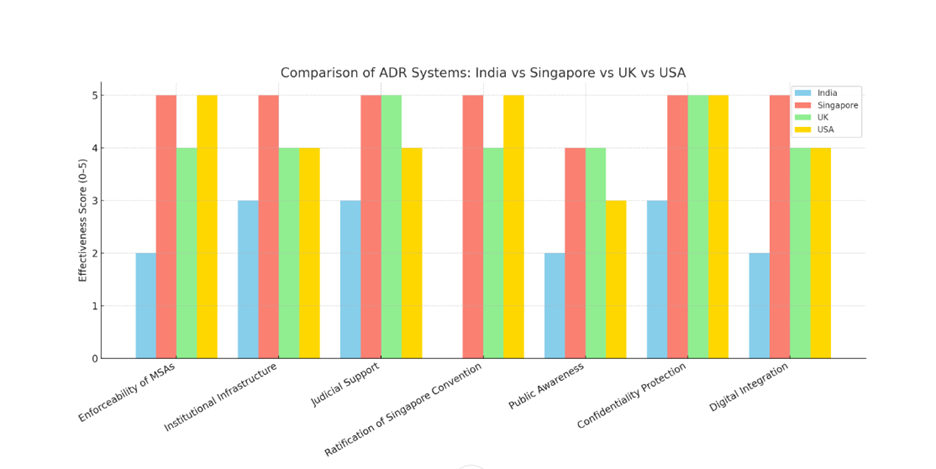
- Given below is a comparison chart with respect to ADR mechanisms in different countries and jurisdictions:-
3.5-> Suggestions
The article has included most of the crucial aspects of all the four jurisdictions. It has elaborated in-depth on the need for Alternate Dispute Resolution mechanisms thoroughly.
Certain things that can be proposed from this are:-
- India ratifying the Singapore Convention on Mediation (2019)
- Developing institutional ADR and making it more powerful
- Compulsory pre-litigation mediation in civil matters
- Advertising a flexible and hybrid model of ADR
- Raising public awareness and competence
- Role of ADR in public administration and administrative disputes
- Alternate Dispute Resolution in the syllabus and curriculum, specifically for law students
These are a few suggestions.
3.6-> Conclusion
In several nations, Alternative Dispute Resolution is playing a crucial role, thereby substituting the traditional litigation techniques. Through the comparative analysis and graphs, it can be comprehended that India still has a lot more to achieve than what it has achieved till now. India has gone way ahead by means of enacting various arbitration and mediation acts, but it still has to achieve several milestones. Though possessing a limited boundary, Singapore is the leader of ADR systems, being a global hub to mediate commercial and business disputes.
There should be ratification of global conventions done, and most importantly, creation of public awareness amongst the masses regarding ADR techniques. ADR has high prospects of growing in India, and if given the right direction, it can build up and grow in the correct manner.
Name:- Kanika Amol Pradhan
College:- Symbiosis Law School, Hyderabad
[1] Akash Gupta, Tejaswini Sahoo; A Comparative Analysis of Mediation Acts in Singapore and India, 4 NUJS JODR 1 (2024).
[2] Prashant Arbune and Dr. Priti Vijaynarayan Yadav, Comparative Analysis of the Efficacy of ADR in India and the UK.
[3] Nausheen Siddiqui, ADR in Commercial Disputes: Effectiveness and Challenges.
[4] Vaibhav Sangam Mishra and Janmejay Singh, Jus Corpus Law Journal (JCLJ), Vol. 1, Issue 3.
[5] Arbitration and Conciliation Act, 1996, No.26, Acts of Parliament, 1996 (India).
[6] Mediation Act, 2023, No. 32, Acts of Parliament, 2023 (India).
[7] Supra note 5.
[8] Arbitration and Conciliation Act, 1996, § 2 cl. a, No.26, Acts of Parliament, 1996 (India).
[9] Code of Civil Procedure,1908,§ 89, No. 5, Acts of Parliament, 1908 (India).
[10] Supra note 6.
[11] Bharat Aluminium Co. v. Kaiser Aluminium Technical Services Inc. (2012) 9 SCC 552.
[12] Ssangyong Engineering & Construction Co. Ltd. v. National Highways Authority of India (2019)15 SCC 131.
[13] Arbitration and Conciliation Act, 1996, § 34, No.26, Acts of Parliament, 1996 (India).
[14] Guru Nanak Foundation v. Rattan Singh & Sons (1981) 4 SCC 634.
[15] Mediation Act, 2017, No,1, Acts of Parliament, 2017 (Singapore) .
[16] Ng Chee Weng v. Lim Jit Ming Bryan (2012) 1 SLR 457.
[17] Farm Assist Ltd v. Secretary of State for the Environment (2009) EWHC 1102.
[18] Mediation Act, 2017, § 9 cl. 2, No,1, Acts of Parliament, 2017 (Singapore).
[19] Dunnett v. Railtrack plc (2002) EWCA Civ 303.
[20] Halsey v. Milton Keynes General NHS Trust (2004)[20] EWCA Civ 576.
[21] AT&T Mobility LLC v. Concepcion, 563 U.S. 333 (2011).
[22] Gilmer v. Interstate/Johnson Lane Corp., 500 U.S. 20 (1991).