

- Abstract:
The right to privacy has faced several legal ramifications and difficulties in the digital age. This research attempts to offer insights into the complexities of privacy in the digital era by an extensive assessment of the literature and analysis of pertinent approaches. This study examines whether or not people’s right to privacy is preserved in the digital era and what obstacles they must overcome to exercise that right. This study aims to determine people’s awareness of the current legal framework and its implications, as well as to provide a concise explanation of the necessity of strict regulations protecting people’s right to privacy. The study’s findings make it abundantly evident that most of the participants are well aware of the right to privacy and how it affects an individual’s right to privacy; however, the government must nonetheless enact laws that raise public awareness and protect citizens’ rights in the digital age. The researcher used the Convenient Sampling Method in accordance with the Descriptive Method of Research. The study has a sample size of 80.
- Keywords:
Privacy rights, Digital age, Legal implications, Privacy Protection, Data protection, Surveillance.
- Introduction:
The digital revolution has completely changed how we engage, communicate, and do business. Technology presents previously unheard-of chances for creativity and connectedness, but it also poses serious issues with respect to private rights. Digital communications technology has permeated daily life, including the Internet, smartphones, and gadgets with Wi-Fi capabilities. Innovations in communications technology have increased freedom of expression, enabled international discussion, and promoted democratic involvement by significantly enhancing access to information and real-time communication. These potent tools promise better enjoyment of human rights by magnifying the voices of human rights activists and giving them new means of documenting and exposing abuses. This introduction provides an overview of the key issues surrounding the right to privacy in the digital age, outlining the objectives and scope of the research.
Evolution of Privacy Rights: A Historical Perspective
The adage “Man’s house is his castle” alludes to a human being’s inherent “right to privacy”. Every person has secret and private aspects of their lives that are not appropriate to share with the world. The global movement for the right to privacy has gained traction, and it is now seen as an essential right. The discussion of the right to privacy began in 1789, the United States Constitution [1]went into force. The Supreme Court has determined that the First, Third, Fourth, and Fifth amendments of the Constitution do, in fact, establish a right to privacy, even though they do not expressly promise it. A law review article titled “The Right to Privacy” (often known as “the right to be left alone”) was published in the Harvard Law Review in 1890[2]. One of the most important writings in American legal history, written mostly by Justice Louis Brandeis (though Warren and Brandeis are also given credit), it is regarded as the country’s first publication to make the case for the right to privacy. The writers accuse that “immediate photos and newspaper businesses have trespassed into the sacred spheres of private and family life” and ask that readers “evaluate whether the current legislation provides a principle which can legitimately be invoked to protect the privacy of the individual”. The U.N. Declaration of Human Rights (UDHU), which was adopted by the UN General Assembly on December 10, 1948, was written by delegates from many countries with differing legal and cultural traditions. Article 12 declares that “No one shall be the victim of attacks upon his honor and reputation, or of arbitrary interference with his privacy, family, home, or correspondence.” Everyone is entitled to legal defense against these kinds of intrusions or assaults.[3] Later in 1960s and 70 there are some supreme court rulings were there- The famous Supreme Court decision Griswold v. Connecticut (1965) [4]concerned a Connecticut “Comstock law” that outlawed the use of any kind of birth control. The “right to marital privacy” was the rationale used by the Supreme Court to reject the legislation by a majority of 7–2, establishing the precedent for the right to privacy with relation to personal habits. The U.S. Supreme Court upheld single people’s freedom to own contraceptives in Eisenstadt v. Baird (1972)[5]. The Equal Protection Clause of the Fourteenth Amendment and the right to privacy established in Griswold v. Connecticut served as the foundation for the decision. Later the Privacy Rights were evolved via enacting so many acts related to Privacy Protection which are- FERPA, the Family Educational Rights and Privacy ACT of 1974[6], Privacy Act of 1974[7], The Telephone Consumer Protection Act (TCPA)[8], HIPAA, or the Health Insurance Portability and Accountability Act of 1996[9], COPPA, or the Children’s Online Privacy Protection Act, 1998[10], E-Government Act of 2002[11], The General Data Protection Regulation (GDPR), 2018, The California Consumer Privacy Act (CCPA), 2020[12] and at last the year 2023 was a turning point for generative AI, and these days, AI tools are pervasive across a wide range of businesses and institutions, including higher education. The first set of regulations pertaining to AI was suggested by the European Commission in April 2021. The European AI Act is awaiting formal adoption by the Parliament and Council in order to become EU law as of January 2024.
The constant attempts to strike a balance between the advantages of cutting-edge technology and the requirement to preserve security, privacy, and other democratic ideals are reflected in the changing regulatory environment.
Technological Advancements and Privacy Concerns
Our lives have changed significantly as a result of technological improvements, which also provide many advantages including more efficient communication, easier access to information, and better productivity. But these developments have also given rise to grave privacy issues. The abundance of data has fueled digital technologies, which have revolutionized several industries, including marketing[13]. Yet, these changes have resulted in serious privacy concerns that have strained the bonds between companies and their customers. As a result, legislative actions as well as individuals’ own privacy-protective actions have changed. Many customers acknowledge that they have no idea what businesses do with the data they gather and that they lack the time or skills to secure their data. Particularly the internet has had a significant influence on privacy. Every day, millions of cameras, gadgets, and sensors produce data about every person on the planet. Many people unwittingly give away their personal information by using the internet. Being private has become nearly impossible as a result, particularly online. The introduction of social media sites such as Facebook has made things even more complex. An exploitation of user data resulted from a large number of people unintentionally disclosing personal information. As a result, maintaining one’s privacy has become nearly difficult, and sharing personal information online might put one at risk of privacy breaches. In conclusion, despite the fact that technological advancements have outpaced our privacy laws, creating a growing digital footprint that the government and businesses can track in previously unimaginable ways, it is critical that individuals, businesses, and regulators collaborate to overcome these obstacles and guarantee the protection of individuals’ right to privacy in this increasingly digital world.[14]
Legal Frameworks and Digital Privacy: An Overview
In the era of prevalent digitalization, legal frameworks pertaining to digital privacy have gained significant importance[15]. These frameworks seek to guarantee data security and safeguard persons’ data rights. A big move in the right direction toward data privacy in India is the Digital Personal Data Privacy Act, 2023 (DPDPA).[16] This is India’s first comprehensive data protection law, having been passed by the Indian Parliament and published in the Official Gazette of India on August 11, 2023. The DPDPA has extraterritorial application in some situations and is applicable to any processing of digital personal data within India. It introduces a broad definition of “personal information”, creates transparent disclosure requirements for data controllers, establishes strong data subject rights, provides for limitations on cross-border data transfers, and places various obligations on data controllers to safeguard personal data[17]. Globally, several data privacy regulations have been enacted to safeguard individuals’ data rights. For instance, the General Data Protection Regulation (GDPR)[18] in the European Union and the California Consumer Privacy Act (CCPA) [19]in the United States set stringent requirements for organizations. However, despite these legal frameworks, privacy has emerged as a basic human right across the globe and in India too, it has been recognized as a Fundamental Right under Article 21 of the Indian Constitution[20]. However, the absence of legal protection for this right has also made it feasible for the ruling majority to violate private rights through discriminatory legislation. In conclusion, even if these legal frameworks have significantly improved the protection of digital privacy, more effort is still required to expand the reach of data protection and uphold citizens’ rights to privacy in the modern era4. In an increasingly digitalized world, it is imperative that individuals, companies, and authorities collaborate to overcome these obstacles and guarantee the preservation of privacy rights.
Challenges Posed by Data Collection and Surveillance
- Data Breaches: A major risk of data breaches is posed by the growing volume and variety of data being collected. Identity theft and other serious repercussions might result from unauthorized access to sensitive information.
- Algorithmic prejudice: In data collecting and surveillance, algorithms may display prejudice, which can result in unjust consequences. When these algorithms are applied to decision-making processes, this is especially troubling.
- Privacy-Preserving AI: One of the biggest challenges is maintaining privacy when using AI for data analysis. While being investigated, techniques such as differential privacy have not yet gained widespread acceptance.
- Informed permission: It might be challenging to give informed permission because many users are not completely aware of the scope of data gathering methods. It is essential that data gathering and utilization procedures be transparent.
- Third-party Data Sharing: The privacy environment is further complicated by the frequent sharing of data gathered by one institution with third parties. Users frequently have minimal control over the sharing or usage of their data.
- De-identification and Re-identification: Although privacy is preserved through the use of de-identification procedures, the possibility of re-identification persists. This is particularly true now that strong AI algorithms have been developed.
- Global Regulatory Compliance: Companies that operate internationally face difficulties in adhering to global regulatory compliance standards because several nations have distinct data protection legislation.
- Mass Surveillance: Concerns regarding unjustified invasion of people’s privacy are raised by the use of technology such as facial recognition and metadata gathering for mass surveillance.
- Spyware: Programs such as “Pegasus” software have the ability to transform cellphones into “24-hour surveillance devices,” giving us access to all of the information on them and using them as a weapon to spy on us.
- Encryption: Although it is under threat, encryption is a crucial component that protects human rights and privacy in the digital sphere. States are urged by the study to refrain from taking any actions that can compromise encryption.
These issues show how important it is to have strong regulatory frameworks, technological advancements, and user knowledge in order to protect privacy and security in the digital era.
- Research Methodology:
This section describes the research technique used in this study. I consulted several internet sources when I was composing this research report. Perused various publications concerning the right to privacy, explored various websites, and reviewed the relevant laws. I also read through the relevant case laws.
- Review of Literature:
The review of literature examines scholarly articles, legal documents, and case studies related to the right to privacy in the digital age. It provides a comprehensive overview of the historical development of privacy rights, the impact of technology on privacy, and the legal frameworks governing privacy protection. This section also identifies key challenges and controversies surrounding privacy in the digital era.
- Method:
The method section details the research approach, including data collection methods, sample selection criteria, and analytical techniques. It provides transparency regarding the research process and ensures the reliability and validity of the findings. I do the data collection by the questionnaire.
Analysis
9. Are there any specific technological advancements that you believe pose significant challenges to privacy rights? (Please specify)
- AI monitoring, have sparked personal privacy. While these technologies can enhance security, they can also be misused
- Unsecured IP address
- Inbuilt the software
- The AI assistant or what we call the Google assistant, Alexa, Siri etc. are constantly hearing what you speak and it can be proved with a simple experiment. Another one is that of AI, The AI do possess some threat to privacy in realm of IPRs.
- Very right
- Sorry I don’t know
- Technological advancements in surveillance, such as facial recognition and AI-driven monitoring, have sparked debates about personal privacy. While these technologies can enhance security, they can also be misused or infringe on civil liberties.
- Policymakers will need to adapt and develop agile regulatory frameworks that keep up with technological advancements. This includes laws related to cybersecurity, data privacy, and emerging technologies.
- Yes, emerging technologies like facial recognition, biometric data collection, and widespread surveillance systems present significant challenges to privacy rights. These advancements raise concerns about data security, consent, and the potential for abuse by governments or corporations.
- Not in my knowledge
- AI
- Government should take action against scammers of social media
- Social media and other online systems are used to gather large amounts of data about individuals either “voluntary”, because users subscribe to a specific service (Google, Facebook), or involuntary by gathering all kinds of user related data in a less
- Artificial intelligence
- AI powered surveillance technologies, such as facial recognition systems and location tracking tools
- Yes, more the advancement in technology more will be the issue of privacy
- Yes, there are several technological advancements that raise concerns about privacy rights. One major area is in surveillance technologies such as facial recognition systems, which can potentially be used for mass tracking and identification without consent.
- Social media
- facial recognition technology and the widespread use of smart devices like IoT gadgets pose significant challenges to privacy rights.
- I’d say artificial intelligence in particular
- The increasing use of facial recognition technology, it has the potential to track and identify individuals without their consent, which can be a challenge to privacy. Another example is the collection and analysis of personal data by companies, which can raise questions about how that data is used and protected. These advancements I believe pose significant challenges to privacy rights.
- Social medias
- The scope of social media has increased drastically over the years. Now people’s information is easily accessible as it is exposed to so many platforms.
- Yes, advancements in facial recognition technology and biometric data collection raise concerns about privacy rights due to the potential for widespread surveillance and tracking without individuals’ consent.
- No, and If there is any advancement then I’m not much aware of it.
- Social Media Data Mining
- Single platform like what’s app having access to everything, from gallery, location to bank account.
- Third party apps which are downloaded from chrome or other browsers.
12. What measures do you think could enhance privacy protection in the digital age?
- No
- By installing security software or working on a password, two factor authentication, careful before clicking and accessing a link
- Have no age limit
- Stop on dark web or third-party application
- The government needs to strengthen the privacy rights. Although governmental initiatives may not be enough. Supreme Court’s ruling in the K.S. Puttaswamy which incorporated Right to Privacy into the realm of Art. 21 needs to be studied and reformed again. The measures should be initiated by the SC, transformed into law by the legislature and enforced by the Executives. Though to start public awareness is must.
- To make laws and give strict punishment to accused
- Don’t know
- 1)Create complex Password
- 2)Update it regularly
- 3)Enable two factor authentication
- 4)Regular Software update
- 5)Avoid uses of application’s which are unsecured in your country
- Enhancing privacy protection in the digital age could involve implementing stronger data protection laws, promoting user awareness and education about privacy rights and online risks, developing privacy-preserving technologies like encryption and decentralized systems, and fostering transparency and accountability among companies and governments regarding their data collection and usage practices.
- No idea I have
- No suggestions
- To take action against unknown social media scammers
- using strong passwords, updating software, avoiding phishing emails, and verifying sources of information.
- Promoting transparency in data collection and usage practices, users should have more control over their data, and strong rules and regulations to hold companies accountable for mishandling personal information.
- Yes
- Enhance and implement the rules of Right to privacy in Digital age
- Using secure browser, strong password protection
- only we are responsible to be cautious and safeguard our privacy
- Enhancing privacy in the digital age requires stronger regulations, privacy-focused design, user empowerment, data minimization, encryption, accountability, education, and international cooperation.
- Encrypt your data, two factor authentication and also VPN
- Implementing stronger encryption, enforcing strict regulations on data collection, promoting transparency, and empowering users with control over their data.
- May be from differential privacy
- More awareness, better legal frameworks which uphold the privacy along with proper regulatory mechanisms
- One important step that can enhance privacy protection is for individuals to be mindful of the information they share online and to regularly review their privacy settings on social media platforms. Stronger regulations and laws can also play a role in protecting privacy rights. Encouraging transparency and accountability from companies that collect and use personal data is crucial. Additionally, using encryption and secure communication tools can help safeguard sensitive information.
- Implementing robust privacy regulations that give individuals more control over their data.
- Nil
- Proper care and data protection
- Awareness about data privacy. There can be million statues for protecting privacy, but no statute can operate on 100% unless there is a civic sense amongst persons using digital platforms daily.
- Implementing stricter regulations on data collection and usage by companies, along with empowering users with more control over their personal information through transparent privacy settings and consent mechanisms.
- – Govt. Should Stop interrupting in personal privacy
- – User should be aware of the privacy regulations of the Application.
- Better and strict laws and regulations
- Better User control
- Transparency by design
- More security measures like 2FA.
- Technical education and making people aware about, how to keep their data safe etc. need of comprehensive law which deals with relevant subject matter.
- Double verification systems in all platforms
Result
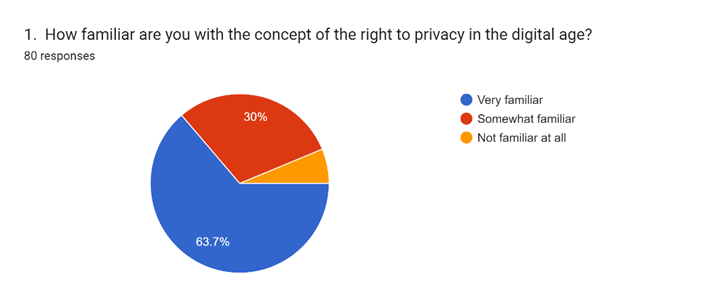
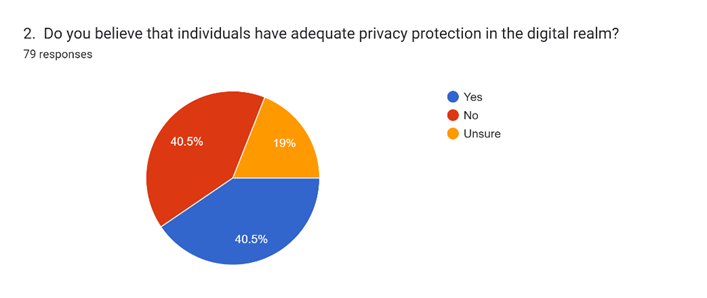
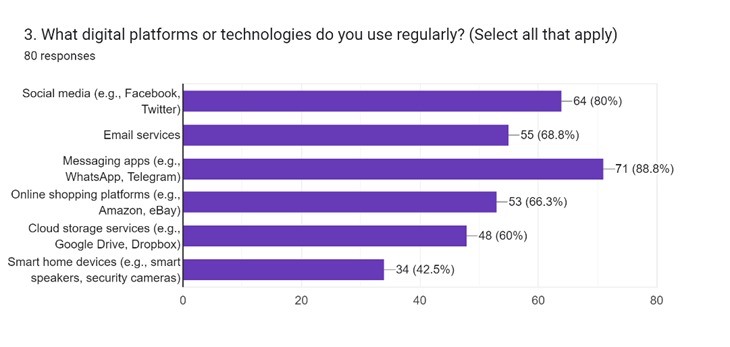
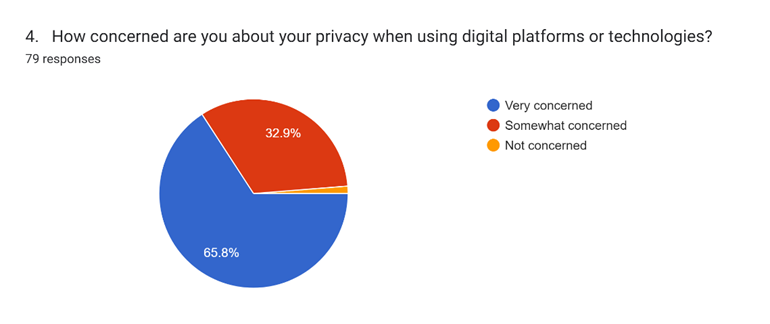
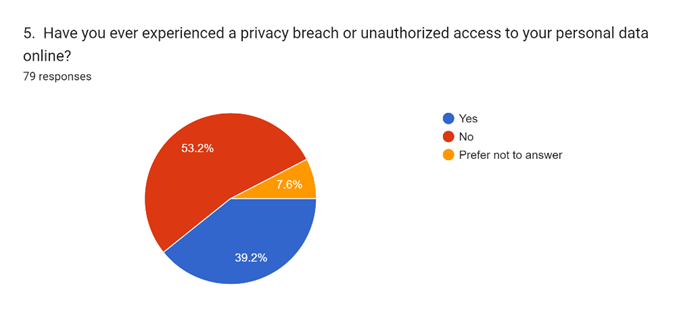
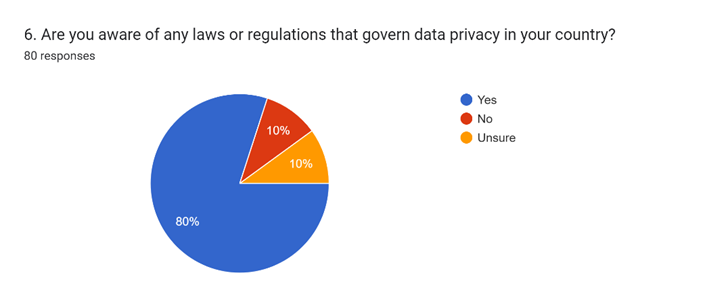
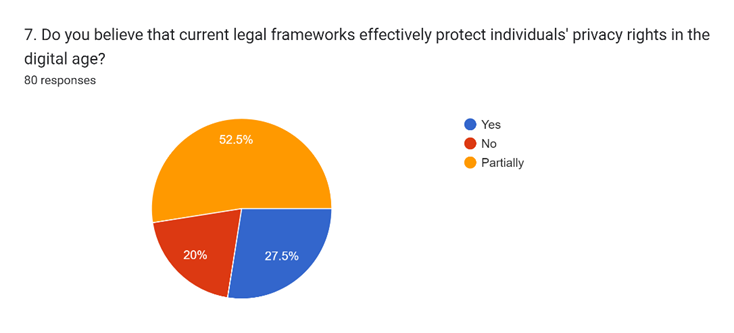
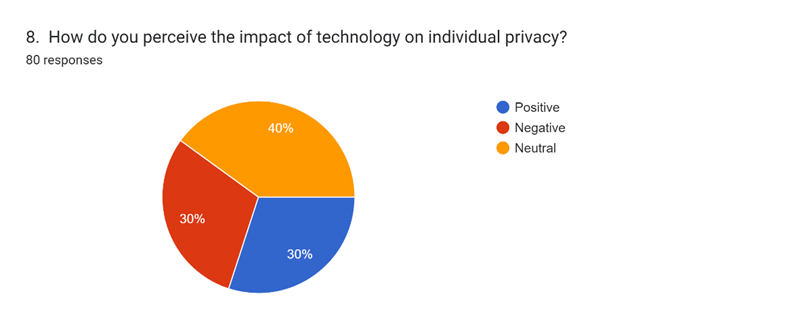
Based on the finding of my survey it is specified that most of the peoples are familiar with the concept of the right to privacy in the digital age. Most of the people were using most of the platforms on the daily basis but 40-40 is the percentage for the believe that individual have adequate privacy protection in the digital realm. After the survey, it is clear that people are aware of their right to privacy, also aware of the laws regarding that but still they have to use the technology because it is the need of every people in this digital age. As a result of my survey is that people were facing lots of challenges and threats towards their right to privacy and it is also clear that there is need to implement strong laws and regulation to protect the right to privacy of every individual in this digital era.
- Suggestions:
Based on the findings of the research, this section offers practical suggestions for addressing the legal implications and challenges associated with privacy in the digital age. It explores potential policy interventions, regulatory reforms, and technological solutions to enhance privacy protection and promote digital rights. There are some effective suggestions I got from the survey to enhance privacy protection in the digital age.
- The government needs to strengthen the privacy rights. Although governmental initiatives may not be enough. Supreme Court’s ruling in the K.S. Putt swamy which incorporated Right to Privacy into the realm of Art. 21 needs to be studied and reformed again.
- 1)Create complex Password
2)Update it regularly
3)Enable two factor authentication
4)Regular Software update
5)Avoid uses of application’s which are unsecured in your country
- Enhancing privacy protection in the digital age could involve implementing stronger data protection laws, promoting user awareness and education about privacy rights and online risks, developing privacy-preserving technologies like encryption and decentralized systems, and fostering transparency and accountability among companies and governments regarding their data collection and usage practices.
- Promoting transparency in data collection and usage practices, users should have more control over their data, and strong rules and regulations to hold companies accountable for mishandling personal information.
- Enhancing privacy in the digital age requires stronger regulations, privacy-focused design, user empowerment, data minimization, encryption, accountability, education, and international cooperation.
- Encrypt your data, two factor authentication and also VPN
- One important step that can enhance privacy protection is for individuals to be mindful of the information they share online and to regularly review their privacy settings on social media platforms. Stronger regulations and laws can also play a role in protecting privacy rights. Encouraging transparency and accountability from companies that collect and use personal data is crucial. Additionally, using encryption and secure communication tools can help safeguard sensitive information.
- Awareness about data privacy. There can be million statues for protecting privacy, but no statute can operate on 100% unless there is a civic sense amongst persons using digital platforms daily.
- Implementing stricter regulations on data collection and usage by companies, along with empowering users with more control over their personal information through transparent privacy settings and consent mechanisms.
- Govt. Should Stop interrupting in personal privacy
- User should be aware of the privacy regulations of the Application.
- Enhancing privacy protection in the digital age could involve implementing robust data encryption standards, enforcing stricter regulations on data collection and usage, promoting transparency about data practices, empowering users with more control over their data, and investing in technologies like differential privacy to anonymize data while still allowing for useful analysis. Additionally, educating users about privacy risks and best practices can help foster a culture of privacy-consciousness.
- With growing digitalization, the foremost priority should be framing and implementation of proper laws related to data breaching and data protection. Recently, Aadhaar data of more than 80 Crore Indians got leaked. The Government must take proper steps like building good digital infrastructure, acquiring better technology and also training and recruitment of good technical experts to safeguard data of citizens. Today, we are using mostly the apps developed by foreign companies and our data is stored on their servers outside India. Government must consider Data Localization. Also, the citizens must be given proper education and informed about their privacy rights. Apart from that, we as a user of technology, must also take proper measures like not sharing our personal details with unauthorized entities, not exploring unsafe websites, being aware about the local laws and using technology wisely.
- Conclusion:
In conclusion, this research paper highlights the complexities surrounding the right to privacy in the digital age. It underscores the importance of balancing individual rights with fostering transparency and accountability, and promoting ethical standards in data handling and privacy protection. The paper deals with all the challenges and legal frameworks which has to be important to implement for the protection the privacy rights of the individual. The paper concludes with a call for collaborative efforts from policymakers, technology developers, and civil society to safeguard privacy rights in an increasingly digitized world.
Submitted by –
Bhumika Rathore
3rd year BA.LLB (Hons) Student
Maharaja Sayajirao University
Baroda, Gujrat
[1] U.S. Const.
[2] Harvard Law Review, Vol. 4, No. 5. (Dec. 15, 1890), pp. 193-220.
[3] G.A. Res. 217 (III) A, U.N. Doc. A/810 at 71 (1948)
[4] Griswold v. Connecticut, 381 U.S. 479 (1965)
[5] Eisenstadt v. Baird, 405 U.S. 438 (1972)
[6] 20 U.S.C. § 1232g (1974)
[7] Privacy Act of 1974, 5 U.S.C. § 552a (1974)
[8] Telephone Consumer Protection Act, 47 U.S.C. § 227 (1991)
[9] Health Insurance Portability and Accountability Act, 42 U.S.C. § 1320d (1996)
[10] Children’s Online Privacy Protection Act, 15 U.S.C. § 6501 (1998)
[11] E-Government Act of 2002, 44 U.S.C. § 3501 (2002)
[12] California Consumer Privacy Act of 2018, Cal. Civ. Code §§ 1798.100-199 (West 2020)
[13] Quach, S., Thai chon, P., Martin, K.D. et al., Digital Technologies: Tensions in Privacy and Data, 50 J. Acad. Mark. Sci. 1299 (2022)
[14] Riley v. California, 573 U.S. 373 (2014)
[15] Babikian, J., Securing Rights: Legal Frameworks for Privacy and Data Protection in the Digital Era, 1 Law Res. J. 91 (2023)
[16] Digital Personal Data Privacy Act, No. 22 of 2023, Ministry of Electronics and Information Technology, Government of India
[17] Digital Personal Data Privacy Act, No. 22 of 2023, Ministry of Electronics and Information Technology, Government of India
[18] Regulation (EU) 2016/679 of the European Parliament and of the Council of 27 April 2016 on the protection of natural persons with regard to the processing of personal data and on the free movement of such data, and repealing Directive 95/46/EC (General Data Protection Regulation), OJ L 119, 4.5.2016, pp. 1–88
[19] California Consumer Privacy Act, Cal. Civ. Code §§ 1798.100-199 (2023)
[20] Boruah, J. & Das, B., Right to Privacy and Data Protection under Indian Legal Regime, 1 DME J. L. (2020)