
Abstract
Indian Democracy is considered to be the world’s biggest successful democratic experiment. It is based on the model of British Method of Parliamentary Democracy which is the source of inspiration for our constitution makers. The methods of elections in India is complex and costly procedure as the elections of various national level, state assembly level and local elections take place one after the other and the society is in the mode of elections after every few months and therefore it takes a lot of expenditure on the part of the parties to ensure smooth campaigning and advertisements of their electoral manifesto on various media platforms in order to censure a large coverage of their targeted vote bank.
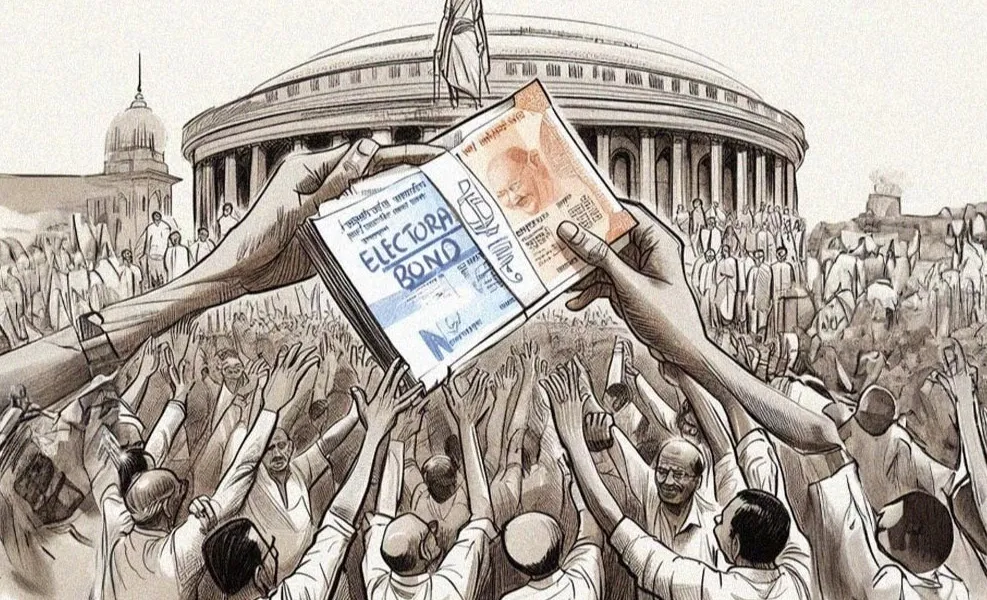
For the purpose of gathering funds from the public and corporate entities, the central government introduced electoral bonds scheme in 2017 and implemented it in 2018. They provide means for fund collection while maintaining the anonymity of the donor. But recently the Supreme Court struck down the 2017 Electoral bonds scheme as unconstitutional and therefore put a hold on the fund collection prior to the 2024 Lok Sabha Elections. It was struck down due to various reasons.
This research paper aims to explain the situation and purposes leading to the implementation of this scheme, it explains the entire scheme covering each and every minute details of the scheme and then investigates the grounds and perspective of the Apex Court while striking down this scheme. It also covers an angle of the views of different political parties on this development and reasons behind their favor or opposition to the scheme. At last, it will cover the view of the voters and how they see this development as a precursor to the upcoming mega event.
Keywords
Electoral Bonds, Democracy, Illicit funding, Legality, Money Laundering, Political Parties
Introduction
Electoral Bonds are the instruments of political donations in the Indian democracy. They were introduced in India in 2017 through a Finance Bill and were officially implemented in 2018. These bonds serve as a monetary instrument for the sale of bonds, providing liquid funds to the bond seller. Examples of such bonds include Government bonds and NHAI bonds, issued by the government to manage liquidity and regulate the flow of funds.
In the case of electoral bonds, India adopted them as a financial mechanism to enhance transparency in political funding. Electoral bonds enable individuals and businesses to make confidential financial contributions to political parties. Donors can acquire these bonds through cheque or electronic transfer from designated banks and then donate them to any registered political party. The recipient party can redeem these bonds in a specified bank account without revealing the donor’s identity. This process aims to provide anonymity to political donations while ensuring traceability through banking channels. Supporters of electoral bonds argue that by reducing political parties’ dependence on undisclosed income and unaccounted funds, they enhance transparency in political financing. However, critics raise concerns about the lack of transparency in donor identities, which could potentially allow undisclosed influence over political parties.
Why is this topic in limelight?
Recently the apex court in India invalidated a scheme that permitted anonymous contributions to political parties. The system that had been criticized for its lack of transparency was terminated on February 15th when the five-judge Supreme Court panel ruled that the electoral bond policy was illegal. In this paper we are going to understand the backdrop of this creation and will try to provide an in depth analysis of the judgment by understanding the issue with this creation.
Review of Literature
The conflict between Democracy and Electoral bonds is a complex issue that requires in- depth analysis. To fully understand the topic, it is important to examine the development and evolution of Indian Democracy. In the early 1950s, funding was regulated under the Representation of People’s Act1.
What is Political Funding and why it is needed?
Political funding refers to the ways in which political parties raise money to finance their election campaigns and ensure the smooth functioning of government activities. Unlike businesses, political parties do not generate income through economic activities. They rely on funding to promote their objectives, manifesto, and candidates through various means such as newspapers, magazines, billboards, radio, and social media.
Representation of People’s Act
1[29B. Political parties entitled to accept contribution.—Subject to the provisions of the Companies Act, 1956 (1 of 1956), every political party may accept any amount of contribution voluntarily offered to it by any person or company other than a Government company:
Provided that no political party shall be eligible to accept any contribution from any foreign source defined under clause (e) of section 2 of the Foreign Contribution (Regulation) Act2, 1976 (49 of 1976).
29C. Declaration of donation received by the political parties.—(1) The treasurer of a political party or any other person authorised by the political party in this behalf shall, in each financial year, prepare a report in respect of the following namely:—
the contribution in excess of twenty thousand rupees received by such political party from any person in that financial year;
the contribution in excess of twenty thousand rupees received by such political party from companies other than Government companies in that financial year.
2[Provided that nothing contained in this sub-section shall apply to the contributions received by way of an electoral bond.
After the first general election of 1952, there were widespread electoral reforms from the first experiment of democracy as there were a lot off learnings post first general elections. Post the Nehru- Shastri era, there occurred widespread changes and developments in the political fold of the republic. Post LBS, Indira Gandhi took over as the Prime Minister. In 1960s, when India’s modern democratic institutions were still developing, the 1971 report of the Wanchoo Direct Taxes Inquiry Commission3 and the 1964 report of the Santhanam Anti-Corruption Committee certainly found that politics was influenced by the presence of dark money.
SANTHAM ANTI CORRUPTION COMMITTEE REPORT 1964
This report is named after its chairman K. Santham4. This report was crucial to the formation of Central Vigilance Commission in order to enquire into governmental corruption. It gave a number of important recommendations such as:
1Representation Of the People’s Act 1951 (last visited 14thMarch 2024).
https://www.indiacode.nic.in/bitstream/123456789/2096/5/a1951-43.pdf
2Foreign Contribution (Regulation) Act 1976 (last visited 14thMarch 2024).
https://www.indiacode.nic.in/repealed-act/repealed_act_documents/A1976-49.pdf
3 Wanchoo Direct Taxes Inquiry Commission Report (last Visited 14thmarch 2024).
https://journals.sagepub.com/doi/abs/10.1177/0019556119720310?journalCode=ipaa
4 Santham Committee Report (last Visited 14thmarch 2024).
https://cvc.gov.in/screport.html
1. Declaration of Private property by civil servants, politicians and legislators.
2. A code of conduct for the ministers.
3. Political parties should maintain a record of the donations and funds received from the private sector and release them publicly
4. The creation of an Ombudsman-style organization modelled after New Zealand’s Parliamentary Commissioner for Investigations
In 1968, the then PM Indira Gandhi banned corporate political donations to political parties. This was viewed as the first major step against corruption in political fold of India. But the motive behind this move is often criticized on the grounds that it was a move to stop the funding to the Swatantra Party who advocated for free market money. This ban was an abrupt decision and no alternate arrangement was done for the donation purposes. It further complicated the problem of black money as there was no legal source of funds for parties.
WANCHOO DIRECT TAXES INQUIRY COMMISSION REPORT 1971
The Wanchoo Committee was given the task of investigating and making recommendations for legislative and administrative actions to counteract tax evasion, halt avoidance, find hidden funds, and lower direct tax arrears. The Wanchoo Committee calculated that the income avoided and tax losses avoided in 1968–1969 reached Rs 1400 crores and Rs 470 crores, respectively, using a modified version of Kaldor’s methodology. The Committee additionally approximated that the total quantity of illicit funds in the same year was over Rs 7000 crores. The Committee allows a deduction of 50% of the qualified donation amount up to 10% of an individual’s gross total income, with a ceiling of Rs 10,000, even though it opposes corporate donations to political parties. The report found that no strict reform in taxation can be introduced without solving the bond between black money and party financing.
The Congress witnessed a lot of factionalism during this period and it eventually resulted in the partition of Congress into two parties in 1970. In 1971, PM Gandhi won a sweeping majority and was elected as the PM. In 1974 the Supreme Court in its judgment Kanwar Lal Amar Nath Chawla5 case that, “part spending on behalf of a candidate should be included in calculating that candidates election expenses. In the context of this judgment the erstwhile Parliament amended RPA in 1975 that, “party and supporter expenditures not authorized by the candidate did not count towards the calculation of candidate’s election expenses.”
During this time period, there was a dictator who was believed to have a left-leaning stance due to funding from foreign agencies like the KGB. To address the corruption and irregularities caused by these leftist parties, reforms were implemented in 1976. These reforms included amending the Company Act in 1985 to allow corporate financing of political parties and implementing a full electoral cycle. In 1990, the Dinesh Goswami Committee recommended that the government partially cover the costs associated with elections. In 1996, amendments were proposed to the RPA to reduce the duration of campaigns. In 1998, the Election National Support Committee promoted free media broadcasts for political parties. The government also recommended cutting subsidies for institutions that failed to maintain proper financial records. In 2013, the Companies Law allowed companies to fund political parties with a maximum of 7.5% of their net profits In 2017, the Modi government introduced electoral bonds as a means of transparent and accountable political financing. These bonds were intended to reduce the influence of black money in politics.
5 Kanwar Lal Gupta vs Amar Nath Chawla 1975 AIR 308 (last visited 14thMarch 2024).
https://indiankanoon.org/doc/680015
However, the implementation of electoral bonds has become a widespread issue. The electoral bond transactions took place through the established banking system, which, according to the government, ensured that only authorized businesses employing white money could benefit from the plan.
This was the foundation of transparency that the government loudly praised. Consequently, a digital paper trail would enable the SBI—and perhaps the banking regulator—to ascertain which firms had donated to which political parties. Regretfully, this is where the transparency stops. The political party receiving the donation is not required to reveal the identity of the donor, and the donor is not required to record the donation. Therefore, every bond transaction is, well, extremely opaque. Put more precisely, opacity is essential to the design of the material and not just coincidental. Three significant changes were made to corporate donation regulations. Firstly, the previous limit on corporate donations was removed. Secondly, companies no longer had to disclose the specific details of their political contributions, instead only providing a total amount in their financial statements. Thirdly, the definition of a “foreign” corporation was expanded, allowing more businesses to legally donate to political campaigns. Unfortunately, these changes had a negative impact, as it opened the door for any individual, company, or group with a specific agenda to contribute financially.
As per the statistics, Electoral bonds worth over Rs 6,000 crore have been auctioned off in 12 rounds. Bonds valued at up to 55% were sold in 2019–20. Political parties are due to submit their 2019–20 audit reports in October 2020, thus it’s possible that we won’t know which parties profited from electoral bonds until then. Now since these bonds were perceived as problematic, it was taken to the Supreme Court for it to decide on its constitutionality.
Supreme Court Judgement
In a landmark unanimous judgment6, the Supreme Court on Thursday struck down as “unconstitutional and manifestly arbitrary” the electoral bonds scheme, which provides blanket anonymity to political donors, as well as critical legal amendments allowing rich corporations to make unlimited political donations.7
Grounds for striking down
I. Violation of the Right to Information:
The court held that the scheme by permitting anonymous political donations infringed upon the fundamental right to information under Article 19(1)(a) of the Constitution.
By holding the government accountable, it was made evident that this type of right goes beyond using one’s freedom of speech and expression and is crucial to strengthening participatory democracy. As such, it is more than just a means to an end; it is an objective in and of itself.
It highlighted how different levels of political participation are caused by the intimate connection between money and politics as well as economic inequality. Therefore, it makes sense to believe that giving money to a political party would lead to reciprocal arrangements.
II. Not Proportionately Justified to Reduce Black Money:
It stressed that the government relied on the proportionality criteria set forth in its 2017 ruling in the KS Puttaswamy case, which upheld the right to privacy, rather than the least restrictive method to achieve its purpose.
6
SBI vs Association for Democratic Reforms SC 267: 2024 INSC 195
(last Visited 14th March 2024).
https://main.sci.gov.in/supremecourt/2017/27935/27935_2017_1_1501_50573_Judgement_15-Feb-2024.pdf
7 Supreme Court Judgment On Electoral Bonds Analysis By Krishnadas Rajagopal Of The Hindu (last Visited 14th March 2024). https://www.thehindu.com/news/national/electoral-bonds-scheme-unconstitutional-sbi-should-reveal-the- details-of-donors-rules-sc/article67848211.ece
The Chief Justice cited two examples of such least restrictive approaches: the ₹20,000 cap on anonymous donations and the concept of Electoral Trusts, which facilitate the collection of political contributions from contributors.
The petitioners contended that there is no justification for limiting the fundamental right to information because the fight against black money cannot be connected to any of the permissible limitations listed in Article 19(2). The court agreed with their arguments.
III. Right to Donor Privacy Does Not Extend to Contributions Made
The court observed that money is usually contributed to political parties for two reasons: as a sign of support or as a trade- off .Consequently, contributions made are not covered by the right to donor privacy.
It did, however, draw attention to the reality that other facets of the community, such students, daily wage workers, artists, or educators, make just as much money as large enterprises and corporations do in terms of politics.
Consequently, the Chief Justice decided that the right to privacy about political affiliation does not extend to contributions made in order to influence policy. It solely includes gifts made with the intention of advancing political causes.
IV. Unlimited Corporate Donations Violate Free and Fair Elections:
Companies Act’s Section 182 modification, allowing firms to make unlimited political payments, was found to be manifestly arbitrary by the court. The clause allows Indian firms to donate money to political parties, subject to specific limitations. However, the Finance Act of 20178 brought about a number of important changes, one of which was the removal of the previous cap on corporate contributions to political parties, which stood at 7.5% of the average profits over the preceding three fiscal years.
Companies were no longer required to disclose in their Profit and Loss (P&L) statements the names of the political parties to which they had contributed.
He emphasized that Section 182 is incorrect in that it treats individual political contributions equally with corporate contributions, which are frequently made with the hope of receiving benefits in return.
IV. Amendment to Section 29C of RPA, 1951 Quashed:
The court overturned the amendment, stating that the original requirement to disclose contributions over ₹ 20,000 effectively struck a balance between the right of donors to privacy and the right of voters to know their financial sources, especially since contributions below this threshold were much less likely to influence political decisions.
Now the SC has asked the SBI to disclose the information and details of the electoral bonds by 12th March and SBI has sought an extension of the deadline for furnishing the statistics.
Research Methodology
This paper will explore the concept of Electoral bonds and political funding in India. It will rely on existing research and analysis, using sources like articles, journals, judicial verdicts and online information to provide a detailed examination of these topics.
8 Finance Act 2017 (last visited 14thMarch 2024).
http://164.100.158.198/rules_reg/Finance_Act_2017.pdf
Method
Literature Review: Provide a brief preview of the followed discussion. Begin with the explanation of the term ‘Political Funding’ and provide a synthesis on the purpose of party funding. Brief the reader about the RPA Act 1951. Analyze the reports of Wanchoo Committee 1971 and Santham Committee 1964. Provide a background to the evolution of the situation leading to the creation of electoral bonds.
Illustrate the introduction and working of the electoral bonds. Give the supporting statistics to solidify the claims. Explain the Status quo of the issue via the judgment of the Supreme Court.
Data collection: Collect data from various sources including but not limited to government reports, news and the activities which are taking place in the county. Organizations such as Press reports, Editorials, etc. have various information related to the instances providing a bridge between funding and the corrupted government action.
Data Synthesis: Systematically organize the entirety related to political funding and money laundering and make laws related to irregular circulation of money to stop such activities. This helps to give a logical flow to it and conclusions can be made.
Conclusion and Recommendations: Summarize all the key findings and developments, the supporting factors and links and propose recommendations to find a way of how illicit political funding can be curbed with the help of law, discuss the potential areas for research and policy implications.
SUGGESTIONS
Firstly, a transparent and independent cell shall be created which should be headed by five member panel consisting of the Election Commissioner, Prime Minister, Chief Justice, Leader of the Opposition in Lok Sabha and Leader of the Opposition in Rajya Sabha.
Secondly, the records of donations shall be made available to the general public and the entire process shall be regulated by the election commission along with Secretary level administrative officers. Each and every donation, be it small or big shall be visible to the public though masking the sensitive information and the donation shall be visible alongside the voter id of the donor thereby preventing the leakage of name, pan card details or any other confidential information.
A periodic audit and investigation shall be conducted in the donations which should be conducted under the authority the aforementioned five member panel.
Thirdly,
Fortifying lawful systems:
Campaign back laws: Actualize clear and comprehensive campaign fund laws that set up commitment limits, revelation necessities for givers and investing, and solid authorization components with punishments for infringement.
Anti-money washing (AML) laws: Guarantee solid AML laws are in put that require budgetary teach to recognize and report suspicious movement, counting potential political financing offenses.
Voter instruction: Teach voters around the significance of campaign back straightforwardness and the potential perils of unlawful financing.
Respectful society engagement: Enable respectful society organizations to screen political funds, raise mindfulness of unlawful financing, and advocate for changes.
CONCLUSION
This research paper talks about the strife between Discretionary Bonds and Popular government in India. Firstly, it understands the initial funding practices prior to the introduction of the practice of electoral bonds as during early days of Indian Democracy Representation of People’s Act (RPA) controlled political subsidizing until the presentation of Constituent Bonds in 2017.After the controversial introduction of the bonds, the Anonymous Bonds were presented to handle dark cash in political subsidizing. The creation of electoral bonds was criticized for being misty because it permitted mysterious gifts. Due to these allegations, legal help was sought in the highest court of justice where the constitutionality of the bonds was challenged. The Supreme Court of India struck down the Appointive Bond conspire in February 2024, citing a few reasons. Firstly, it damaged the Proper to Data as the personality of benefactors was not uncovered.
Besides, the Court contended that the plot did not proportionately address dark cash concerns. Moreover, the Court regarded boundless corporate gifts as unjustifiable for races. The judgment too subdued an alteration to the RPA that exempted Discretionary Bonds from divulgence prerequisites. The Court coordinated the State Bank of India (SBI) to yield subtle elements of bond deals to the Race Commission by Walk 12th, 2024. The SBI has asked an expansion. This paper goes from the pre electoral bond days, the circumstances leading to creation of the bonds, the issues related to the bonds and its current status which is being struck down. The entire story of this has been explained in the best possible and capable way. This paper can provide a proper timeline for the study of the subject for further research.
Name: Ayush Anand Purohit
College Name: ILS Law College Pune