
ABSTRACT
This paper delves into the impact of the Citizenship Amendment Act (CAA) on Indian secularism and the legal framework governing citizenship. It discusses the idea provided by the government for the Act, which is to offer protection to religious minorities facing issues in the three neighbouring countries to our nation India. The exclusion of Muslims from this act created a large amount of queries all about the discriminatory nature of the law and how it leans away from secularism as given by the Indian constitution. The historical context and evolution of the Indian citizenship laws as given by their developments from the colonial period to post-independence India. This paper will further it by exploring these ideological transitions and political motivations behind the legislation, also looking at the constitutional principles of secularism in India contrasting it with the CAA, and looking at how they align or conflict with each other. Seeing how it does or does not undermine the principle of equal treatment of all religions by introducing religion-based criteria for citizenship. The literature review will provide a comprehensive overview of the existing academic publications, and media reports on the Citizenship Amendment Act showcasing what they mentioned and how certain things within those could have been different to help further their arguments. In this, I will also give an overview of the legal challenges that have come up with regard to the CAA in the Indian courts, especially the Indian Supreme Court. Seeing how the arguments presented and the judgment given play a role. While also talking about certain constitutional rights like Article 14 ( right to equality), 15 (prohibition of discrimination on the grounds of religion, race, caste, sex, or place of birth), and 21 ( right to life and personal liberty) of the Indian constitution. Finally, I’ll end the paper by providing a comprehensive understanding of the Citizenship Amendment Act and its impact on Indian secularism and citizenship laws. Giving emphases on the importance of maintaining the secular fabric of our nation. I will also provide concise suggestions from my understanding of this act and how to make sure to avert any issues.
KEYWORDS
A few keywords that can be found within the paper are as follows:
- Citizenship Amendment Act (CAA)
- Indian Secularism
- Discrimination
- Constitutional Rights
- Legal Challenges
- Religious Minorities
- Citizenship Laws
INTRODUCTION
The Citizenship Amendment Act (CAA) enacted in December 2019 has created a large controversy within the nation of India. The great nation of India which is widely recognized and appreciated for its secular and non-discriminatory constitution which treats all in the same way has lost that. The Citizenship Amendment Act led to that disembarkment from secularism as it touched upon its core tenets. The act opens a gateway to Indian citizenship for undocumented immigrants from three countries namely Pakistan, Bangladesh, and Afghanistan, but not for all rather religious minorities of Hindus, Sikhs, Buddhists, Jains, Parsis, and Christians which exclude the Muslims. This selective inclusivity is what has hampered the secularistic idea of India, which with its constitution discouraged such actions.
The paper focuses on the intersection of citizenship laws and secularism in India. More specifically the objectives of the paper are to analyze the historical development of citizenship laws in India from the pre-independence to post-independence and present times as well. Further focusing on the provisions of the Citizenship Amendment Act, 2019, and its implications for the principle of secularism while also investigating the broader sociopolitical impacts of the CAA, including public protests, legal challenges, and international reactions.
The Citizenship Amendment Act, of 2019, is quite different from the previous laws. The pre-colonial era was referred to as a period where Indians were not considered their own but rather British subjects, as Indians were only provided with limited rights and lacked knowledge about it too. But all of this started to change with the Government of India Act, of 1935, which introduced a few portions of citizenship but primarily focused on administrative structures only, after independence in 1950 the Indian constitution laid the foundation for citizenship as articles ranging from 5 – 11 had defined the concept very clearly mentioning things such as who could be a citizen of India. Further, the Citizenship Act of 1955, was passed to start the constitutional facilities. This act has been amended quite a few times but some were a bit more important than others such as the 1986 amendment which gave way to more restrictive criteria for citizenship by birth and also the amendment of 2003, paved through with allowing overseas citizenship creating the concept of Overseas Citizenship of India (OCI) which allowed people who were a citizen of India at the time of, or at any time after 26th January 1950. This not only created the OCI but laid the foundation for the National Register of Citizens (NCR), which is a register that contains the names of Indian citizens.
Finally, the CAA was passed in the parliament in December 2019, amending the 1955 act, to open up citizenship for undocumented immigrants from Pakistan, Bangladesh, and Afghanistan, wherein the non-muslim minorities of those nations such as Hindus, Sikhs, Buddhists, Jains, Parsis, and Christians. This comes on a condition though which states that the migrants must have entered India on or before 31 December 2014.
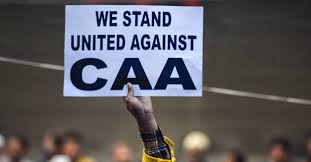
The Citizenship Amendment Act of 2019, has sides to it with one having proponents and others opposing the enforcement of this act on the grounds of it being discriminatory as the act duly mentions the religions from which the immigrants will be granted citizenship and it excludes Muslims, they oppose on the grounds of the right to equality and right to practice any religion of choice. While the proponents speak their viewpoints that it’s for the benefit of the minorities within those 3 nations. This in some sense is correct with all three countries being majorly Muslim and two out of the three nations are not endorsers of secularism, which creates a great sense of fear within the minorities. I dont encourage any one decision as not including Muslims in this act was something that does not showcase India’s secularism. After the enforcement of this act, large-scale protests broke out wherein more than 100 Muslims were killed and many injured too.
The CAA has had to face many legal challenges in Indian courts, where petitioners such as the Indian Union Muslim League led by advocate Kapil Sibal have filled them on the violation of Article 14 (right to equality), 15 (prohibition of discrimination on grounds of religion. Race, caste. Sex, or place of birth), and 21 (right to life and personal liberty) of the Indian constitution. The Supreme Court of India has a total of 230 petitions filed and are pending. Through a thorough analysis of legal texts, public opinion, published articles, journals, etc I would further continue to explore the Citizenship Amendment Act of 2019. Providing a discourse on citizenship, identity, and secularism in India.
RESEARCH METHODOLOGY
Doctrinal methodology, often referred to as “black letter law” methodology, is a traditional and highly respected approach in legal research. This methodology is primarily focused on the examination and interpretation of legal texts, such as statutes, regulations, and judicial decisions. In research papers, doctrinal methodology is used to provide a detailed analysis of legal issues. For example, in this paper the impact of the Citizenship Amendment Act on Indian secularism and citizenship laws, doctrinal research would involve:
- Analyzing the text of the Citizenship Amendment Act and related legal provisions.
- Reviewing judicial decisions interpreting the Act and its constitutional validity.
- Examining legal doctrines related to citizenship and secularism in India.
- Concluding the Act’s legal implications and its alignment with constitutional principles.
REVIEW OF LITERATURE
The Citizenship Amendment Act (CAA), 2019 has created a large amount of scrutiny in India by provoking large-scale protests and debates. It has led to a great amount of articles being published that provide different viewpoints on the Act and debate. The debate in the matter is on the fact that the act is discriminatory and is against the very spirit of the constitution of India. Thus, within this section of the paper, I will be extending my critical analysis over a few articles that were published. These articles have differing or somewhat similar outlooks on the Citizenship Amendment Act and will help in furthering my research paper.
- Bhaumik Aaratrika, 2024
This specific article is by The Hindu wherein they talk about providing a comprehensive study of the CAA, explaining its legalities, the current position of the judicial proceedings, and how everything changed with its implementation. The Citizenship Amendment Act provides a pathway to undocumented immigrants from six non-muslim religions and three separate countries. This pathway is crucial as it strays from the secular notion of our country.
By pointing out the ongoing Supreme Court challenge of this act based on violation of Article 14 of the constitution which guarantees equality before the law, they explain the selective criteria for citizenship being discriminatory. It further mentions the exemption of tribal areas in Assam, Meghalaya, Mizoram, and Tripura, which protects these areas from the changes that the Citizenship Amendment Act might bring forth. But in regard to this exception, the article questions the uniform application of laws in our nation as well. The article in a very articulate manner presents its viewpoints by talking about the amendments on its flaws while providing support by mentioning points like how Rohingyas from Myanmar and Tamil Hindus from Sri Lanka are excluded from this and only Muslim majority nations were picked.
- Staff Al Jazeera, 2024
The following publication of Al Jazeera provides us with a perspective on the Citizenship Amendment Act, wherein they mention its discriminatory nature and the socio-political turmoil it created. They start by providing the Citizenship Amendment Act provisions and explaining it. Overall the article argues that the CAA’s exclusion of Muslims from the citizenship process has not been received well, with it leading to large-scale protests as well. Similar to the previous article they also mention points of Rohingyas not being included but further increase the list by mentioning Ahmadiyyas and Hazaras. The article talks about Article 14 of the Indian constitution taking place which I believe further pushes their point and strengthens it. Taking a different approach they look at this as a politically motivated move that polarizes voters ahead of the national elections that were to take place. Looking at this as a socio-political move the article raises its concerns about the potential link between CAA and the National Register of Citizens (NCR), fearing how it may be used to disenfranchise Muslims altogether by marking them as illegal immigrants, but on the other hand granting the citizenship to non-muslims through the introduction of CAA. This article has provided great points creating a strong footing for its argument, but in my opinion, the article could favor more with a little more inclusion of the voices of the proponents of the CAA to create a little balance.
- M. Kakkar Jhalak, 2020
This piece by Lawfare Media explains the contentions surrounding the Citizenship Amendment Act and its broader implications. The article opposes CAA on the grounds that it has led to the introduction of religious criteria for citizenship again by touching upon Article 14 of the constitution. But mainly the paper addresses the socio-political unrest triggered by the CAA in terms of the large-scale protests erupting across the country. It mentions the violence and deaths that had occurred due to these protests, and the tensions and division too that have been created because of the Citizenship Amendment Act. While also scrutinizing the implementation of this act right before the elections in India to possibly rally up the electorate.
The article mentions a few points that the government had mentioned in its defence of this Act and what I believe is that the article would have benefitted more from an in-depth analysis of the government’s defence of the Citizenship Amendment Act, 2019. It mentions briefly how the government views this act as a humanitarian measure to protect persecuted minorities. While it should have worked on the point of government’s defence the article in a very vast manner explains that any laws being introduced within a country are to be formulated and implemented on the basis of the constitution it withholds rather than being made on one’s self ideology.
SUGGESTIONS
The Citizenship Amendment Act (CAA) of 2019, which was started with humanitarian objectives faced widespread criticism for its discriminatory nature and its conflicting nature too with the secular principles of the Indian constitution. In this section of the research paper, I would like to put forth certain suggestions that in all likelihood may improve the effectiveness of the act and ensure its proper acceptance and implementation within the country. By mainly ensuring equal treatment for all religions and addressing the humanitarian concerns of the minorities.
One of the most required changes is the inclusion of Muslims in the Act, this is one the major reasons why the protests and concerns had risen with regards to the act since it had excluded Muslims from the eligibility list. India is a secular nation as prescribed within the constitution, it must uphold that and include the Muslim sectors such as the Ahmadiyyas, Hazaras, and Shias, who have faced significant persecution within their nations. With this inclusion, one of the most prominent features of our constitution will be upheld once again the principle of equality before the law stated under Article 14 of the Indian Constitution.
The current act has limited the eligibility of undocumented immigrants to only from three nations namely Pakistan, Bangladesh, and Afghanistan. But as we know minorities are not only present in these three nations but rather across many more. Such as in countries like Myanmar, Sri Lanka, and many more where such issues are also very much prevalent. Increasing the geographical reach of this act will address the proposed humanitarian concerns even more greatly.
The assumed linkage between the Citizenship Amendment Act and the National Register of Citizens leads to the fear amongst Muslim communities largely as they may face disenfranchisement. In order to decrease such feelings of unease the government should issue clear assurances that no such conjunction between the CAA and NCR will be used to target any specific community. With clarity in the procedures, it should establish that it is not to discriminate against a specific community.
In my opinion, to ensure the safety of all judicial oversight must be strengthened at a large scale so that a check on the CAA’s compliance with the constitutional principles can be ascertained. By creating a committee picked by the citizens in order to ensure no governmental bias is being used members can be selected to prevent such discriminatory practices.
Addressing the needs of the refugees is a must, by providing basic healthcare, housing, education, and legal aid to these refugees irrespective of their religions. Not only that but such actions should be framed with due care and diligence and should be collaborated with international organizations like the United Nations High Commissioner for Refugees (UNHCR) to ensure their well-being and proper integration into the society.
The government is made by the people for the people and of the people of a democratic country. The elected government should not take such huge steps without obtaining proper consent from the citizens of the nation. Such acts impact every person on a very large scale and thus such important implementations should be done after feedback from the people. Leaders of each community shall form a committee or at least gather the feedback from their communities which shall be compiled and provided to the government after which the action of implementation shall be taken by making sure the act satisfies every group equally.
Finally, as mentioned before India should make ways and relations with international bodies it should go ahead and collaborate with international human rights bodies and adhere to the global human rights norms in its citizenship policies. With that, it can implement the act with policies that are just and fair.
CONCLUSION
The Citizenship Amendment Act of 2019 has largely impacted India’s secular status and its principles which led to a nationwide protest and unrest among many. The act selectively granted citizenship to 6 non-muslim minorities from three nations making it a discriminatory act that goes against our constitution. The historical evolution of the Indian citizenship laws reflects a commitment to inclusivity and secularism. Fears rising among many due to linkages between the CAA and the National Register of Citizens giving it the potential for abuse of power. It created a feeling of unease. The main purpose of this paper was to clearly understand the Citizenship Amendment Act of 2019 and how it was a political move. We identified them with the published articles. One of the major questions of this paper was to see if the act was discriminatory and unequal which as we went on found out that it mostly was. Now finally, In conclusion, while the CAA aims to address humanitarian needs, it must do so in a manner that upholds India’s constitutional values. Following the suggestions provided by me and how the articles explore this act, it can be implemented again which will ensure that it is accepted by all. Thus ensuring the secular fabric of the nation.
ARMAAN ARORA, O.P. JINDAL GLOBAL UNIVERSITY