
ABSTRACT
Marital rape stands as one of the most despicable acts within the confines of India. It should not be regarded as anything less severe than rape itself; rather, it constitutes a distinct form of such violence. Married women predominantly suffer its brutal consequences. This form of abuse poses a significant threat to gender equality in the country and has persisted through generations, wreaking havoc on society. Unfortunately, Indian society has largely turned a blind eye to this issue, largely due to ingrained cultural norms and societal pressures. Even the legislative body, entrusted with the responsibility of safeguarding the nation’s well-being, has shown little interest in addressing this grave injustice. While the judiciary offers some hope, its hands are tied as the creation of laws falls under the purview of the legislature. Presently, the laws pertaining to marital rape in India are insufficient and fail to adequately address the magnitude of the problem. Urgent action is needed to enact robust legislation capable of tackling this heinous crime head-on.
Keywords: Rape, Marital Rape, Indian Jurisprudence, Indian Judiciary, India, Society
INTRODUCTION
For centuries, the sanctity of marriage has served as a veil, obscuring a brutal reality: the existence of marital rape. In India, where the institution of marriage holds deep social and cultural significance, this hidden form of sexual violence carries unique complexities and poses a profound challenge to legal and societal frameworks. This essay delves into the murky waters of marital rape and Indian jurisprudence, examining its prevalence, legal ambiguities, social barriers, and ongoing fight for recognition as a criminal offense.
We begin by shattering the silence surrounding marital rape, acknowledging the devastating physical and psychological trauma it inflicts on countless women. We then dissect the inconsistent and controversial legal landscape, delving into the infamous Exception 2 of Section 375 of the Indian Penal Code, which effectively exempts husbands from rape charges against their wives above 18. This exemption stands in stark contrast to international legal norms and ignites debates about gender equality, bodily autonomy, and the very definition of consent within marriage.
Further, we explore the entrenched social and cultural attitudes that normalize and perpetuate marital rape in India. Patriarchy, notions of marital duty, and societal stigma often silence victims and prevent them from seeking justice. We examine the role of family dynamics, community pressure, and limited access to legal resources in creating an environment where reporting such crimes remains incredibly difficult.
Finally, we turn our gaze towards the ongoing struggle for justice. We highlight the tireless efforts of activists, NGOs, and survivors who are challenging the legal and social status quo. We analyze landmark judgments and ongoing petitions in courts that seek to criminalize marital rape and provide much-needed protection to victims. This analysis considers both the achievements and limitations of these efforts, acknowledging the long road ahead towards achieving true gender equality and a society free from this form of violence.
By traversing through these intricate layers, this essay aims to not only raise awareness about the critical issue of marital rape in India but also to foster a nuanced understanding of the legal, social, and cultural complexities surrounding it. As we move forward, let this exploration pave the way for meaningful dialogue, legislative reforms, and ultimately, a future where all individuals, regardless of marital status, have the right to bodily autonomy and freedom from violence.
History
In most of the countries of the world, marital rape is prohibited and a punishable offence, however that is not the case with India. In India, there are no effective laws to tackle the menace of marital rape. Ancient Hindu texts like Manusmriti, while not explicitly condoning marital rape, placed the wife under the complete control of the husband, creating a power imbalance conducive to abuse. The concept of a wife’s consent within marriage wasn’t recognized, further solidifying the husband’s authority.
Throughout its history, Indian society has consistently upheld patriarchal structures, wherein men hold dominant positions. Consequently, marital rape is often not condemned within Indian culture, as its primary victims are women. Had men been the primary targets of this form of abuse, it is likely that it would have been prohibited long ago. Regrettably, there is minimal support within India for the criminalization of marital rape, with only a few advocating for its prohibition. The pivotal role of society in combatting social injustices cannot be overstated. Unless a society actively opposes a particular evil, its eradication remains elusive. In the case of India, the persistence of marital rape can be attributed to the society’s reluctance to denounce it, allowing this issue to persist unchecked.
The Indian Penal Code (IPC) of 1860, drafted under British rule, included rape as a criminal offense. However, Exception 2 to Section 375 notoriously exempted “sexual intercourse by a man with his own wife, the wife not being under fifteen years of age,” from the definition of rape. This exemption was based on the Victorian-era notion of marriage as a sacred union and a wife’s duty to submit to her husband. Despite independence in 1947, Exception 2 remained deeply embedded in the legal system. However, voices against marital rape began to emerge. The 1983 Law Commission report recommended abolishing the exemption, but it was not implemented. Landmark cases like Sheela Barse and State of Maharashtra Vs. Khairnar (1998) brought attention to the issue, challenging the exemption’s validity.
The 21st century saw growing activism and public discourse around marital rape. The brutal gang rape and murder of Nirbhaya in 2012 further ignited calls for reform. In 2013, the Verma Committee recommended removing Exception 2, leading to the Criminal Law Amendment Act, 2013, which included marital rape within the definition of rape for certain categories of wives, but the controversial exemption remained for others. Despite ongoing legal challenges and public protests, Exception 2 persists, creating a two-tiered system of justice for married women. Activists continue to fight for its complete abolition, citing violation of fundamental rights and gender equality. Landmark judgments like Justice AP Shah Vs. Union of India (2018) declared the marital rape exemption unconstitutional, but its applicability remains under debate.
Legal Scenario
In India, laws exist to address and punish perpetrators of rape, as outlined in Section 376 of the Indian Penal Code. However, when it comes to the specific issue of marital rape, there is a notable absence of dedicated legislation. Section 375, Exception 2, of the IPC is the lone provision that offers some level of protection to victims of marital rape. This clause stipulates that if a husband engages in sexual intercourse with his wife who is below the age of 15 years, he can be charged with rape. However, this age threshold was amended to 18 years by the Supreme Court of India in the landmark case of Independent Thought Vs. Union of India. Consequently, under current legal precedent, if a husband sexually assaults his minor wife, he can be prosecuted for rape, but there exists no legal recourse for adult wives in similar circumstances. This legal framework thus offers only partial safeguarding to victims of marital rape, lacking comprehensive protection against this pervasive form of abuse.
In 2012, a significant shift in discourse occurred when a committee led by Justice J.S. Verma (Retd.) recommended the criminalization of marital rape, diverging from past discussions. This committee was established amidst nationwide protests advocating for more effective criminal laws to address egregious sexual assaults against women. The resulting ‘Report of the Committee on Amendments to Criminal Law’ (commonly known as the ‘J.S. Verma Report’) highlighted the necessity of criminalizing marital rape. It proposed two key recommendations: firstly, the removal of the exception clause, and secondly, the assertion that marital or similar relationships should not serve as a defense or factor in determining consent or sentencing. The report critiqued the outdated notion of women as property and emphasized that in modern marriages, such immunity for perpetrators, especially husbands, is untenable.
Subsequently, the Criminal Law Amendment Bill, 2012, was drafted, aiming to broaden the scope of sexual offenses by replacing the term ‘rape’ with ‘sexual assault.’ However, this bill did not incorporate provisions to criminalize marital rape, ignoring the recommendations of the J.S. Verma Report. The Parliamentary Standing Committee on Home Affairs, in its 167th Report, reviewed the Amendment Bill, 2012, and conducted public consultations. Despite suggestions to amend Section 375 by removing the exception clause, the Standing Committee declined to adopt this recommendation.
The reluctance to criminalize marital rape is not confined to the legislative branch but also extends to the judiciary. While there haven’t been cases explicitly affirming the constitutionality of the exception clause in Section 375, there have been instances where courts have sidestepped this issue. Some courts have dismissed petitions seeking to strike down this exception clause or have utilized it to evade addressing whether a husband raped his wife.
In line with the prevailing approach, the Supreme Court declined a woman’s petition to recognize marital rape as a criminal offense, asserting that her plea was deemed a matter of ‘personal’ rather than ‘public’ concern. The petitioner, an executive residing in Delhi, had endured marital rape and endured ongoing sexual violence perpetrated by her husband. Regrettably, due to the absence of legal provisions in the Indian Penal Code addressing marital rape, she was unable to seek redress through formal channels.
However, the Gujarat High Court emphatically declared that the act of rape remains unchanged regardless of the perpetrator’s relationship to the victim, firmly rejecting a bail application lodged by a woman accused of involvement in her daughter-in-law’s ordeal of rape and domestic abuse at the hands of her husband and in-laws.
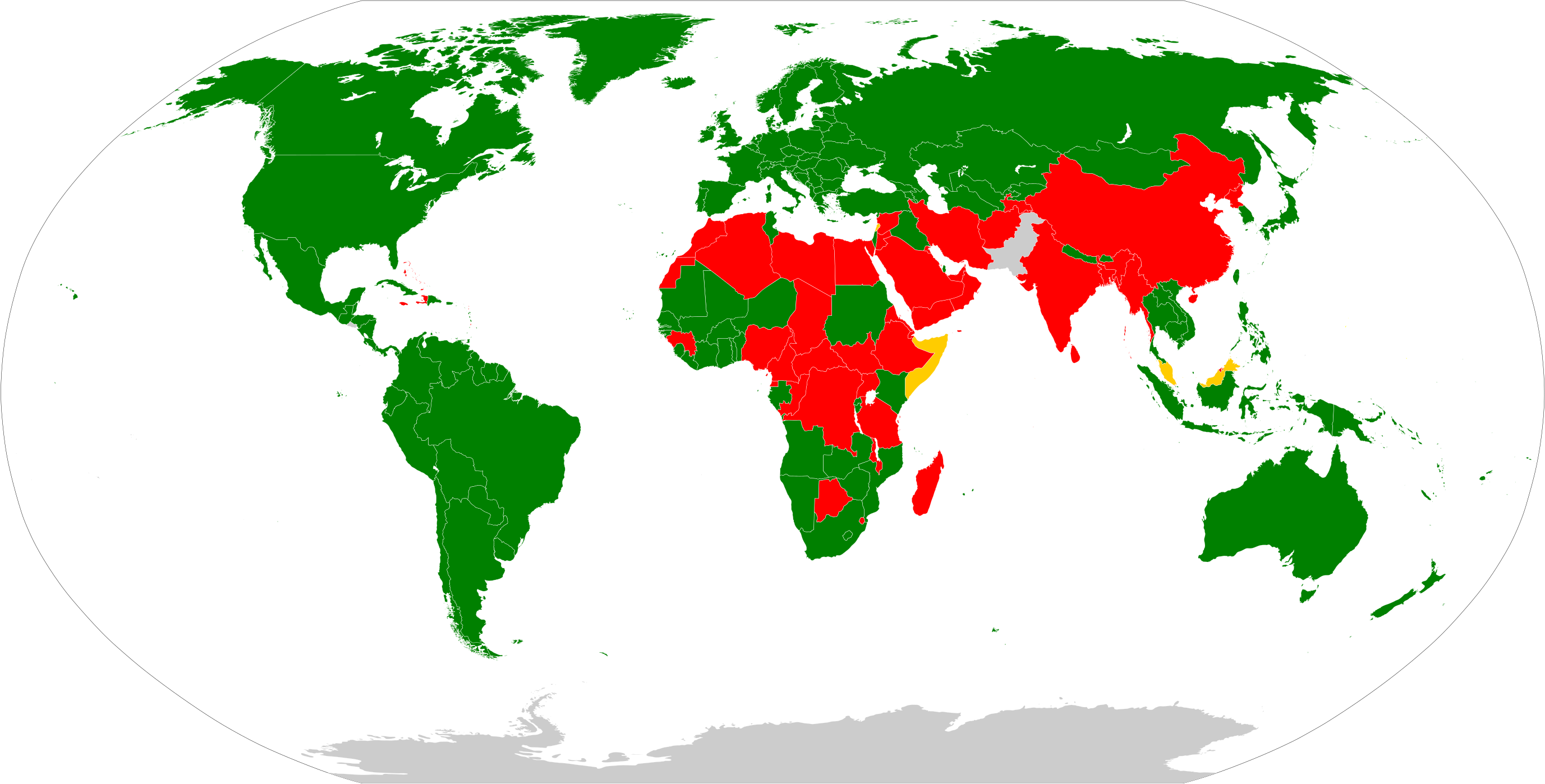
The Supreme Court of India is on the verge of issuing a significant ruling that could criminalize spousal rape. A series of petitions challenging the current legal exemption for marital rape have been under review in recent months. If the judgment aligns with expectations, India may join the ranks of nearly 150 other countries that have already outlawed marital rape.
The prevalence of marital rape in India is troubling, as highlighted by data from the latest National Family Health Survey, which indicates that a significant portion of married women who have experienced sexual violence cite their current or former husbands as perpetrators.
While civil remedies for marital rape exist within the Protection of Women from Domestic Violence Act of 2005 and matrimonial law, which allows for divorce and judicial separation on the grounds of cruelty, the criminal law provision on rape includes an exception for husbands. Exception 2 to Section 375 of the Indian Penal Code explicitly excludes sexual acts by a man with his wife from the definition of rape. Furthermore, Section 376B of the Indian Penal Code deals with a husband’s rape of his separated wife, albeit with a lesser penalty compared to other cases of rape.
In 2016, the Union Minister for Women and Child Development argued against enacting a law against marital rape, citing marriage as a ‘sacrament’ and pointing to factors such as poverty, illiteracy, and religious beliefs.
In 2022, during proceedings before the Delhi High Court, X (formerly Twitter) observed a phenomenon dubbed as a ‘marriage strike’ among men in response to the potential removal of the marital rape exemption. These men expressed a sense of entitlement to sexual relations within marriage, even if non-consensual, and threatened to boycott marriage if the exemption was eliminated. In contrast, women responded with the hashtag “May #Marriage Strike Remain for Centuries.”
The debate highlighted the issue of bodily autonomy and sexual integrity of married women in relation to their husbands. Removing the marital rape exemption would establish a normative standard for acceptable behaviour within marriage, aligning with the constitutional guarantee of fundamental rights in India.
Marital rape is a serious felony that violates a woman’s equality and rights under the Indian Constitution (Articles 14 and 21). This is the main argument in favor of making it a criminal offense. International standards (General norms 19 and 35) that see sexual and mental injury as discriminatory and a violation of basic rights are also at odds with this marital impunity.
International accords like the Universal Declaration of Human Rights and the International Covenant on Civil and Political Rights, which call for equal protection for all individuals regardless of marital status, are also broken by the Indian government’s stance on marital rape. In essence, marital rape creates unfair distinctions between married and single women. Women’s basic and human rights are violated when they are the victims of violence.
The Delhi High Court, in Union of India Vs. RIT Foundation, ruled that the government should reevaluate changing the law to criminalize marital rape. The legal protection of women in violent marriages and marital rape were topics of discussion for the Delhi High Court. Section 375 of the Indian Penal Code (IPC), which shields men from rape charges if their wives are over 15, was challenged by the RIT Foundation as unconstitutional.
The Delhi High Court, citing the Section 375 exception as a violation of married women’s rights to life and personal liberty, directed the government to investigate changing the law to criminalize marital rape.
Despite the fact that this case was a significant step toward making marital rape a crime in India and brought attention to the need for legislative change, as of the most current update, marital rape is still unpunished in the nation.
Furthermore, Kavita Vs. State of Haryana, dealt with the issues of marital rape and the necessity of providing women in violent relationships with legal protection. In this instance, the Punjab and Haryana High Court determined that it was necessary to investigate the discriminatory nature of the Indian Penal Code (IPC) provision that shields a spouse from rape allegations.
RESEARCH METHODOLOGY
The methodology of this research is conceptual, based on intellectualization and bespeaks the prospects of and developments in Marital rape and Indian Jurisprudence. The study uses a descriptive and critical approach to analytically review existing literature and routine excepts and write in furtherance of them. The study takes a doctrinal and analytical approach.
This study is based on secondary methods of research. Data analysis technique is qualitative, owing to research of affairs as they exist.
REVIEW OF LITERATURE
(Zehra, 2023) in their study critically analyses the concept of marital rape and its legality in different countries. It was observed that Marital rape has been recognized and criminalized in several countries worldwide, and it is an evident violation of human rights. However, India has not yet done so, with its legal system shielding husbands from accusations of rape if their wives are older than fifteen. This omission has drawn harsh criticism for being discriminatory and violating women’s constitutional rights.
(Sabhapandit, 2023) argued in her study that selective state penetration exists notwithstanding the judiciary’s reluctance to introduce constitutional rights into the private domain in cases of marital rape. Consider the spousal rights reparation imposed by the court. The main idea of Section 9 of the Hindu Marriage Act, 1956 is that a court may issue a restitution judgment in the event that a husband and wife do not live together “without reasonable excuse.” Women are disadvantaged by this part as they are frequently compelled to get back into married relationships with their spouses.
(Yadav & Dalal, 2023) highlighted how in Indian society, marital rape has never been acknowledged as a significant issue and is rarely challenged due to various societal factors. The stance of the Indian legislature mirrors this indifference, despite being entrusted by the Constitution with the crucial responsibility of enacting laws for the nation’s safety, security, and progress. Unfortunately, the legislature shows no inclination to address the scourge of marital rape. While the Indian judiciary offers a glimmer of hope, its ability to act is limited since lawmaking falls within the purview of the legislature, not the judiciary. Consequently, India lacks effective laws specifically targeting marital rape, and those that do exist are insufficient to combat such a heinous crime. Urgent action is needed to enact robust legislation to address this issue head-on in Indian society.
The review also identifies gaps and challenges in addressing marital rape within the Indian legal system. Scholars critique the limited scope of legal reforms and enforcement mechanisms, citing institutional barriers, judicial bias, and societal stigma as hindrances to justice for survivors. Furthermore, the literature calls for interdisciplinary research that integrates legal analysis with sociocultural insights, intersectional perspectives, and survivor narratives to inform policy advocacy and social change.
METHOD
This research employs a qualitative approach to explore the intricate aspects of marital rape, aiming to gain a nuanced comprehension of its legal and ethical dimensions. Qualitative methodology is preferred for its aptness in examining complex and context-specific phenomena, facilitating thorough analysis and interpretation of both primary and secondary sources.
The data collection process involves a comprehensive review of scholarly literature, legal statutes, regulatory frameworks, and relevant case studies concerning marital rape and various legal perspectives. Academic literature offers insights from diverse fields such as law, ethics, and sociology, providing varied viewpoints on the subject. Legal statutes and regulatory frameworks serve as foundational knowledge for understanding the legal landscape surrounding marital rape.
During the analysis phase, key themes, patterns, and conflicting viewpoints are identified across the collected data sources. This entails a systematic and rigorous approach to coding and categorizing the data, enabling the recognition of recurring themes and emerging patterns. Through iterative analysis, the researcher aims to uncover underlying trends, controversies, and complexities inherent in the phenomenon of marital rape.
Moreover, the analysis process involves critically examining the nuances and implications of the identified themes and patterns. This includes assessing their alignment with legal principles and societal values, as well as identifying potential areas of disagreement or controversy. By engaging in reflexive analysis, the researcher acknowledges their own biases and assumptions, thereby enhancing the validity and reliability of the research findings.
SUGGESTIONS
The Delhi High Court, in a ruling, rejected a plea to criminalize marital rape, asserting that the drafting of laws falls within the purview of the legislature rather than the judiciary, which is primarily concerned with interpreting existing laws. This rationale is regrettable, particularly in light of the Supreme Court’s clear pronouncement in the case of State of Maharashtra Vs. Madhukar Narayan, affirming every woman’s entitlement to sexual privacy and rejecting any notion that her privacy can be violated at will.
After thoroughly examining the various facets of marital rape and its impact on Indian society, it is evident that marital rape is a significant social issue that urgently needs to be addressed. To achieve this objective, several vital suggestions are proposed:
- Full criminalization of marital rape in India.
- Equal legal protection against marital rape for both minor and adult married women, without differentiation.
- Imposition of the same punishment for rape and marital rape.
- Repeal of Exception 2 of Section 375 of the Indian Penal Code, which currently treats marital rape as an exception to the offense of rape.
- Application of the provisions of the Indian Evidence Act to marital rape in the same manner as they apply to rape cases.
- Establishment of gender-neutral laws regarding marital rape.
- Implementation of adequate safeguards in marital rape laws to prevent misuse, including proper investigation before the arrest of the accused husband and protection of the accused’s family members from harassment.
- Provision for penalties on individuals who falsely accuse others of marital rape.
- Recognition of marital rape as a specific ground for divorce.
- Establishment of special fast track courts across India with female judges and staff to handle marital rape cases, while ensuring that media trials of such cases are prohibited.
By implementing these suggestions, India can take significant steps toward eliminating the scourge of marital rape and ensuring justice for victims in a fair and efficient manner.
CONCLUSION
The debate on marital rape holds immense significance in advocating for substantive equality for married women, who often find themselves confined to their homes in public and legal discussions. It is essential to acknowledge that this represents a significant gap in current criminal law, contradicting constitutional provisions that guarantee women equality and autonomy. As I have consistently demonstrated, there have been strong political, legal, and cultural arguments against criminalization. I have carefully analyzed the validity of these arguments, which are often intertwined with notions of family, marriage, and women’s societal roles. I have shown that all arguments against criminalization lack legal merit. Moreover, I have argued that the exemption clause in S.375 of the IPC is unconstitutional as it fails the equality test outlined in Article 14. Additionally, I have highlighted the absence of effective legal alternatives and emphasized that our focus should be on criminalizing marital rape rather than seeking alternatives. Furthermore, I have pointed out that cultural reluctance to accept marital rape should not serve as a justification for its non-criminalization.
According to the UN, educating boys and men to regard women as valuable partners in life, societal development, and the pursuit of peace is just as crucial as implementing legal measures to safeguard women’s human rights. While one of the primary aims of matrimonial laws is to preserve marriages and confidence in the institution, this objective cannot be pursued at the expense of violating women’s fundamental human rights.
In conclusion, it is evident that the solution does not lie in refusing to enact necessary amendments out of fear of potential misuse by society. Instead, it requires a more effective implementation of the law. The foremost challenge in our society is the proper enforcement of laws, and therefore, the law must be implemented to protect victims of marital abuse rather than being misused as a tool for harassment. It is essential to distinguish genuine cases from frivolous ones, and it is the responsibility of law enforcement agencies to conduct thorough and proper investigations. Marital issues warrant the necessary relief and protection under the law. The true test lies in understanding the purpose and rationale behind criminalizing marital rape, rather than allowing the law to be trivialized through its misuse.
REFERENCES
1. Marital Rape: Does Marraige Mean Automatic Consent? (2023), Retrieved from – https://voiceofbarristers.com/marital-rape-in-indian jurisprudence/#:~:text=This%20exception%20explicitly%20makes%20rape,(Articles%2014%20and%2021).
2. Criminalising Marital Rape in India (2023), Retrieved from – https://www.theindiaforum.in/law/criminalising-marital-rape-india.
3. Marital Rape in India – A Critical Study (2021), Retrieved from – https://papers.ssrn.com/sol3/papers.cfm?abstract_id=3847118
4. Marital Rape – Current Legal Scenario in India in Comparison to the World (2020), Retrieved from – https://www.legalserviceindia.com/legal/article-3759-marital-rape-current-legal-scenario-in-india-in-comparison-to-the-world.html
5. Criminalisation of Marital Rape in India: Understanding its Constitutional, Cultural and Legal Impacts (2018), Retrieved from – http://nujslawreview.org/wp-content/uploads/2018/01/11-1-Raveena-Rao-Kallakuru-Pradyumna-Soni.pdf
Author:
Arnav Hardas
Symbiosis Law School, Pune