
ABSTRACT
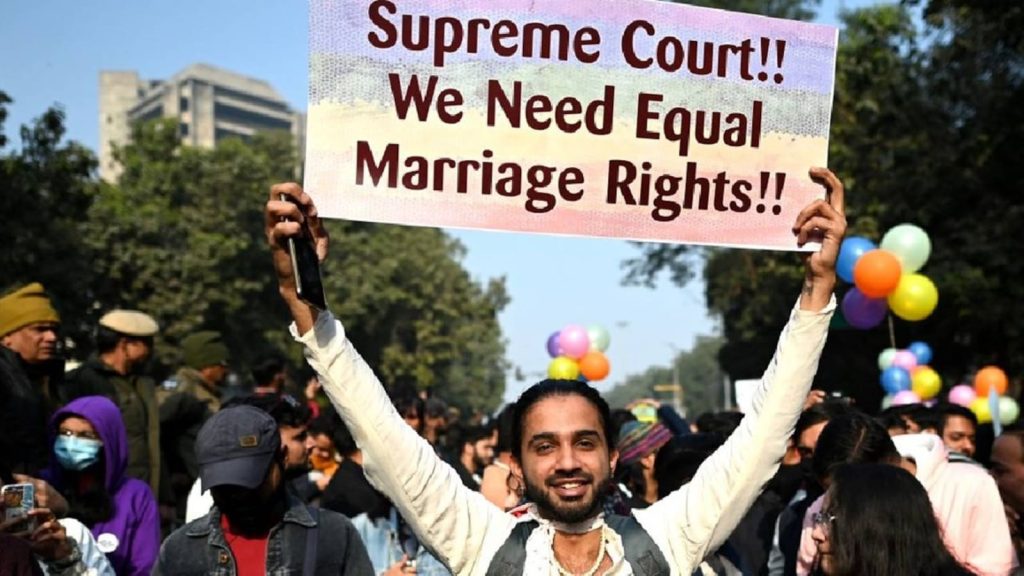
This essay will examine the legal odyssey of same-sex marriage in India, which started with the introduction of Section 377 into Indian Penal Code during the colonial era. It does this by studying how sexual minorities fought the unjust laws which eventually led to milestone events such as the progressive ruling of Delhi High Court in 2009 and eventual decriminalization by Supreme Court in 2018. It looks at recent developments concerning the Supreme Courts handling of petitions seeking legal recognition for gay marriages under the Special Marriage Act. The paper discusses differing judicial opinions and the court’s directive to the government to set up a committee on queer unions’ rights and entitlements. Finally, it uses the doctrinal method to give insight regarding LGBTQ+ rights in India.
KEYWORDS
Homosexual Marriages, LGBTQ+ Rights, Section 377, Legal recognition, Special Marriage Act.
INTRODUCTION: A LOOK INTO HISTORY
The legal history of homosexuality in India dates to the era of British rule. During the colonial administration of 1862, Section 377 was enacted by the Raj. This section provided for criminal penalties for “carnal intercourse against the order of nature,” which was understood to include all kinds of same-sex relations, even though the word “homosexual” did not appear in Section 377. There were further litigations after India gained independence with regards to section 377 of IPC. The LGBTQ+ community rose up and began questioning this statute with numerous petitions that they filed advocating for legalization of homosexual marriages and recognition. 2009 also marked a turning point in discussing gay acts when the Delhi High Court decriminalized consensual sexual acts amongst adults ruling that Section 377 violated fundamental rights. This act marked a watershed moment as well, it sparked off progress and indeed affirmed that love should not be seen as a crime according to Delhi High Court thus full support to free loving people on earth.
Following the 2009 judgment of the Delhi High Court, this ruling was reversed by the Supreme Court in 2013 and homosexual acts were once again proscribed with section 377. In 2018, final decriminalization came into effect when the supreme court of India delivered a verdict in the case of Navtej Singh Johar v. Union of India. It is through inventiveness on part of judges that consensual homosexual acts have been described as unlawful under Section 377 therefore decriminalizing homosexuality. This is what Justice D.Y Chandrachud said “It is hard to rewrite history by correcting one mistake at a time but we can make amendments for our future.”. Therefore, with this profound decision, the Supreme Court established a precedent that could lead to an era where love has no boundaries and justice is served.
RESEARCH METHODOLOGY
I will be employing the doctrinal method for this research, the study extensively examines legal principles, statutes, and judicial precedents relevant to the case presented in the Supreme Court of India under Writ Petition (Civil) No. 1011 of 2022, involving Supriyo @ Supriya Chakraborty & Anr. versus Union of India. By closely analysing the arguments presented and the legal context surrounding the case, this approach aims to provide a thorough understanding of the legal framework and contribute to legal scholarship.
REVIEW OF LITERATURE
“The nature of injustice is that we may not always see it in our own times. The generations that wrote and ratified the Bill of Rights and the Fourteenth Amendment did not presume to know the extent of freedom in all of its dimensions, and so they entrusted to future generations a charter protecting the right of all persons to enjoy liberty as we learn its meaning.” This quote by Justice Anthony Kennedy suggests that denial of same-sex marriage is injustice, as society evolves the law must adapt and evolve to ensure justice and dignity to individuals. Yet in India same-sex marriage remains denied. Despite there being several legal victories in decriminalising of homosexual relations as pronounced in the Navtej Singh Johar case, the denial of same-sex marriage rights compromises the dignity of LGBTQ+ individuals.
October 17th 2023 was the day when the Supreme court headed by CJI DY Chandrachud held against decriminalising same sex marriage. With that the bench also ruled in a 3:2 verdict against non-heterosexual couples having civil unions. The Chief Justice of India (CJI) focused on the concept of “civil union,” suggesting the possibility of implementing such unions for same-sex marriage. While a civil union is a marriage-like legal sanction provided to two individuals generally of same sex. While on the other hand marriage is a religious institution that allows two individuals of opposite sexes to marry. This brings u to the concept of marriage, marriage comes from both religion and society, for instance every religion has its own rituals and rules for marriage within a particular society. This leads us to a larger question of what the state has to do with marriage. The state organises those rights in the public sphere and grants legal status.
The LGBTQ+ rights in India have evolved over time, from Naz Foundation in 2002 filing a PIL to challenge section 377 in the Delhi high court with the court refusing to consider the petition by saying that the petitioner had no locus standi. Later in 2009 the Delhi High Court decreed on the Naz Foundation V. Govt. of NCT of Delhi, verdict was to be found that section 377 and other legal prohibitions against same sex conduct to be in direct violation of fundamental rights. In addition to that in 2012 many appeals were filed against decriminalisation of gay sex. However the supreme court observed that homosexuality should be seen in the context of evolving society. But the central government opposed the decriminalisation of gay sex. Later in 2014 supreme court overturned the decision of Naz foundation V. Govt. of NCT of Delhi and a 2 bench judge consisting of G. S. Singhvi and S. J. Mukhopadhya reinstated section 377 of the IPC.
It was in August 2018 that a five-judge bench struck down IPC section 377 to the extent that it criminalises homosexuality. Moving onwards, after that many petitions were filed in India by same-sex couples seeking recognition of their relationship with the legal and social status of “marriage”. Finally coming to the case of Supriya Chakraborty & Anr. v. Union of India, the petitioners had several arguments. Senior Advocate Mukul Rohatgi argues that the right to marry for non-heterosexual couples is implicit in articles 14,15,16,19 and 21. She justifies by saying that according to article 15 the state shall not discriminate on the basis of sex, now does this mean that the word sex should only be considered in a biological way or considering it as a gender norm it can be assumed that the state is actually violating article 15. Now in Navtez Singh Johar case homosexuality has already been decriminalised, the next step is marriage which requires legal recognition only. Advocate Mukul Rohtagi also argues that section 4 of the special marriage act already uses the word “spouse” so that implies scope for gender neutrality. Mr. Mehta argued that the current laws create a “discriminatory exclusion based solely on sexual orientation” which violates fundamental rights. Petitioner also argues that the right to exercise choice of partner, right to free association, and the basic right to privacy and dignity are also being denied to same sex couples. Petitioners also sought the interpretation of the SMA, 1954 to read marriage as between spouses instead of “man and women ” for this Rohtagi pointed that section 4 of SMA refers to marriage as gender neutral. Arguments were also brought upon challenging section 5 of the SMA arguing that it violates individuals privacy and autonomy as this indies unwarranted interference by displaying public notice.
The Centres argues that with the religious definition of marriage, various religions have already recognised marriage between a man and a woman and if a new idea of marriage has to be imagined, then it must come from the parliament and not the court that can create it. Petitioners argued that the state can have no role in regulating personal relationships. Centre replied by saying that the right to marry is not absolute and is always subjected to statutory regime provided by the competent legislature. Several aspects of marriage are regulated by the state such as prohibition of bigamy, age of consent, prohibited decrees of marriage etc.
The Supreme Court in 2017 recognised the right to privacy as a fundamental right, it also held that sexual orientation is an essential component of identity. Court argues that while the right to privacy exists it cannot be extended to marriage. When consulting adults want a societal acceptance of the relationship by way of marriage, they are conferred with a public status by the state. Court further argues that consenting sex between two adults is in the sphere of privacy within the intimate zone. However, recognising the relationship between the very same as marriage falling in the public zone has a necessary and inevitable public element.
The court had repeatedly said that the decision of same sex marriage can only be made in parliament, the argument essentially is that there exists a democratic right of people to regulate themselves and that it cannot be made by a court. Moving to the question of interpreting the law the key argument of the court is that court cannot interpret the same sex marriage to include same sex marriage in a meaningful way. For that the court will have to examine the “entire architecture of the act rather than examine a few words like husband, wife”.
There were also discussions on the concept of adoption. A five-judge bench ruled (3:2) that unmarried and queer couples cannot adopt children. The majority opinion, led by Justice Bhat, cited the 2020 Central Adoption Resource Authority Guidelines and the Juvenile Justice (Care and Protection of Children) Act, 2015, which require adopters to be married for at least two years. Justice Bhat argued that marriage provides important protections for children, though he acknowledged the need to recognize the rights of queer parents. He urged the state to ensure maximum welfare and benefits for the largest number of children needing safe and secure homes, in line with the guiding principle of the Juvenile Justice Act: the best interest of the child.
SUGGESTIONS
Although the Supreme Court recently decided not to legalize same-sex marriage, there are several steps that can be taken to continue this effort. First, the government should set up the committee suggested by the Supreme Court to look into the rights and benefits of same-sex couples. This committee should include people from the LGBTQ+ community to represent themselves, legal experts, and human rights advocates to ensure everyone’s needs are considered. Second, there should be a push in Parliament to discuss possible changes in the Special Marriage Act to include same-sex couples. Additionally, public awareness campaigns are needed to change how society views same-sex marriage in order to have public support. Education programs in schools and higher educational institutions are required to explain to youth the importance of equality and constitutional rights can help achieve this, as society is evolving. Finally, looking at how other countries for example the United States, have handled similar issues can help strengthen the case for same-sex marriage in India. By ensuring these steps, India can move forward in ensuring that LGBTQ+ individuals have the same rights, dignity and protections as everyone else.
CONCLUSION
Given that many countries have legalised same sex marriage, but in India although homosexuality was decriminalised years ago but same sex marriage still not legal in India. It makes one wonder that decriminalising homosexuality enables same sex couples to take their relationship forward and if that can be legal then why not marriage, Afterall marriage is an institution that just formalises that relationship. It is heart-breaking that LGBTQI+ community has to fight for this bear minimum, for being able to live as they desire. Throughout history in India man petitions were files by queer couples, LGBTQI+ activists and transgenders, these petitions challenged statutes governing marriage in India.
The reason these acts were challenged was as they do not recognise non-heterosexual marriages.
70 plus years since independence, society has changed, so many laws have been developed. Yet the LGBTQI+ community has to fight for inclusivity, dignity and respect, they have to fight for not being discriminated. With same sex marriage not being legal these couples also don’t have the right to legal benefits that come along with marriage for instance medical insurance etc. But it might be possible for queer couples to have these benefits without the recognition of their marriage, as the government hinted at examining the same. The case was head by a five judge bench including the CJI Dr. Dhananjaya Y Chandrachud. The judgement was delivered with a 3:2 majority, justices Bhat, Kholi and Narisimha held the majority opinion while the CJI and Justice Kaul held the minority one. With the majority opinion legal recognition of marriage was denied to queer couples, with the judgement pronouncing on October 17th. Basically the court held that it is not a matter for judiciary to decide rather a one to be decided by the legislature. With that the bench also agreed upon that a committee should be constructed for examining the entitlements and rights of LGBTQI+ community without recognising their union as “marriage”. The court also delivered that same sex couples do have the right of cohabitation without any threat or interference. The dilemma is such that, while on one hand homosexuality is not a problem, cohabitation is not a problem then what is it with the recognition of the same legally that is marriage, still not legal.
The judges had disagreements on many aspects while delivering a judgment. The majority opinion held that if we do give them the right of recognition of their union they do have any qualified right, when there isn’t anything inscribed in the law, how can they seek recognition. On the other had the CJI held a contrasting opinion to this and pronounced that queer couples do have the right to seek recognition as the constitution does guarantee the freedom to their union. Given that he also held that reason being “institutional limitations” the court does not have the authority to strike down the inscribed provision of the SMA. He said the authority lies with the executive and not with the judiciary for the same. Solicitor General Mr. Tushar Mehta, appeared for the Union and it was recorded that a committee would be constituted by the government for examining the entitlements and rights of same sex couples. CJI also held that they also have the right to adopt and that the CARA (regulation 53) is in violation of fundamental rights guaranteed by the constitution (article 15 specifically).
Now moving onto the opinion of Justice S Ravendra Bhatt, it differed from the CJI’s opinion that it only through “enacted law” that the recognition and entitlement of civil union could happen, and henceforth it was up to legislature to decide on the same matter and not the judiciary. He also agreed with the fact that a committee should be set up by the legislature for examining the rights of queer couples. In addition to this it was also observed that granting legal status by the legislature was not required by the SC. He also stated, “If it is agreed that marriage is a social institution, does it follow that any section of society which wishes for the creation of a like institution can seek relief by court intervention?” He agreed with the decision that it is up to parliament to decide on this matter and the court does not have the authority to change the already inscribed provisions of the statues, with the authority of creation of a legal framework for same sex couples is with the parliament. But at the same time, he enunciated that queer couples had a right to a relationship and the right to choose their partner. He stated that undoubtedly the denial of legal benefits which are not granted to them but to those whose marriage is recognised could have a discriminatory effect.
With the majority opinion of 3:2 legal recognition of marriage for queer couples is still a long battle to be fought for. It is in our knowledge that many countries have permitted same sex marriage. Same sex marriage have been legalised by nationwide voting in 23 countries around the world and through courts in 10 countries. But India still has a long way to go, I think it’s about time and it’s only fair and crucial for advocating equality that the LGBTQI+ community should have the rights they seek for and should not have to fight for them. They should be granted to live with dignity and respect and not have to fight for the same, it’s about time the society does not discriminate against them regardless of their sexual orientation.
It is high time for India to embrace equality and justice by legalizing same-sex marriage. The LGBTQI+ community should not have to battle for basic rights and recognition any longer. Legalizing same-sex marriage would affirm their dignity and respect, ensuring that love and commitment are honoured without discrimination. The journey towards true equality must continue relentlessly.
REFERENCES
- Monica Bathija, How the 2009 Section 377 Judgment Changed the LGBTQ Discourse in India, 4 Min Read (May 30, 2024, 12:54 PM), https://www.forbesindia.com/article/15th-anniversary-special/how-the-2009-section-377-judgement-changed-the-lgbtq-discourse-in-india/93249/1#:~:text=How%20the%202009%20Section%20377%20judgement%20changed%20the%20LGBTQ%20discourse%20in%20India,-The%202009%20judgment&text=On%20July%202%2C%202009,in%20more%20ways%20than%20one
- Padmakshi Sharma, Marriage Equality Case: Key Highlights From The Landmark Hearing Before Supreme Court, LiveLaw.in (Oct. 16, 2023, 9:40 PM), https://www.livelaw.in/top-stories/marriage-equality-case-key-highlights-from-the-landmark-hearing-before-supreme-court-240304
- Writ Petition (Civil) No. 1011 of 2022, Supriyo @ Supriya Chakraborty & Anr. v. Union of India, IN THE SUPREME COURT OF INDIA CIVIL ORIGINAL JURISDICTION.
- “Section 377,” Wikipedia, https://en.wikipedia.org/wiki/Section_377
- PTI, Same-Sex Marriage: Centre Says Court Can’t Rewrite, Alter Fundamental Architecture of Law as Conceived at Time of Framing, Udayavani (Apr. 26, 2023, 8:50 PM), https://www.udayavani.com/english-news/same-sex-marriage-centre-says-court-cant-rewrite-alter-fundamental-architecture-of-law-as-conceived-at-time-of-framing.
SUBMITTED BY –
JEEVANJOT KAUR BEDI
OP JINDAL GLOBAL UNIVERSITY (JGLS)