
ABSTRACT-
Euthanasia is a process aimed at ending a person’s suffering. It is essentially about ending life
with suffering, especially for the patient. Euthanasia is made up of two Greek words: “Eu”
meaning good, “Thanatos” meaning death. It basically works by inhibiting the cardiovascular
and respiratory systems. Now, this article will basically highlight the recent death due to
nitrogen hypoxia of an Alabama citizen. The question is: if euthanasia is performed to end a
person’s suffering, how is it used as a method of execution? One of the biggest questions of
the time is that the oxygen deprivation method of execution was designed to end animals’
suffering, but now is officially used to execute humans. Do all these actions constitute a
threat to humanitarian work? Is the same method of executing animals and humans justified?
But the state says death from lack of oxygen is humane, because people lose consciousness
before dying. This article attempts to provide a broader view of all aspects of hypoxia
implementation. This article will also discuss whether this type of enforcement is reasonable
or not.
Keywords: Euthanasia, Nitrogen Hypoxia, Alabama’s decision, Humanitarian.
INTRODUCTION-
Kuhse wrote that killing is not always morally worse than letting die and sometimes may be
better 1 . There is an old saying that if a person is suffering a lot, then death is their greatest
reward. Sometimes living in pain is much worse than to die, so by keeping this in mind
human being comes out with a terminology of ‘Euthanasia’ which means
the act of killing someone who is very ill or very old so that they do not suffer any more:
Although some people campaign for the right to euthanasia, it is still illegal in
most countries. 2 It is different from assisted suicide, which refers to a physician assisting the
person in ending their life. 3 These are the methods which are basically performed on sick and
1 Cambridge university, , https://dictionary.cambridge.org/dictionary/english/euthanasia#google_vignette last
visited- Feb 10,2024.
2 Cambridge university, https://dictionary.cambridge.org/dictionary/english/euthanasia#google_vignette , last
visited-Feb 11, 2024.
Page 2 of 2
injured animals to end their sufferings. In recent news the same practice has been performed
over a murderer of Alabama. The man named Kenneth Smith was executed using nitrogen
hypoxia. Smith was subjected to inhale pure nitrogen hypoxia until death. Now this kind of
execution comes under active euthanasia. Basically, euthanasia is of two types-
- Active Euthanasia
- Passive Euthanasia
Both types of Euthanasia would be discussed later. This paper basically aims to find out
about euthanasia and all the aspects of the recent execution by nitrogen hypoxia and its
effects on humanity.
RESEARCH METHODOLOGY-
This paper is descriptive in nature and the research is based on secondary sources for the deep
analysis about execution by nitrogen hypoxia and its effect on humanity. Secondary sources
like Newspapers, journals, websites, magazines, etc are used for the research.
REVIEW OF LITERATURE-
Euthanasia is the deliberate termination of a person’s life to alleviate suffering, usually
associated with a terminal illness or intolerable pain. This practice is highly debated and
controversial because it raises ethical, moral, and legal concerns regarding the sanctity of life,
autonomy, medical ethics, and the role of medical professionals.
Euthanasia includes voluntary euthanasia, where a patient asks for help to end his or her life,
and involuntary euthanasia, where the decision is made by someone other than the patient,
often without the patient’s consent. Voluntary euthanasia is also known as active euthanasia
and involuntary euthanasia is also known as passive euthanasia.
Active euthanasia is also known as aggressive euthanasia. It occurs when a person
deliberately does something to end another life and set them free from pain. This often
involves using lethal substances or performing a procedure intended to hasten death, such as
lethal injection. Advocates say it is a compassionate end to suffering that respects individual
autonomy and dignity. However, this remains controversial for ethical, legal and religious
reasons. Opponents worry about the risk of abuse, the sanctity of life and the erosion of trust
3 Law Cornell, https://www.law.cornell.edu/wex/euthanasia, last visited- Feb 11,2024.
Page 3 of 2
in medical professionals. The legal frameworks relating to euthanasia in operation vary
significantly between jurisdictions. The goal of passive euthanasia is to let a terminally sick
or suffering patient pass away peacefully by refusing or stopping medical care or life-
sustaining measures. Passive euthanasia permits death to happen as a result of the illness or
condition’s natural course, as opposed to active euthanasia, which includes a purposeful
action to end life.
Since this type of euthanasia involves abstaining from actions that might artificially prolong
life rather than intentionally causing death, it is frequently regarded as ethically unique.
Removing artificial nourishment and hydration, stopping mechanical ventilation, and
delaying the start of intensive treatments with slim chances of success are common examples.
The practice of passive euthanasia proponents contend that it honours patient autonomy by
enabling terminally ill people to pass away with dignity and without needless suffering.
Additionally, they argue that it is consistent with the idea of non-maleficence, since it
prevents needless medical procedures from exacerbating pain.
Critics, however, express worries about the possibility of abuse and the trend toward more
aggressive euthanasia. They contend that biases against particular patient demographics,
familial pressures, resource limitations, and other considerations may play a role in choices to
discontinue or reduce treatment.
The legal frameworks for passive euthanasia differ throughout jurisdictions; some expressly
allow it in specific situations, while others include limitations or outright bans on it.
Decisions about passive euthanasia in medical practice are heavily influenced by ethical
norms and principles, such as the beneficence principle and informed consent.
Many people make a moral distinction between active and passive euthanasia. They believe
that it is acceptable to allow a patient to die by refusing treatment, but it is never acceptable
to kill a patient by a deliberate act. Some doctors like this idea. They believe this allows them
to give patients the death they want without having to deal with the difficult moral questions
they would face if they intentionally killed someone. Some people (mostly philosophers) go
further and argue that active euthanasia is morally superior. This is because it is faster,
cleaner, and potentially less painful for the patient. Different critics have different views.
Page 4 of 2
Since euthanasia whether active or passive, is a way of terminating life for medically ill
patients. But in January 2024, humankind saw euthanasia as a means of capital punishment.
A process which is made for helping humankind to get relief from prolonged pain is now
used as a means of execution. In this paper we will discuss the consequences and the effect of
this earth shaking decision to humanity.
Kinneth Smith was arrested for the murder of Elizabeth Dorlene Sennett. Mr. Smith was one
of the three men convicted in the 1988 murder of Elizabeth Sennett, whose husband, a pastor,
had recruited them to kill her. 4 Smith and Parker arrive at Sennett’s house and tell Elizabeth
that Charles has given them permission to survey the property for hunting purposes. Elizabeth
called Charles and he told him to let them in. Charles also provided the men with funds to
purchase firearms to kill Elizabeth. However, Smith and Parker decided to spend the money
on drugs. Instead of her gun, they used a 6-inch survival knife and various items found in her
home to kill her. Elizabeth remained indoors while the men walked the grounds. The two
then knocked on the door and asked to go to the bathroom, to which Elizabeth agreed. While
Parker was in the bathroom, Smith decided to sneak up on Elizabeth and hit her. Just like
Elizabeth fought for her life, she was hit with a fireplace set, a walking stick and a galvanized
pipe. Parker then joined Smith in hitting her. After Elizabeth was beaten, she was stabbed
eight times with a survival knife and then she died struggling. In March Pastor Sennett found
his wife’s body at their home.
She was found to have been stabbed multiple times in the chest and neck and had multiple
cuts and injuries. It was discovered that Sennett hired Smith to kill his wife to acquire a large
sum of money from the insurance policy, after which he could pay off his debt. A week after
the murder, the case was investigated, Sennett committed suicide and Smith was arrested for
murder. The jury, voting 11 to 1, recommended that Smith be sentenced to life in prison
without the possibility of parole. The judge in Smith’s second trial, however, essentially
vetoed the jury’s vote and sentenced the defendant to death – a practice known as judicial
override that’s since been repealed in Alabama. 5
4 New York Times journal, https://www.nytimes.com/2024/01/25/us/alabama-nitrogen-execution-kenneth-
smith.html, last visited 9th February, 2024.
5 CNN News, https://edition.cnn.com/2024/01/25/us/kenneth-smith-nitrogen-gas-execution-alabama/index.html ,
last visited- Feb 11,2024.
Page 5 of 2
Smith was initially subjected to lethal injection in 2022. But the procedure failed and Smith
was left alive. Then a second death warrant was finalized ordering Smith to be put to death by
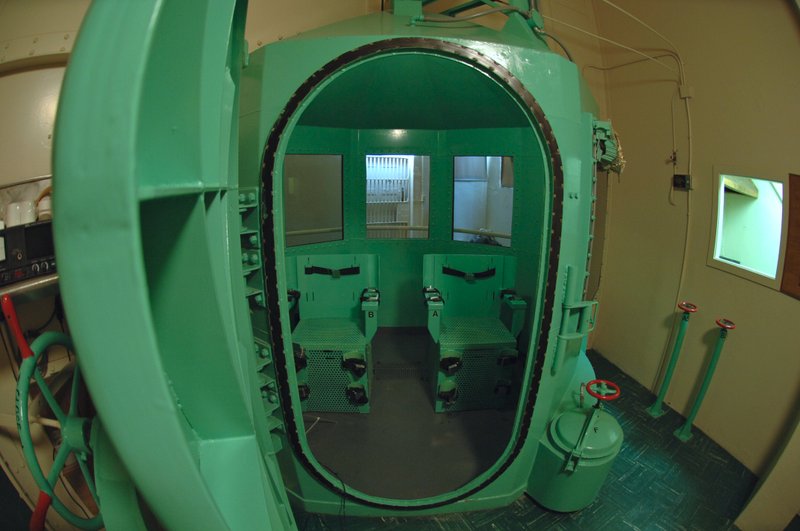
nitrogen hypoxia in January 2024. Execution by nitrogen hypoxia is the second-degree
execution in Alabama and has not been practised since it was formulated. Smith at the age of
58 was executed by putting him in a gas chamber filled with nitrogen hypoxia.
Now what does nitrogen hypoxia do to human bodies? Nitrogen hypoxia, also known as inert
gas asphyxiation or nitrogen asphyxiation is a method of causing death by reducing the
oxygen concentration in the air to a level that is insufficient to sustain life. This method
involves replacing the air a person breathes with nitrogen gas, which is an odourless,
colourless, and tasteless gas that makes up about 78% of earth’s atmosphere.
Nitrogen hypoxia works by partially reducing the oxygen pressure in the air an individual
breathes, leading to a reduction in the amount of oxygen available for cellular respiration.
When a person breathes air with reduced oxygen content due to increased nitrogen levels, the
body’s tissues and organs receive less oxygen than needed to function optimally. As a result,
the body is deprived of oxygen, which can cause serious physiological effects. Nitrogen itself
is not poisonous, but someone who inhales it, with no air, will pass out quickly, probably in
less than a minute, and die soon after — from lack of oxygen. The same is true of other
physiologically inert gases, including helium and argon, which kill only by replacing oxygen 6
Death by nitrogen has been suggested as a painless method and may even be mildly
euphoric. 7
The execution of Kinneth Smith,58, began at 07:53 pm central time and he was declared dead
at 08:25 pm in the execution chamber. He then began “shaking and convulsing” for at least
two minutes, then began breathing heavily for several minutes. According to journalists, at
one point his breathing slowed to the point that it was no longer noticeable. Spiritual guide
Jeff Hood said the moment was the “worst thing” he had ever witnessed. He said that even
prison officials gasped in horror as Smith writhed in pain for 22 minutes before he died 8 .
6 New York Times journal, https://www.nytimes.com/2024/01/25/us/alabama-nitrogen-execution-kenneth-
smith.html last visited -Feb 9 ,2024.
7 Times of India, https://timesofindia.indiatimes.com/world/us/death-by-nitrogen-was-supposed-to-be-painless-
kenneth-gasped-for-6-minutes/amp_articleshow/107175824.cms last visited- Feb 10, 2024.
8 Hindustan times, https://www.hindustantimes.com/world-news/alabama-carries-out-us-first-execution-using-
nitrogen-gas-101706237760245.html last visited on- Feb 10,2024.
Page 6 of 2
According to a pool report by five Alabama journalists who witnessed the incident, Smith,
who was strapped to a gurney with a mask over his head, died several times after nitrogen gas
entered the mask and began depriving him of oxygen. He appeared to be conscious for
several minutes. Prosecutors have previously argued in court documents that nitrogen
executions cause “unconsciousness within seconds.”
Justice Sotomayor stated that:
- “Alabama plans to execute Smith tonight due to nitrogen hypoxia. That method is
untested. Smith is the first person in this country ever to be executed in this way. The
details are hazy because Alabama released its heavily redacted protocol under five
months ago. What Smith knows is that he will be strapped to a gurney. He will wear a
nitrogen-supplying, off-the-rack mask for which the state has not fitted him or even
tried him. Once the nitrogen is flowing into the mask, his executioners will not
intervene and will not remove the mask, even if Smith vomits into it and chokes on his
own vomit” 9
Justice Sonia Sotomayor voiced concerns about Alabama’s new method. “Having failed to
kill Smith on its first attempt, Alabama has selected him as its ‘guinea pig’ to test a method of
execution never attempted before,” she wrote. “The world is watching.” 10
INDIA’S VIEW ON DEATH PENALTY-
India maintains the death penalty as a legal punishment for certain serious crimes, but the
permissible methods of execution are specified in Indian law. Any proposal to introduce
nitrogen enforcement is likely to require careful legal and legislative consideration, including
consideration of constitutional rights and human rights standards internationally.
Public opinion on the death penalty in India is very different. Some individuals and groups
support the death penalty, especially in cases of extreme violence or terrorism, seeing it as a
form of justice and deterrence. However, there are also voices in civil society, human rights
9 Smith V Hamm, Case No- 23-6562(23A688) (SC).
10 New York Times journal, https://www.nytimes.com/2024/01/25/us/alabama-nitrogen-execution-kenneth-
smith.html last visited -Feb 9 ,2024.
Page 7 of 2
organizations and some political circles that support the abolition of the death penalty, citing
concerns about fairness, the risk of wrongful convictions and irreversibility of the sentence.
India often takes international standards and practices into account when assessing its own
policies, including with regard to the death penalty. Discussions about the use of new
methods of execution such as nitrogen hypoxia are likely to require a review of international
practice and human rights standards.
The issue of the death penalty is a complex and controversial issue around the world, and any
proposed changes to the method of execution will provoke significant debate and scrutiny in
India and internationally.
SUGGESTIONS-
The question of whether death by nitrogen hypoxia is justified is highly subjective and
depends on individual perspectives, cultural norms, legal frameworks, and ethical beliefs.
From a utilitarian perspective: Some advocates argue that nitrogen hypoxia can be justifiable
if it reduces suffering compared to other methods of execution. They could argue that this
could be seen as a more humane option, potentially minimizing the pain and suffering of the
executed as well as witnesses.
From a human rights perspective: Many human rights advocates oppose all forms of capital
punishment, including nitrogen hypoxia, because it violates the inherent dignity and right to
life of each individual. They argue that state-sanctioned killings are fundamentally
inconsistent with the principles of human rights and justice. From an ethical perspective:
Ethical considerations surrounding execution by hypoxia include questions of consent,
potential for pain and suffering, and irreversibility of punishment. Critics say that although
hypoxia appears less violent, it still raises moral concerns about the authority of the state to
end human life.
From a legal perspective: In jurisdictions where the death penalty is legal, the justification for
hypoxia will be determined by the law, court decisions, and public opinion. The legal system
can evaluate this approach’s compliance with constitutional standards, including the
prohibition of cruel and unusual punishment.
Page 8 of 2
Ultimately, the justification for death by nitrous hypoxia depends on an individual’s beliefs
about the legality of the death penalty, perception of justice, and moral values regarding the
treatment of the dead individuals, even those considered to have committed serious crimes.
The debate surrounding this issue reflects broader societal discussions about punishment,
human rights and the role of the state in the administration of justice.
CONCLUSION-
In the middle of the 19th century hanging was the only method of capital punishment, slowly
then the capital punishment began to shift to electro conduction, which at that time was
considered less painful than hanging. Following lethal injection became the go to method for
capital punishment. This method was considered more humane than electro-conduction. But
the shortage of drugs made humans think of a more humane way of execution. Before anyone
proposed using nitrogen as an execution method, researchers looked at how nitrogen
accidentally kills people. So a new method of execution comes out by nitrogen hypoxia.
In short, the debate over the death penalty by nitrogen hypoxia reflects broader discussions
about the ethics, legality, and practicality of capital punishment. While its supporters believe
that the death penalty can offer a more humane alternative, its critics highlight ethical
concerns and argue for its abolition of the death penalty. Any decision to adopt nitrogen
hypoxia as an implementation method requires careful consideration of these complex and
often controversial issues.
Submitted by-
ANNU RANJAN
IMS LAW COLLEGE NOIDA.