

Ms. Bhoomika Mishra **
Abstract:
Custodial violence and human rights violations against tribal communities in India represent a grave challenge to the nation’s constitutional commitment to equality, dignity, and justice. Despite legal safeguards such as the Scheduled Castes and Scheduled Tribes (Prevention of Atrocities) Act, 1989 and constitutional provisions under Articles 15, 17, and 21, incidents of arbitrary arrest, torture, and extrajudicial killings persist, especially in regions affected by conflict and resource exploitation (National Campaign on Dalit Human Rights [NCDHR], 2021). These violations often stem from systemic discrimination, socio-economic marginalization, and the misuse of security laws like the Unlawful Activities (Prevention) Act (UAPA), which disproportionately target tribal populations without due process.
High-profile cases, such as custodial deaths in Jharkhand, Maharashtra, and Madhya Pradesh, underscore a pattern of impunity within law enforcement agencies. The erosion of trust between tribal communities and the State perpetuates cycles of fear, alienation, and resistance. The lack of independent investigations, weak prosecution of offenders, and delayed judicial remedies exacerbate the crisis.
Addressing this requires a multipronged approach: strengthening accountability mechanisms for police misconduct, ensuring the strict implementation of protective laws, enhancing legal aid for tribal victims, and promoting rights-based policing through sensitization and training. Furthermore, empowering tribal communities politically and economically can help dismantle structural inequalities that fuel such violations.
Ultimately, the research paper seeks to discuss the instances where the rights of tribal are violated by the law machinery. And also focuses to establish that the protection of tribal rights is not merely a matter of legal compliance but of moral and constitutional obligation. Upholding these rights is essential for building a just, inclusive, and democratic India.
Keywords: Tribals, Human right Violation, Custodial deaths.
** Student BALLB III Sem Sec B, Amity Law School, Amity University Gwalior Madhya Pradesh
INTRODUCTION
“Injustice anywhere is a threat to justice everywhere.” – Martin Luther King Jr.
Picture yourself being taken into custody not as a defendant, but simply as a suspect only to be subjected to beatings, humiliation, and in many instances, death. Picture this happening to an individual who is part of a community already stigmatized by poverty, illiteracy, and social exclusion. This is the harsh truth of many tribal Indians who are victims of custodial violence a matter that not only infringes on constitutional rights but also exposes the deeply ingrained structural discrimination in our judicial system.
The custodial violence is the physical, psychological, and occasional sexual assault endured by persons in the custody of law and order authorities. Although large in number, tribal communities are perhaps the most vulnerable because they lack political representation, have poor legal aid, and are subjected to systemic discrimination. Traditionally marginalized, tribals are frequently suspected of being left-wing extremists or petty criminals and therefore are soft targets for police brutality, unauthorized detention, and even enforced disappearance.
The importance of this problem is its far-reaching effect, not only on the individual victims and their communities but also on the core principles of democracy, justice, and equality. The Custodial violence erodes citizen’s confidence in the rule of law and goes unrestrained because of strong institutional apathy and weak mechanisms for accountability. For indigenous people, these abuses are reinforced by their exclusion from access to legal remedies, language disadvantage, and unfamiliarity with judicial processes, further entrenching their alienation from the dominant legal system.
This paper seeks to critically analyze the nature and degree of custodial violence against tribal people in India, tracing its legal, social, and human rights aspects. It will identify major case laws, analyze the role of state institutions, and point out the lacunae in law enforcement and judicial accountability. Finally, the essay contends that reforming custodial violence against tribals is not merely a case of legal reform but a challenge to India’s commitment towards constitutional morality and human dignity.
HISTORICAL CONTEXT
Custodial violence, while often considered a recent phenomenon, has extensive historical origins within the Indian policing and judicial system, especially as it pertains to its marginalized population. The term “custody” itself originated in colonial India, where the British colonizers created legal and penal institutions with the aim of quelling opposition and managing government of the native subject. The Indian Police Act of 1861 itself was enacted after the revolt of 1857, with a view to establishing colonial dominance by fostering a disciplined and obedient police force. This police force was not to be for the service of the people but was used as a tool of state violence. Regrettably, the inheritance of that oppressive machinery continues to haunt contemporary India, particularly in its handling of marginalized communities such as tribal people.
India’s tribal populace, more formally known as “Scheduled Tribes” under the Constitution, represents more than 8% of the country’s population and is found in areas abundant with natural resources. These populations have traditionally had a symbiotic relationship with nature, practicing distinctive customs, cultures, and forms of governance. Nonetheless, post-independence development initiatives, forest conservation policies, and mining operations have disturbed their own way of life, causing massive displacement, alienation of land, and social exclusion. As tribal populations resisted their exploitation and claimed their rights over land and resources, they came to be seen in greater numbers as threats to “development” and state control.
The state’s reaction to tribal opposition tended to be military, surveillance, and violent policing of regions categorized as “disturbed” or “naxal-affected.” The Armed Forces (Special Powers) Act (AFSPA), Unlawful Activities (Prevention) Act (UAPA), and related security laws have often been abused to arrest tribal members on suspicion without trial, on grounds of suspected Maoist sympathizers or anti-national elements. Once arrested, these people are harassed, tortured, and subjected to extrajudicial violence abuses that are rarely recognized and punished by the system.
In addition, institutionalized racism and discrimination against tribal individuals based on their unique look, speech, and way of life have also spurred custodial bias. They are frequently deprived of access to legal assistance, healthcare, and impartial trials, which makes them soft targets for scapegoating in criminal proceedings. As much as constitutional provisions such as Article 15(4), Article 46, and the Fifth and Sixth Schedules meant to safeguard tribal rights exist, implementation is weak and accountability minimal.
Therefore, the historical background of custodial violence among tribal people is based on colonial oppression, ongoing marginalization, and the inability of the Indian state to provide justice and dignity to its indigenous people. This background is crucial in understanding the reasons why custodial torture and human rights abuses continue even in the 21st century, even though India has been committed to democratic principles and international human rights standards.
CASE STUDIES AND STATISTICS
Human rights abuses against tribal communities in India present a deeply troubling picture of systemic marginalization and exploitation. The tribals faces the problem such as Lands Dispossession, Public Violence, Land Displacement due to Projects, Illegal Detentions, Sexual Violence and Denial of Basic Services. The figure shows the clear cut stats of the Human Right abuse case in the above mentioned criteria such as displacement due to development projects (26.5%) emerges as the most frequent abuse, followed closely by land dispossession (21.2%) and denial of basic services (19.5%). These violations are often intertwined, stripping communities of their ancestral lands, livelihoods, and cultural identity. Police violence (15%), illegal detention (10.6%), and sexual violence (7.1%) further highlight the vulnerability of tribals in conflict-prone and resource-rich regions. Such patterns reflect structural inequalities, inadequate enforcement of protective laws like the Forest Rights Act, and the neglect of constitutional safeguards for Scheduled Tribes. The consequences go beyond material loss these abuses erode trust in governance, deepen poverty, and perpetuate cycles of social exclusion. Addressing them requires not just legal reform but also political will, community empowerment, and a shift towards inclusive and rights-based development policies.
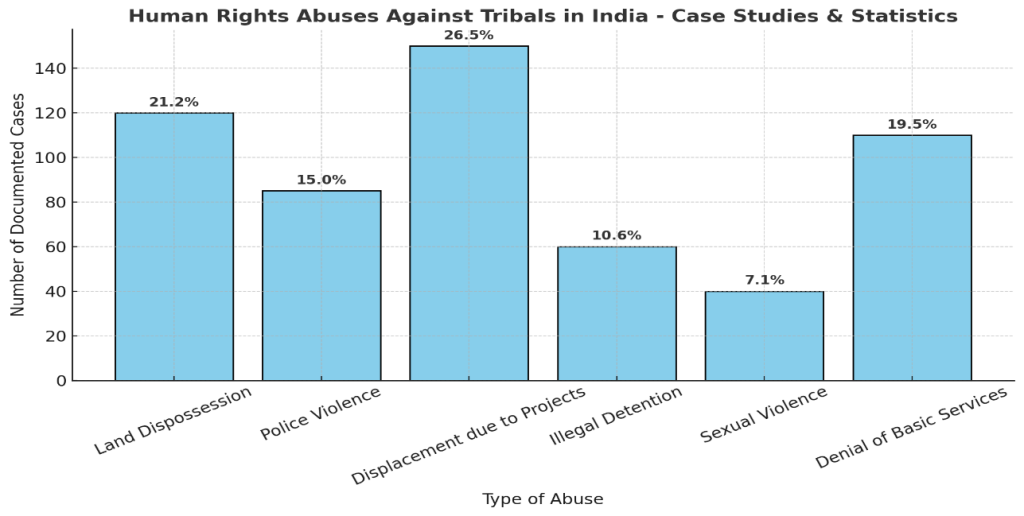
To grasp the extent of custodial violence and human rights abuse of tribal communities, it is necessary to analyze certain case studies and statistical data that expose the extent and trend of abuse. Such cases do not just identify individual hardships but also lay bare systemic failure in law enforcement and the dispensation of justice.
Case Study 1: Soni Sori (Chhattisgarh)
Among the most thoroughly documented cases is that of Soni Sori, a school teacher from the tribal belt of Dantewada in Chhattisgarh. She was charged with being a courier of Maoists in 2011 and was arrested and interrogated with severe custodial torture at by the police machinery. The Medical examinations showed stones had been pushed into her private areas while in custody. The police officers involved had little to worry about despite the seriousness of the episode. Soni’s case gained international attention, and she went on to receive the Front Line Defenders Award for Human Rights Defenders at Risk in 2018. Her story represents the dual oppression faced by tribal women both as members of a marginalized community and as females in custody.
Case Study 2: Bastar Region Violations
The Bastar area in south Chhattisgarh has become infamous for human rights abuses in the guise of counterinsurgency operations. In 2016, the National Human Rights Commission (NHRC) substantiated that no fewer than 16 tribal women were raped and sexually abused by policemen while conducting anti-Naxal operations in the area. The NHRC report was based on field visits, medical tests, and testimonies. Still, despite the overwhelming evidence, punishment for the accused officials was limited with most of them still in place, reflecting the impunity afforded to state forces.
Case Study 3: Jharkhand Adivasi Arrests
In Jharkhand, particularly in tribal-majority districts of Latehar and Gumla, hundreds of young tribal people have been arrested in the last ten years on suspicion of being Maoist sympathisers. A 2016 report by Jharkhand Janadhikar Mahasabha documented 3,000+ undertrial prisoners, the majority tribal, held without adequate legal assistance. Most were imprisoned for years on charges under the Unlawful Activities (Prevention) Act (UAPA) or comparable accusations, in the absence of any evidence presented in court. This has resulted in what a great many activists refer to as the “criminalization of Adivasi identity.”
There have been several unreported cases identified by the NGOs such as in the Latehar & Gumla Jharkhand area, several tribal have been arrested without following the proper trial under UAPA. In the Gadchiroli Maharashtra area several tribal were arrested and were allegedly tortured in connection with Naxal related investigations.
On World Tribal Day, forest department officials in Lateri (Vidisha district) shot and killed a young tribal man, Chand Singh Bhil. The tragic irony of a tribal person being killed on a day meant to celebrate tribal heritage exemplifies the harsh reality tribals face in India.
In Manpur, Indore district, a 10thgrade tribal student was beaten to death by the police on false charges of theft. This case highlights how tribals are often falsely accused and subjected to police brutality without due legal process.
Thus these incidents underscore the pervasive nature of human rights abuses faced by tribal communities in India, where systemic discrimination, misuse of stringent laws like the UAPA, and excessive use of force by authorities persist unchecked. The killing of Chand Singh Bhil on World Tribal Day, custodial torture in Naxal-related probes, and the brutal death of a young student in Manpur reveal a disturbing pattern of impunity. Such acts not only violate constitutional safeguards but also erode faith in the justice system. Urgent reforms, accountability mechanisms, and genuine respect for tribal rights are essential to break this cycle of oppression.
Statistical Evidence
The National Crime Records Bureau (NCRB) 2022 report shows 175 deaths in police custody, but only 23 were registered against police personnel. The numbers, however, do not indicate the caste or tribal status of the victims, a significant shortcoming in documentation and transparency.
A 2020 survey conducted by the National Campaign Against Torture (NCAT) reported that 60% of custodial deaths in India take place among the poor, Dalits, and tribal communities. Most of these instances involve torture in the form of beatings, electric shock, and starvation and withholding of medical treatment.
The Chhattisgarh State Legal Services Authority conceded that more than 70% of tribal undertrials in the state were not legally represented during the time of arrest and did not know their basic rights.
These case studies and figures clearly indicate that tribal citizens are not only more vulnerable to custodial violence, but are also trapped in a nexus of institutional apathy, tardy justice, and systemic prejudice. The absence of disaggregated data pertaining to tribal victims further undermines accountability and impedes reform processes.
LEGAL AND CONSTITUTIONAL FRAMEWORK
India’s legal and constitutional framework offers significant protections against custodial violence and the violation of human rights, especially for vulnerable groups like Scheduled Tribes (STs). However, the gap between laws on paper and their enforcement on the ground remains stark. While several national and international legal instruments address custodial abuse, tribal communities often remain outside the effective reach of justice due to systemic neglect and institutional failure.
1. The Constitution of India
The Indian Constitution recognizes the rights of Scheduled Tribes and incorporates specific provisions for their protection:
- Article 15(4): Allows the state to make special provisions for the advancement of socially and educationally backward classes, including STs.
- Article 46: Directs the state to promote the educational and economic interests of Scheduled Tribes and protect them from social injustice and exploitation.
- Fifth and Sixth Schedules: Provide for the administration and governance of tribal areas, giving them a degree of autonomy and protection from exploitation.
- Article 21: Guarantees the right to life and personal liberty, which includes protection from torture and custodial abuse.
2. Bhartiya Nyaya Sanhita (BNS) 2023
The BNS i.e. Bhartiya Nyaya Sanhita is the new criminal law that replaced the Indian Penal Code 1860. The provisions have been included within the BNS to bring the custodial violence within its ambit. Some of the provisions are:
- Section 106 (formerly IPC Section 330/331): Penalizes voluntarily causing hurt or grievous hurt to extort confession or information. This prescribe the punishment as for imprisonment upto 10 years, if the grievous hurt is caused.
- Section 109: Specifically addresses custodial sexual violence and assault by public servants, including against women in custody. Recognizes the power imbalance between the victim and the accused public official.
- Section 74: Deals with wrongful confinement by a public servant, including during unauthorized detention or arrests.
These sections maintain continuity with previous IPC provisions but aim for more clarity and stronger wording to prevent abuse of power.
3. Bharatiya Nagarik Suraksha Sanhita (BNSS), 2023
Key reforms and procedural safeguards:
- Section 35: Emphasizes recording reasons for arrest and mandates that arrest should only be made when necessary. It aims to prevent unnecessary arrests, especially of marginalized individuals like tribals.
- Section 38 & 39: Ensure that the arrested person has the right to inform a relative or friend and the arrest must be communicated to them promptly.
- Section 48: Mandates medical examination of the accused at the time of arrest a crucial provision to detect and prevent custodial torture.
- Section 262: Provides for audio-video recording of statements and confessions, especially during interrogations a step towards transparency.
These provisions enhance accountability in policing and are particularly relevant in regions with a history of police excesses against tribal people.
4. Bharatiya Sakshya Adhiniyam (BSA), 2023
Key evidentiary reforms:
- Section 23: Maintains the inadmissibility of confessions made to police officers unless recorded before a magistrate.
- Section 85: Recognizes electronic evidence, including CCTV footage, body cams, and audio-video records in custody, as admissible and primary evidence.
- Section 86: Deals with burden of proof and allows shifting the burden onto the accused officer in cases involving misconduct if certain foundational facts are established.
5. Protection of Human Rights Act, 1993
The Protection of Human Rights Act, 1993 was enacted to provide for the constitution of the National Human Rights Commission (NHRC), State Human Rights Commissions, and Human Rights Courts for the protection and promotion of human rights in India. “Human rights” under the Act are defined as rights relating to life, liberty, equality, and dignity guaranteed by the Constitution or embodied in international covenants.
For tribal communities, the Act holds special significance as it offers a legal framework to address systemic abuses such as displacement, custodial violence, denial of basic services, and police excesses. The NHRC has the power to inquire into complaints of human rights violations by public servants, intervene in court proceedings, and recommend relief and rehabilitation measures. It also monitors the implementation of constitutional safeguards for Scheduled Tribes and evaluates the functioning of protective laws such as the Forest Rights Act, 2006 and the Panchayats (Extension to Scheduled Areas) Act, 1996.
However, while the Act empowers the NHRC to investigate and recommend actions, its recommendations are not binding, which limits its effectiveness. In the context of tribals, cases often face delays, poor documentation, and inadequate follow-up by authorities. Despite these limitations, the Act remains a crucial instrument for raising awareness, documenting violations, and exerting moral pressure on governments to uphold tribal rights. Strengthening its enforcement mechanisms, ensuring timely interventions, and enhancing access to complaint mechanisms in remote areas are essential for the Act to serve as a truly effective shield for India’s most marginalized tribal populations.
However, their recommendations are not binding, and their powers are often limited to inquiries and advisories. In tribal regions, access to such commissions is minimal, and awareness about them is nearly non-existent.
6. Scheduled Castes and Scheduled Tribes (Prevention of Atrocities) Act, 1989
The Scheduled Castes and Scheduled Tribes (Prevention of Atrocities) Act, 1989 (hereinafter “PoA Act”) was enacted to address the historical injustices, discrimination, and violence faced by members of Scheduled Castes (SCs) and Scheduled Tribes (STs) in India. For tribal communities, the Act serves as a crucial legal safeguard against atrocities committed by non-tribals, particularly in the context of land alienation, exploitation, and social exclusion. The PoA Act criminalizes a range of offences, including dispossession from land, denial of access to public resources, humiliation, and physical violence, when committed with the intent to demean members of SC/ST communities.
For tribal people, who often inhabit resource-rich areas vulnerable to encroachment, the Act provides legal recourse against forced displacement and land grabbing. It also prescribes stringent punishment for crimes such as sexual violence, social boycotts, and destruction of property. The Act mandates the establishment of Special Courts for speedy trials, relief measures for victims, and rehabilitation support.
Despite these provisions, challenges persist in its implementation. Factors such as fear of reprisal, lack of awareness about rights, procedural delays, and inadequate investigation often deter tribal victims from seeking justice. Strengthening awareness programs, ensuring independent monitoring, and increasing conviction rates are vital for making the Act effective.
In essence, the PoA Act is a legislative recognition of the structural vulnerability of tribal communities and a tool aimed at dismantling caste- and ethnicity-based discrimination, thereby fostering social justice and equality.
No doubt this is an important legislation that criminalizes specific acts of violence, humiliation, and exploitation committed against SCs and STs. It includes custodial violence within its ambit if it can be shown that the act was motivated by caste or tribal identity. However, conviction rates under this Act remain extremely low, and implementation is weak due to poor policing and administrative apathy.
India’s legal framework provides robust protections in theory, but enforcement is inconsistent, especially in tribal areas. The combination of legal illiteracy, fear of authority, systemic bias, and institutional indifference renders tribal people extremely vulnerable to custodial violence. Without stronger implementation mechanisms, oversight, and accountability, these legal protections remain largely symbolic.
ARGUMENTS FROM DIFFERENT PERSPECTIVES
Custodial violence against tribal people is a deeply complex issue involving multiple stakeholders with divergent perspectives. Understanding these viewpoints is essential to grasp the full scope of the problem and to design fair, inclusive, and effective solutions.
- State and Law Enforcement Perspective: From the standpoint of the police and state authorities, especially in regions affected by insurgency (like Chhattisgarh, Jharkhand, and Odisha), custodial measures are often portrayed as necessary for maintaining national security and public order. Authorities argue that many tribal areas are breeding grounds for left-wing extremism (LWE), and that tough policing including arrests, interrogations, and surveillance is a necessary response. In this context, certain “excesses” are sometimes justified as collateral damage in the fight against internal threats. Additionally, police often cite resource limitations, lack of training in human rights practices, and operational challenges in difficult terrains as reasons for procedural lapses.
- Human Rights Activists and NGOs: Human rights organizations strongly criticize this approach, arguing that it criminalizes poverty and dissent, especially among tribal people who are simply asserting their rights over land, forests, and identity. Activists claim that the structural bias within the law enforcement system disproportionately targets tribal individuals, many of whom are falsely implicated in Maoist activities without any concrete evidence. They highlight the lack of due process, torture in custody, sexual violence, and the use of draconian laws like the UAPA to suppress tribal voices. NGOs also raise concerns about delayed trials, denial of bail, and inadequate legal aid, which further trap tribal undertrials in long-term imprisonment.
- Judicial and Legal Perspective: The judiciary has played a mixed role. On one hand, courts have issued important judgments upholding the rights of detainees, including tribal individuals. The Supreme Court has reiterated that torture in custody violates Article 21 (Right to Life and Liberty). In the DK Basu v. State of West Bengal case, the Court laid down detailed guidelines for arrests and detentions, emphasizing transparency and accountability. However, critics argue that the judicial system is slow, often inaccessible to marginalized communities, and reluctant to hold police officers accountable unless there is massive public pressure or media scrutiny.
- Tribal Community Perspective: For tribal people, custodial violence is not just a legal issue but part of a larger pattern of historical marginalization, land alienation, and state-sponsored violence. Many tribal communities see law enforcement not as protectors, but as agents of oppression, especially when their leaders, youth, or activists are picked up without warning or disappear in custody. There is a widespread sense of mistrust toward the state and its institutions. For these communities, justice is not only about legal redress but also about recognition, dignity, and autonomy.
- Academics and Policy Think Tanks: Scholars emphasize the need to contextualize custodial violence within the broader framework of structural violence and developmental injustice. They argue that the Indian state has historically prioritized resource extraction and infrastructure projects over tribal welfare, leading to displacement and resentment. Many believe that unless inclusive governance, cultural sensitivity, and community participation are built into the system, custodial violence and state brutality will continue.
CHALLENGES TO REFORM
In spite of growing awareness, media reports, and court judgments, effective reform to avoid custodial violence specifically against tribal groups continues to elude efforts. These issues stem from long-standing structural, institutional, and social impediments that make reform hard and slow.
- Institutional Impunity and Lack of Accountability: The major challenge is the absence of accountability in police departments. Police officers who are accused of custodial violence are seldom prosecuted and, when they are, conviction is exceptional. Internal investigations tend to be biased, and the few available watchdog bodies, including the State Police Complaints Authorities or Human Rights Commissions, are not empowered to enforce their decisions. Complaints in tribal areas are simply rejected, not registered, or actively suppressed based on institutional bias.
- Ineffective Enforcement of Available Laws: India has various laws and constitutional safeguards against custodial torture, but their enforcement is extremely erratic, particularly in far-flung tribal regions. Laws such as the Scheduled Castes and Scheduled Tribes (Prevention of Atrocities) Act, Forest Rights Act, and constitutional protections under the Fifth Schedule tend to be disregarded or circumvented. Local officials and police either are not trained or deliberately ignore these legal instruments.
- Apathy in Politics and State-Focused Security Strategy: Governments tend to focus on “national security” and counterinsurgency at the expense of human rights, particularly in so-called tribal belts along the borders, which are designated as Maoist-affected. Utilization of such legislation as the Unlawful Activities (Prevention) Act (UAPA) and AFSPA fosters a climate of militarization, where human rights are subordinated to perceived threats. This security approach lowers political will to enact reforms likely to be perceived as diluting law enforcement powers.
- Inadequacy of Legal Awareness and Access to Justice: Tribal communities usually reside in far-flung places with poor access to legal assistance, courts, or even elementary legal awareness. Most are not aware of their rights when being arrested or detained and can’t deal with the law. Language issues, absence of documentation, and poverty render it almost impossible for them to access redress. There are no public defenders or they are undertrained, and most tribal undertrials remain jailed for years without a trial.
- Cultural and Social Discrimination: There is widespread prejudice deep within institutions and society against tribal people. They are sometimes viewed as uncivilized, or violent, or anti-national. Such prejudice is used to justify their treatment by the police and judicial authorities. Efforts at reforms are easily foiled by dehumanizing tribal people, which allows for easier excusing of excesses against them.
- Lack of Independent Investigative Mechanisms: India lacks an anti-torture act, and it has not signed the UN Convention Against Torture. Independent custodial violence probes are exceptional, and police are allowed to conduct them, which means the investigations tend to be biased. In the absence of checks from outside, victims, particularly tribal ones, have little chance of justice.
SUGGESTIONS
Addressing custodial violence against tribal people requires a comprehensive and multi-layered approach that combines legal reform, institutional accountability, community empowerment, and a shift in state policy from coercion to inclusion. The following suggestions outline the urgent steps necessary to bring justice, dignity, and protection to tribal communities:
- Enact a Comprehensive Anti-Torture Law: India must enact a dedicated anti-torture legislation in line with the UN Convention Against Torture (UNCAT), which it signed in 1997 but has not ratified. A specific law would clearly define torture, provide safeguards, and lay down procedures for investigation and punishment. It should also include mandatory reporting, independent inquiries, and witness protection mechanisms.
- Strengthen Oversight and Accountability Mechanisms: Independent institutions like the National Human Rights Commission (NHRC) and State Human Rights Commissions (SHRCs) should be strengthened with binding powers and greater autonomy. Additionally, setting up Independent Police Complaints Authorities at the state and district levels can ensure prompt investigation of custodial abuse complaints. Police officers found guilty of human rights violations must face immediate suspension, prosecution, and departmental action.
- Police Reforms and Human Rights Training: There is a pressing need for structural police reforms, including:
- Human rights sensitization, particularly about tribal cultures and rights.
- Mandatory audio-video recording of interrogations.
- Appointment of tribal liaison officers to bridge the gap between the police and local communities.
- Recruits from tribal backgrounds should be encouraged to join law enforcement to create more trust and representation.
- Legal Aid and Awareness in Tribal Areas: To empower tribal individuals, the government must ensure the presence of trained legal aid lawyers in tribal belts and provide free, accessible legal education in local languages. Legal literacy camps, awareness drives, and paralegal training for community members can significantly enhance tribal people’s ability to assert their rights.
- Speedy Justice and Bail Reforms: Special fast-track courts should be set up to review pending cases of tribal undertrials, many of whom have spent years in jail without conviction. Bail procedures must be simplified, and non-violent, petty offenders must be released on priority. This will help decongest jails and ensure justice is not denied due to delay.
- Community Participation and Tribal Self-Governance: Laws such as the Panchayats (Extension to the Scheduled Areas) Act (PESA), 1996 and the Forest Rights Act, 2006 must be fully implemented to empower tribal communities to manage their own affairs. Greater self-governance reduces dependence on external law enforcement and promotes dialogue over repression in resolving conflicts.
- Data Transparency and Disaggregated Statistics: The National Crime Records Bureau (NCRB) and NHRC should publish caste and tribe-wise data on custodial deaths, torture, and illegal detentions. Without accurate and disaggregated data, it is impossible to understand or address the scale of the problem.
By implementing these recommendations, India can take meaningful steps toward ending custodial violence and affirming the dignity and rights of its tribal citizens. Reform is not merely a legal necessity, but a moral and constitutional obligation.
CONCLUSION
Custodial violence against tribal communities in India remains a profound human rights concern, reflecting the intersection of systemic discrimination, inadequate legal protections, and weak institutional accountability. Despite constitutional guarantees under Articles 14, 21, and 46, which ensure equality before the law, the right to life and personal liberty, and the promotion of educational and economic interests of Scheduled Tribes, the lived reality for many tribal individuals in custodial settings is one of abuse, neglect, and denial of dignity.
The persistence of custodial violence against tribal people is not an isolated phenomenon but a structural issue rooted in historical marginalization, economic deprivation, and geographical isolation. In many conflict-affected and resource-rich tribal regions, such as parts of Chhattisgarh, Jharkhand, and Odisha, security operations targeting insurgency have often led to arbitrary arrests, torture, and extrajudicial killings of tribal persons under the pretext of law enforcement. Such actions constitute grave violations of international human rights obligations, including those under the International Covenant on Civil and Political Rights (ICCPR), to which India is a signatory.
Legislative measures such as the Scheduled Castes and Scheduled Tribes (Prevention of Atrocities) Act, 1989, and institutional safeguards like the National Human Rights Commission (NHRC) have attempted to create deterrence and provide avenues for redress. However, these mechanisms often fail in practice due to lack of awareness among tribal populations, fear of reprisal, procedural delays, and institutional bias within law enforcement agencies. Even when inquiries are initiated, low conviction rates, inadequate witness protection, and pressure on victims’ families contribute to a culture of impunity.
The issue is compounded by the limited accessibility of legal and administrative systems in remote tribal areas, which are often under-policed in terms of rights protection but over-policed in terms of security enforcement. Custodial settings become sites where the socio-economic vulnerability of tribal persons is exploited. The absence of interpreters for tribal languages, non-availability of legal aid lawyers with cultural competency, and lack of independent oversight further undermine justice delivery.
For a meaningful change, there must be a multidimensional approach. Firstly, strengthening accountability mechanisms is essential. Independent oversight bodies must be empowered to investigate custodial deaths and torture without interference from the police hierarchy. Secondly, capacity-building and sensitization of law enforcement regarding tribal rights, cultural diversity, and constitutional protections is crucial for preventing custodial abuse. Thirdly, strengthening access to justice through mobile legal aid units, tribal language interpretation services, and awareness campaigns can empower tribal communities to assert their rights and report violations.
From an international human rights perspective, India must align its domestic enforcement practices with its commitments under the ICCPR, the UN Declaration on the Rights of Indigenous Peoples (UNDRIP), and the UN Convention against Torture (UNCAT) the latter of which India has signed but not yet ratified. The ratification and domestic incorporation of UNCAT, coupled with strong anti-torture legislation, can bolster the legal arsenal against custodial violence.
In conclusion, custodial violence against tribal people is not merely a question of police misconduct; it is an indicator of systemic inequities in India’s justice and governance systems. Addressing it requires more than punitive action against individual perpetrators it calls for dismantling structural biases, fostering institutional reforms, and embedding a rights-based approach in law enforcement. Only through sustained political will, community empowerment, and judicial activism can India move toward a justice system that respects the dignity, autonomy, and human rights of its tribal citizens. Until then, the promises of constitutional equality and international human rights law will remain unfulfilled for some of the country’s most vulnerable populations.
REFERENCES
- King Jr, M. L. (2022). Injustice anywhere is a threat to justice everywhere.
- Jain, P. (2024). Custodial Violence And Its Impact. Available at SSRN 4946758.
- Villettaz, P., Killias, M., & Zoder, I. (2006). The effects of custodial vs. non‐custodial sentences on re‐offending: A systematic review of the state of knowledge. Campbell Systematic Reviews, 2(1), 1-69.
- Gupta, S. S. (2020). Relation Between Nature and Tribal Culture in Tripura.
- Pelly, G. (Ed.). (2009). State terrorism: torture, extra-judicial killings, and forced disappearances in India: report of the Independent People’s Tribunal, 9-10 February 2008. Socio Legal Information Cent.
- Case History: Soni Sori. Frontline Defenders. https://www.frontlinedefenders.org/en/case/case-history-soni-sori
- Mishra, J., & Deora, S. (2025). Conflicts over Natural Resource Extraction and Development in Bastar. Economic & Political Weekly, 60(3), 45.
- Pal, G. C. (2018). Atrocities against Adivasis: the implicit dimension of social exclusion. In Adivasi Rights and Exclusion in India (pp. 217-241). Routledge India.
- V. B. (n.d.). Escalating Atrocities Against Tribals: A Human Rights Crisis in Madhya Pradesh. Indian National Congress. https://inc.in/congress-sandesh/comment/escalating-atrocities-against-tribals-a-human-rights-crisis-in-madhya-pradesh
- Tiwari, R., & Shubham, N. (2023). Trends and patterns of crime against scheduled tribes in India. Trans. Inst. Indian Geographers, 45(1), 41-42.
- Gupta, M. S. (2021). Torture and Custodial Death, Role of the Indian Judiciary and National Human Rights Commission (Doctoral dissertation).
- Grover, V. (2018). The Adivasi Undertrial, a Prisoner of War: A Study of Undertrial Detainees in South Chhattisgarh. In Violence and the Quest for Justice in South Asia (pp. 201-285). SAGE Publications, Inc..
- Government of India. (1989). The Scheduled Castes and Scheduled Tribes (Prevention of Atrocities) Act, 1989.
- Kumar, R. (2020). Caste, Crime, and Justice: Evaluating the PoA Act in India. New Delhi: Legal Studies Press.
- (1997) 6 SCC 642
- Government of India. (1950). Constitution of India.
- Human Rights Watch. (2016). Bound by Brotherhood: India’s failure to end killings in Chhattisgarh. New York: HRW.
- United Nations. (1966). International Covenant on Civil and Political Rights.
- Government of India. (1989). The Scheduled Castes and Scheduled Tribes (Prevention of Atrocities) Act, 1989.
- National Crime Records Bureau. (2022). Crime in India – Statistics.
- National Human Rights Commission. (2021). Annual Report. New Delhi: NHRC.
- Amnesty International India. (2019). Torture in India: Evidence, Accountability, and Reform.
- Ministry of Law and Justice. (2020). Legal Services to Scheduled Tribes Report.
- United Nations. (2007). United Nations Declaration on the Rights of Indigenous Peoples.