
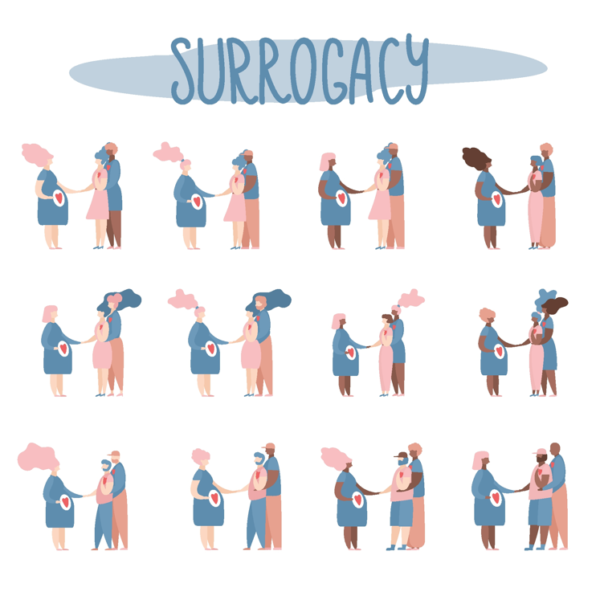
Abstract- Surrogacy and sperm donation are two forms of assisted reproductive technology (ART) that allow individuals and couples to have children who are biologically related to them. A woman carries and gives birth to a child on behalf of another person or couple through the procedure of surrogacy. A guy donates his sperm to a woman or couple so they can have a child. This technique is known as sperm donation. Both sperm donation and surrogacy are difficult and sensitive topics. Before choosing to use these methods to create children, there are numerous legal factors to weigh.
Keywords- Surrogacy, Sperm donation, Artificial insemination, Assisted Reproductive Technology (ART), Anonymous donor, Known donor, Traditional surrogacy, Gestational surrogacy
Introduction- In the modern world, the need for surrogacy, sperm donation, and other ARTs like In-vitro Fertilisation (IVF), Egg freezing, Embryo selling etcetera is rising. This increase is due to several factors: changes in population demographics (older couples trying to conceive), increased patient awareness and access to services, and advances and improvements in fertility treatments.[1] This research paper deals with legal implications related to sperm donation and surrogacy.
Research Methodology
In terms of its nature, this research paper is mainly theoretical and descriptive. It is qualitative in nature. The research has been conducted mainly through secondary sources. This research mainly contains descriptive information, understanding obtained through research using the secondary sources already available.
Review of Literature
Recent advancements in ARTs have led to significant changes in the legal world, impacting laws concerning families and children. Researchers have highlighted the need for policymakers to address the legal and ethical implications of ARTs. Complex bioethical concerns like sperm donation and surrogacy have drawn a lot of interest from academics, decision-makers, and the general public. Depending on state laws and federal restrictions, these practices may or may not be legal or ethical in the USA. By highlighting the historical context, ethical concerns, governing bodies, case studies, and global comparisons, this literature review attempts to give a thorough study of the extant literature on bioethics legislation in the USA regulating surrogacy and sperm donation.
Surrogacy
Some women who want to have a child cannot carry a pregnancy because of medical problems or lack of a uterus. They can use another woman’s uterus to have their baby if they have healthy ovaries and embryos. This is called surrogacy.
The difference between two types of surrogacies: traditional and gestational. In traditional surrogacy, the woman who carries the child also provides the egg and gives up the child to the biological father and his partner. In gestational surrogacy, the intended parents use their sperm and eggs and the carrier has no genetic link to the child.
The American Society of Reproductive Medicine recommends, and in some states the law requires, that surrogates be a minimum of 21 years of age.
Baby M case[2]
Facts
William Stern and Mary Beth Whitehead signed a surrogacy agreement in February 1985. The agreement called for Mrs. Whitehead to contribute her egg and bear the child for the Sterns through traditional surrogacy. It was agreed that after giving birth, she would give up her parental rights so that Mrs. Stern may adopt the kid. For this deal, Mrs. Whitehead would earn $10,000. There were three parties to the agreement: Mr. Stern, Mr. and Mrs. Whitehead.
Mrs. Whitehead had second thoughts when the baby was born, so she first offered the Sterns the kid. She was unable to survive without the baby, even for one week, so the next day she went to their house and begged for the baby back. Mrs. Whitehead occasionally discussed the subject with Mr. Stern during this time. Mr. Stern recorded these talks. Mrs. Whitehead also threatens to hurt herself and the child while falsely accusing Mr. Stern of having molested Mrs. Whitehead’s other daughter.
Judgment
It was held that the contract is unenforceable. That these are not enforceable in the state of New Jersey.
Reasoning
- Parental fitness is seen by the state as a key consideration in adoption and the termination of parental rights. Allowing financial exchanges in adoption can raise issues since it might put the interests of the money over those of the kid. In this case, the court determined that there was no evaluation of the adopting parents’ parenting abilities; rather, it appeared that only financial factors were taken into account.
- An essential factor to think about is whether adoptions and parental rights terminations can be revoked. According to New Jersey law, parental rights can only be permanently terminated in certain situations, as when a child is abandoned to the government or child protective services. The court noted that it is unlawful to permanently terminate parental rights in private adoptions, where two unrelated parties exchange a child.
- The contract in question was found to be against public policy since it prioritised the father’s parental rights over those of the mother. Equal parental rights are supported by New Jersey’s state policy for both women and fathers. The court expressed worry regarding Mrs. Whitehead’s suitability to serve as a surrogate after noting that she had not received necessary psychological or counselling care.
Johnson vs Calvert[3]
Facts
Crispina Calvert was unable to carry a pregnancy, despite Mark and Crispina’s desire to become parents. In 1990, they signed a surrogacy contract with Anna Johnson. According to the terms of the deal, Anna would be implanted with an embryo made from Mark and Crispina’s genetic material, after which she would give up her parental rights. Anna would receive compensation, and the Calverts would purchase a life insurance policy on her. However, Anna’s secret past and worries about the insurance policy caused the relationship to worsen. Anna threatened to keep the child unless she received cash. Genetic testing was used by the Calverts to establish their legal parentage, which led to the filing of a lawsuit.
Judgment
The court held that the child is of intending and genetic parents and not of a gestational mother.
Reasoning
The Calverts were given custody of the kid by the California Supreme Court. The court’s ruling was supported by a 1975 statute that used genetic motherhood rather than gestational motherhood to define maternity. This law, which was drawn from the Uniform Parentage Act, served as the basis for granting custody to the Calverts, who are the children’s biological parents. The court highlighted that the complex ethical and legal issues raised by surrogacy arrangements should be resolved using present laws as a guide. Even though the court rejected the contract, it did see it as evidence of the parties’ intentions.
Rogers vs Fasano[4]
Facts
In New York, Rogers received IVF treatment. Rogers’ embryo was accidentally placed in Donna Fasano, leading to the birth of Akeil, who shared their genetic heritage. Both the physicians and Fasanos were sued. The Fasanos eventually signed a legal arrangement releasing them from custody of Akeil in exchange for visitation privileges. A pressure to sign the contract resulted from Mrs. Rogers’ infrequent visits with Akeil.
Judgment
The court held that Akeil be turned over to Rogers and no visitation rights to Fasanos.
Reasoning
The judge agreed that pregnant moms might be granted visitation privileges over a kid, but he or she distinguished this situation from custody by focusing on the child’s genetic parentage. Rogers’ circumstances, preparations, and prompt identification of the embryo error were all taken into account by the court. They came to the conclusion that the Fasanos were lacking in a close enough bond with Akeil to warrant visitation rights. The court emphasised the significance of immediately addressing mistakes before parental bonds emerge rather than stating that gestational parents lose all visitation rights.
Comparing these cases gives a different perspective on how law is interpreted and how existing law is used when it is absent.
- Legal validity of contracts: The court determined that the surrogacy agreement in the Baby M case was not enforceable in the state of New Jersey. This judgement was made on the grounds that the contract treated the kid like a commodity and contravened the laws governing the evaluation of parental fitness and the termination of parental rights without cause. In Johnson v. Calvert, however, the court maintained the surrogacy agreement and acknowledged the biological and intended parents as the child’s legal parents. The court referred to a statute that used genetic motherhood rather than gestational motherhood to define maternity. In Rogers v. Fasano, the court concentrated on finding custody and visitation rights based on genetic parenthood, hence the enforceability of the contract was not a key issue.
- Public- Policy: In the Baby M case, the court determined that the surrogacy contract was against public policy because it prioritised the father’s parental rights over the mother’s and did not offer enough counselling and evaluation for the surrogate. Equal parental rights for mothers and fathers were stressed by the court. In Johnson v. Calvert, public policy issues were not specifically covered by the court because it mostly relied on statutory interpretation and on the best interest of the child. In Rogers v. Fasano, the court decided custody and visitation rights after taking the depth of the parent-child bond into account.
- Genetic vs gestational parentage: The methods used in the cases to establish parentage are different. The court did base its ruling in Baby M on the child’s genetic relationship to the surrogate. The case’s implications on unequal parentage rights were highlighted. In Johnson v. Calvert, the court dismissed the pregnant mother’s claim to parenting since genetic parentage was so important in determining the child’s legal parentage. When granting custody to the biological parents in Rogers v. Fasano, the court likewise placed a strong emphasis on genetic paternity; nonetheless, visiting rights were denied to the gestational parents due to their lack of a strong link with the child.
- Jurisdiction and codified law: The Baby M case was heard in New Jersey, where there was not any codified law on surrogacy. A provision in California that defines maternity based on genetic parentage served as legal justification for upholding the surrogacy contract. in the case of Johnson v. Calvert. In the New York case of Rogers v. Fasano, the court’s judgement was based more on genetic paternity than it was on any particular law provision, although there was not any codified law regarding this.
| Differences | Baby M Case | Johnson v Calvert | Rogers v Fasano |
| Type of Surrogacy | Traditional | Gestational | IVF |
| Basis of Contract | Donation | Payment | Medical Error |
| Codified Law | No specific statute regarding surrogacy in NJ. The court had to decide the case based on existing laws. | California had a codified law regulating surrogacy at the time of the case. | New York did not have a codified law regarding surrogacy at the time of the case. The court had to rely on common law principles and existing statutes. |
| Legal Parentage | Intended Mother | Intended Parents | Intended Parents and Gestational Mother |
| Resolution | Unenforceable | Declaratory Judgment/ Enforceable Contract | Settlement Agreement |
| Maternal Rights | Terminated | Relinquished | N/A |
Sperm Donation
The process of a man giving his sperm usually to a sperm bank so that it can be used to help women get pregnant.
Craigslist (Kansas vs WM)[5]
Facts
JLS and AB, a lesbian couple, sought to have a child together. They found a known sperm donor, Marotta, through Craigslist. They provided him with a contract relieving him of legal parenthood. Marotta donated sperm to the couple, and JLS became pregnant through self-insemination. They had a child in December 2009. After their relationship ended, JLS applied for welfare benefits but did not include Marotta’s information on the forms. When asked for a copy of the contract, JLS provided it, establishing Marotta’s legal parenthood. Marotta objected to paying child support, claiming he was not the legal parent.
Judgment
The court says Marotta is the legal father. He has to pay child support.
Reasoning
- The court said under state law there was a correct way to do this. Marotta needed to use a licensed physician to do the insemination. Because he failed to do it that way, he doesn’t get relieved of legal parenthood.
- The court says, “A parent may not terminate parental rights by contract, however, even when the parties have consented”.
In re R.C.[6]
Facts
JR and EC met in 1983 and were unmarried. In 1985, EC asked JR to be a sperm donor, and he agreed. He provided his semen to EC, who took it to her gynaecologist for artificial insemination. She became pregnant and gave birth to their son, RC, in 1986. In August of that year, EC informed JR that Colorado State law extinguished his parental rights, and she refused to allow him to see the child unless he signed a release. JR refused to sign the release and filed a paternity action, claiming that he intended to maintain a parental relationship with RC when he donated the semen.
Judgment
The Court says that in such a case, where it’s an unmarried woman and a known sperm donor, the agreement should be enforced.
Reasoning
- The court recognized that there was an agreement between the parties, in which JR, the sperm donor, had intended to maintain a parental relationship with the child born from his donation. This agreement was considered binding, and therefore JR had parental rights over RC, the child.
- The court noted that Colorado State law section 19-4-106 part two, which was cited by EC as extinguishing JR’s parental rights, did not apply in this case. This law only applied to anonymous sperm donors and not to known sperm donors such as JR.
- The court’s decision was based on the principle that where there is a known sperm donor and an unmarried woman, the agreement between the parties should be enforced. This principle recognizes the importance of honouring agreements between parties and protecting the rights and interests of all involved.
Ferguson v. McKiernan Case[7]
Facts
McKiernan and Ferguson were former lovers who began an affair in November 1991 while Ferguson was married. Despite Ferguson’s claim of using birth control, they did not use protection during their relationship. Their relationship eventually evolved into a non-sexual friendship by the end of 1993. Ferguson requested McKiernan’s sperm for IVF, promising to release him from financial and legal obligations and stating that she would raise the child as a single parent. McKiernan claimed that if she would have asked for child support later, he would have never agreed to be the sperm donor. He kept his identity as the genetic father a secret. After the birth, there was minimal contact between McKiernan and the twins. He saw them a few times in the hospital and visited them two years later while visiting his parents. Ferguson had no contact with McKiernan until May 1999 when she found his phone number and demanded child support.
Judgment
The court concludes that in this case, the agreement is enforceable, and McKiernan will not be the legal father. So, child support cannot be sought from him.
Reasoning
The court acknowledged the value of promoting and safeguarding women’s reproductive choices, including her right to decide whether to get pregnant and raise her children alone. Pennsylvania law does not recognise sperm donors as parents because it views sperm donation as a medical procedure rather than a reproductive act. Donor sperm use would be discouraged and reproductive options would be restricted if sperm donors were required to pay child support. Due to the use of IVF in this situation, the sperm donor had no genetic connection to the children, and he had no contact with them following their birth, showing that he had no parental intentions. The court came to the conclusion that the sperm donor shouldn’t be required to provide child support as a result of these reasons.
After comparing these laws, it is understandable that how sperm donation cases vary from different cases, how small changes in facts, can affect the judgment. The analysis on some aspects like enforceability, jurisdictions, public policy is as follows:
Legal enforceability of agreements: The court found that Marotta, the sperm donor, was the child’s biological father in the Craigslist case and was accountable for child support. The necessary legal procedure, which required using a licensed doctor for insemination, had not been followed, which was the basis for the court’s decision. Contrarily, in In re R.C., the court upheld the unmarried lady and the known sperm donor’s agreement and acknowledged the donor’s parental rights. The judge considered the parties’ intentions as well as the fact that there was no law in place to revoke the donor’s parental rights. In Ferguson v. McKiernan, the court decided that the agreement between the mother and the sperm donor was legitimate and enforceable, that the donor was not the biological father, and that he was therefore immune from paying child support. The court stressed both the public policy of promoting reproductive freedom and the absence of a genetic connection between the donor and the offspring.
Legal status of sperm donors: In the Craigslist case, the court found that Marotta was the child’s legitimate father, underscoring the fact that a parent cannot contractually revoke parental rights. In In re R.C., the court disallowed the application of a law meant for anonymous sperm donors in favour of recognising the known sperm donor as the child’s legal parent based on their consent. In Ferguson v. McKiernan, the court decided that sperm donors were not legally required to pay child support because of the medical nature of sperm donation, the absence of a genetic connection, and the donors’ lack of contact with the children.
Public policy considerations: The judge in the Craigslist case stressed the need of following the proper legal procedures in order to protect the child’s best interests and discourage noncompliance. The court acknowledged the importance of respecting contracts made between individuals involved in known sperm donation arrangements and preserving reproductive choices in In re R.C. In Ferguson v. McKiernan, the court prioritised public policy that supports and safeguards reproductive choice and acknowledged the possible drawbacks of making sperm donors pay child support.
Genetic relationship and intention to parent: The genetic compatibility of the sperm donor and the kid was not the primary deciding element in the Craigslist case. The disregard for legal protocol was the main point of discussion instead. In In re R.C., the court recognised the lack of a genetic connection and the known sperm donor’s desire to preserve a parental bond with the child. Because there was no genetic link between the sperm donor and the children and because he had no contact with them after they were born, it was determined in Ferguson v. McKiernan that the donor was not the biological father.
In conclusion the Craigslist case showed the value of following the proper legal procedures, which resulted in the sperm donor being recognised as the child’s legal father. Contrarily, In re R.C. and Ferguson v. McKiernan upheld the contracts between known sperm donors and unmarried women, with the former granting the donor parental rights and the latter exempting the donor from child support obligations due to public policy and the lack of a genetic connection.
| Differences | Craigslist (Kansas vs WM) | In re R.C. | Ferguson v. McKiernan Case |
| Type of Surrogacy | Self-insemination | Artificial insemination | IVF |
| Basis of Contract | Private arrangement | Agreement between parties | Promise of release from financial and legal parenthood |
| Maternal Rights | JLS | EC | Ferguson |
| Legal Parentage | Marotta | JR | McKiernan |
| Resolution | Marotta ordered to pay child support | Agreement enforced | McKiernan not considered the legal father |
| Reasoning | Failure to follow proper procedure | Intent of the contracting party. | Protection of reproductive choice, donor not considered legal parent |
| Court Judgment | Marotta is legal father | Agreement should be enforced | McKiernan not liable for child support |
Suggestions
- Mandating insurance policy to all the persons related in the process.
- Transfer of only one embryo at a time.
- Collecting basic data about the individuals involved in the fertility market such s
- the number of donors, recipients, and resulting children
- experiences of those involved in the market
- Making ARTs less stigmatized and more acceptable in society.
- Price control so that exploitation can be stopped.
- Having a court supervise the entire process of contracting.
- Limiting reproductive goods that could be bought or sold.
- Prohibit advertising.
- Without the necessity for adoption or even a guardianship declaration, the law should recognise a surrogate kid as the lawful child of the commissioning parent(s).
- The commissioning parent(s)’ name(s) alone shall appear on the surrogate child’s birth certificate.
- Both surrogate mothers and donors should have their right to privacy respected.
- Sex-specific surrogacy ought to be outlawed.
- Adopt legislation that explicitly forbids the sale of children when surrogacy is involved.
- Create safeguards to stop the sale of children when it comes to commercial surrogacy. These safeguards should either include a ban on commercial surrogacy up until and unless properly regulated systems are in place to ensure that the ban on the sale of children is upheld, or strict regulation of commercial surrogacy.
- Ensure that a court or other competent authority decides all parentage and parental responsibility matters regarding a surrogacy arrangement, with the child’s best interests acting as the primary factor;
- restrict, closely monitor, and control the financial aspects of surrogacy agreements, and call for full disclosure of all financial details to the court or other appropriate body that will be approving the surrogacy agreement;
- Enforce regulations governing all intermediaries participating in surrogacy agreements with relation to the financial aspects, appropriate competences, usage of contracts, and moral obligations;
- Regardless of the legal status of the surrogacy agreement under national or international law, protect the rights of all children born through surrogacy.
- Children are not discriminated against or abandoned on grounds of disability.
- Mechanisms are in place to prevent any child born through surrogacy being stateless. Any child born through a surrogacy arrangement shall be granted a nationality from birth, as part of their right to identity.
Conclusion
In conclusion, the legal and ethical issues surrounding surrogacy and sperm donation are complex and multifaceted, as evidenced by the landmark cases discussed in this paper. The Baby M case to the Ferguson v. McKiernan case, these cases illustrate the many challenges and controversies that can arise when attempting to regulate these practices. The legal environment around sperm donation and surrogacy in the United States is fragmented and varies widely from state to state, with some having tight regulations governing these practices and others having few or none at all. Although surrogacy and sperm donation enable infertile individuals and couples to have children, they also pose important ethical issues regarding the commodification of children, the use of women’s bodies for gain, and the importance of biological ties in family formation. In order to create a complex legal and ethical framework that balances the rights and interests of all parties, decision-makers and lawmakers must take these nuanced issues into account. Further policy development in the USA may be inspired by the international comparisons made in this article, which offer insightful information about various regulatory frameworks for sperm and surrogacy. In order to ensure that these practices are carried out in a safe, ethical, and responsible manner, continuing research, conversation, and collaboration between all stakeholders are ultimately required due to the legal and ethical difficulties of surrogacy and sperm donation.
Author:
Name- Kanhaiya
University- Rajiv Gandhi National University of Law, Patiala
[1] Assisted Reproduction Technology: Overview, Cause of Infertility, Diagnostic Tests, (2021), https://emedicine.medscape.com/article/263907-overview#a4 (last visited May 12, 2023).
[2] Matter of Baby M, 109 N.J. 396, 537 A.2d 1227 (N.J. 1988)
[3] Johnson v. Calvert, 5 Cal.4th 84, 19 Cal. Rptr. 2d 494, 851 P.2d 776 (Cal. 1993)
[4] Perry-Rogers v. Fasano, 276 A.D.2d 67, 715 N.Y.S.2d 19 (N.Y. App. Div. 2000)
[5] Kansas v. W.M., No. 12D 2686 (2001)
[6] In re R.C. 775 P.2d 27 (1989)
[7] Ferguson v. McKiernan 940 A.2d 1236 (2007)