

Abstract
Equality means everyone is entitled to be treated equally and without discrimination. It is a constitutional right provided under Article 14 of the Indian Constitution[1] which ensures, “equality before the law or the equal protection of the laws.” Women both before and after independence have always been subjected to violence, social exclusion, discrimination, ill-treatment or treated as chattels thus, being a vulnerable group and, therefore requires protection and upliftment in society. To achieve the equal participation of women in every aspect of life, many legislative measures were introduced to empower them and secure a better living environment for them.
However, the purpose of securing a better environment for women is achieved partly. Equality is unevenly distributed among women that some are aware of their rights and using them justifiably, then there are certain circumstances where rights have been exploited by some of them and the marginalized remain deprived of even their basic rights.
Educated women are well-aware of their rights, like- “equal pay for equal work” as enshrined under article 39(d) of the Indian Constitution, both- literate and illiterate women are unaware of their rights and if aware they do not know how to use these rights effectively. Maternity Benefit Act and Prevention of Sexual Harassment at Workplace are
examples of some legislatures that are significantly introduced for the protection of women. To avail the benefits of these legislature one should be informed about them and that their problems have prominent solutions, if reported. As several legislations have been already introduced, now it is the time to spread them uniformly across the various parts of the country, especially the backward one that lacks access to technology and education. Thus, the challenge is inequitable access to rights by women across the different strata of society.
Keywords
Equality, Protection, Marginalized group, Uneven distribution of rights, Inequitable Access, Rural Women.
Introduction
The history of India is the witness of inhumane treatment, discrimination and social exclusion against women over decades. Practices such as the Sati System, Child marriage, denied education and female foeticide were prevalent during the late medieval and early modern periods.
Subsequently, during the British Rule, major steps were taken, abolition of sati by reformer Raja Ram Mohan Roy, the remarriage of widows supported by Ishwar Chandra Vidyasagar, restraint on child marriage supported by reformer Behramji Malabari and promotion of education among women supported by Jyotirao Phule for the betterment of women.
After independence, the Constitution of India drafted under the leadership of Dr B.R. Ambedkar came into force on 26th January, 1950 to protect and uplift the condition of women. Fundamental rights (provided under Part III) such as Articles 14, 15 and 16 were inserted in the Constitution[2] to ensure equality, no discrimination (including based on sex) and social inclusion by providing equality of opportunity in respect of employment to women, respectively, to ensure equal participation of women in every field. These rights sought to achieve gender justice whilst focusing women empowerment.
Additionally, the government has taken various steps in promoting a gender-just society and enhance representation of women in various domains. These include enactment of criminal laws and special laws like ‘the Protection of Women from Domestic Violence Act, 2005’, ‘the Dowry Prohibition Act, 1961’, the Prohibition of Child Marriage Act, 2006’; ‘the Indecent Representation of Women (Prohibition) Act, 1986’; ‘the Sexual Harassment of Women (Prevention, Prohibition and Redressal) Act, 2013’, ‘the Immoral Traffic (Prevention) Act, 1956’, ‘the Commission of Sati Prevention Act, 1987’, ‘the Protection of Children from Sexual Offenses Act, 2012’, ‘the Juvenile Justice (Care and Protection of Children) Act, 2015 , as well as providing a minimum 1/3rd reservations for women in Panchayati Raj Institutions (PRIs), reservations for women in central/ state police forces, enabling provisions for induction of women in National Defence Academy (NDA) and Sainik Schools, Commando Forces.
As a result, the condition of women in contemporary India has been improved significantly. Despite making such efforts, not all women are aware of their rights, especially rural and marginalized women. This raises the question: “Why equality is not uniformly accessible among women even after many years of independence?” As various legal reforms were initiated regarding women, the question is how effectively these rights were used by rural and marginalized women? How much education, money resource, and technological accessibility are provided to them? Is these being equally accessible to women of urban and rural area?
Gender equality and social inclusion has made progress, but inadequately as many women denied of these rights. The purpose of this paper delves into whether the rights sought to empower women has been spread among them uniformly irrespective of the fact that resources are unevenly accessed and discrimination based on caste is still prevalent against Scheduled Castes and Scheduled Tribes or has been reserved only with them who have sufficient access to those resources.
As the topic equality is always been controversial in India, where some allege that women are misusing their legal rights, while other believes that due to reasons such as, poverty, lack of education facilities, denied or less accessibility to internet in rural areas and belongingness to marginalized communities like Scheduled Castes or Scheduled Tribes are remained mostly unaware and excluded from these rights.
Research Methodology
This paper employs doctrinal method of legal research and is entirely based on secondary sources of information for critically analysing the status of women’s equality in India and aims to address the problem that: has progress reached all women? It is based on secondary sources, mostly on different journals, website, legal text, case laws and statistic available.
Review of Literature
Shabnum Ali and Nikhat Yashmin (2021) argue that within marginalized group, the condition of women is worse. They face severe discrimination and are excluded from the process of progress and development. They were refrain from participating in social life and thus, remain isolated. Women belonging to these communities are still backward in the field of education despite of taking various measures by the government.
Also, a study found that legal awareness of a women is closely linked to level of her education, income and profession. Women engaged in higher professions like teaching are aware of laws like Dowry Act and Divorce Act though not in detail. Whereas, women working as sweepers had almost no legal awareness.
Parker (1972) argues that the purpose of women’s education in earlier times was “to produce a skilled housewife rather than an educated person.” This means thattheir education earlier was merely for reinforcing their domestic roles and not encouraging their intellectual empowerment.
While Saha (2001), highlighted that “education served the interest of the dominant class.”
Forbes cited that we are 131 years away from achieving full gender parity, according to the 2023 World Economic Forum. And, achieving full intra-gender parity is even more far due various factors including societal stigma, patriarchal mindset, lack of accessibility to resources and so on.
Recent data by Jadav (2016) highlights the significant gaps in human rights awareness among women (victims of domestic violence) in India. Women belonging from urban areas reported a higher awareness (mean score: 63.89) while rural area women have had less awareness (57.41), indicating better access to information to urban women. Similarly, survivors supported by non-governmental institutions are more aware (62.62) compared to those in governmental institutions (58.67).
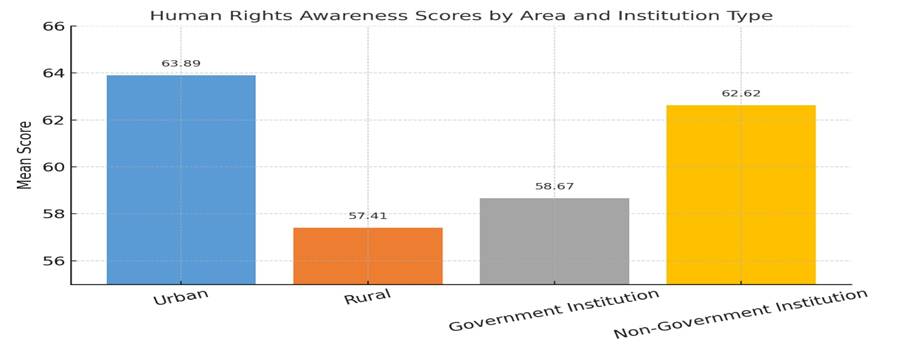
Figure 1: Mean human rights awareness scores by area and institutional affiliation (based on data from Jadav, (2016).
Schemes taken by Government of India for Women
- Ministry of Agriculture and Farmers Welfare has introduced Rashtriya Mahila Kisan Yojana for encouraging women farmer taking steps towards leadership role in field of agriculture.
- Ministry of Law and Justice introduced incentives like Bettering Women’s Rights and Gender Equality and Promotion of Legal Education Among Women for promoting, enacting and amending women centric laws and increasing female enrolment in LL.B. courses.
- Ministry of Women and Child Development has also introduced various schemes. One-stop centres is one among others where women exposed to violence get shelter, legal aid, medical examination and psychological counselling under a roof.
- Ministry of Social Justice and Empowerment initiated Mahila Samridhi Yojana for the benefit of women entrepreneur belonging to backward classes.
- Ministry of Rural Development implemented Deendayal Antyodaya Yojana-National Urban Livelihoods Mission (DAY-NULM) aiming to provide financial support to women belonging to urban areas to help them establish self-help groups (SHGs) and start micro enterprises.
How Equality Overreached or Underreached?
As we discussing the overreach and underreach of equality among women, it is also important to understand whether it is truly overreached or underreached? Let’s get into it with a real-life experience and observation.
Some opinion I received from peer side and from social media were like- “the laws are too feminine that all women are misusing it against men such as cruelty against husband and his relative under section 498A of IPC, 1860[3] and want to take undue benefit of some provisions like maintenance as provided under section 125 of Code of Criminal Procedure, 1973[4]. Some laws should be enacted for the protection of men as they require protection from such harassment and unlawful demands. While other commented: “In the name of feminism, they are doing anything that is nonsense.”
But what they would have witnessed is only the part which is overreached. As these were the women who are pursuing their higher education and have access to the digital world. The digital platform can be a boom if used rightfully as well as a bane if used wrongly. They sometimes get influenced by watching women doing wrong things for the sake of views or exposed to a woman who is highly educated and abusing her rights and thus behave accordingly. This demonstrates that the equality is overreached as they do not really need any protection but influencing the younger generation in a wrong path.
While on the other hand, in January this year I did my winter internship with Delhi State Legal Service Authority (DSLSA), where we had conducted door to door surveys for spreading legal awareness. Shockingly, those women were really not well-informed of their rights at the same time afraid to take their step into the court (probably due to its lengthy process and paper work). Even, by conduct of some women I can understand that they are subjected to some kind of violence, but are not seeking any kind of help and tolerating it silently. This demonstrated that the equality is underreach.
Therefore, in my opinion, some women who do not require any legal protection for themselves are influencing others in a negative way whilst it is dependent on the viewer’s understanding of right and wrong. Some gets driven by them due to less education or not having reached the age to determine the rightness or wrongness of their actions. Others, who genuinely requires help are under the pressure of societal norms and behind the patriarchal mindset that a woman has to tolerate the anger of the man. Thus, it creates a dual-reality where overreach and underreach co-exist, and masking each other.
Legal Rights- Must be known by all women
- Entitled to free Legal aid.
- Only a women constable shall be allowed to arrest and inquire a woman.
- No woman shall be arrested before sunrise or after sunset.
- A police officer cannot refuse to accept your FIR.
- Doctor cannot conclude verbally that a woman has been sexually assaulted or not. An application in wring is always required for the same.
- Also, only a female doctor may examine the female accused and convicts.
- Right to file FIR at anytime and at any police station.
- The identity of woman subjected to sexual violence shall be kept confidential.
Suggestions for Improvements
As the equality has not reached to all women uniformly, certain things can be done to promote equality, so that no one feels left behind and is aware that law is providing equality to everyone without creating any discrimination on any basis. The suggestions are mentioned below:
- Strict Implementation: As there are various schemes and incentives taken by the government to promote women empowerment via giving free education and access to digital facilities among rural and marginalized women, a strict compliance with the proper implementation of these schemes is required so that the benefit reaches to those who are in need of it.
- Simplifying the complex court process: The fact is known to everyone that our court process is very much lengthy, involves a lot of paper work and is complex. If we, simplified this complex process and provide speedy solutions to the required one (especially to marginalized and backward women), then they may start gaining faith on justice system and approach the court for their problems. Thus, helps in securing dual-purpose, that is, (a) social justice by including those who left behind due to complex process of court and no solution to their problem and (b) enhanced credibility and effectiveness of the judiciary system by delivering just, fair and timely judgements with greater accessibility and representation.
- Increasing Legal Literacy: Merely providing rights can never help in securing equality. It shall be known by everyone that they are entitled to certain rights, violation of which is punishable. Legal Literacy campaigns and awareness programmes should be conducted frequently to spread legal literacy. As even the women who are educated are not well aware of their legal rights and punishment associated with it. It is not only the duty of government but also everyone who is the part of the society to uplift the unprivileged and unaware one.
- Promoting awareness among Parents: The equality should be approached to the doors of every woman when we start spreading the literacy not among the young females but to their parents (especially to the mother). It is important to educate the parents as well because when parents are educated, they do not restrain or prevent their daughters to get higher education. This may help in increasing level of education among women.
- Societal Support: Society plays a crucial role contributing in the development of the female. The mindset of the society also influences the overall condition of the women. Therefore, acceptable norms for the betterment of the women are also required for the promotion of equality rather than supporting the patriarchal mindset of keeping the women away from their rights. Above mentioned points cannot be achieved without the support of the society.
- Role of governmental and non-governmental institution: Both governmental and non-governmental institutions collectively play a significant role in bridging the gap in women’s access to equality. While governmental agencies should strengthen legal aid services, establishing legal aid desk staffed by educated women for creating a women friendly environment and ensure effective implementation of laws and schemes related to women. On the other side, non-governmental organisations (NGOs) should conduct awareness programmes and legal aid campaigns to disseminate legal literacy to grassroots. The collaborative works between them such as, conducting door to door visit by Legal aid members with the help of NGOs in local language helps in disseminating legal awareness among the unreached community, simultaneously addressing individual problems.
- Equality should be equitable: Since there are instances when some women use the women centric law in an inappropriate way just to cause mental and physical harassment to another person. As equality will ensure equal protection and opportunity among every woman, equity will ensure that women get what they need. This simply means that, offering equal rights to women is not enough. Different women face different societal barriers, and thus, providing them with equity ensures fair treatment based on their individual needs.
- Enforcing punishments or penalties for misuse: On circumstances where misuse is proved against women of laws like false case of dowry and domestic violence laws or a woman who influences other women in a negative way for misusing their rights should be punished or imposing a proportionate penalty on them. This will consequently help in creating balance between overreach and underreach by preventing those who are misusing these rights and preserving these rights for those who genuinely need them.
Conclusion
The whole paper delves into the issue that development and equality reached to some women while others are left far behind. After India gained independence in 1947, various enactments and schemes were introduced that significantly contributed to the upliftment of the women in various areas. Even certain schemes and enactments are introduced and amended from time to time to ensure equality among women. Government has played a vital role for their benefit while the hon’ble court has also struck down those provisions which were derogatory for woman such as ceases the enforcement of divorce by triple talaq pronouncement by muslim man[5], Air India’s discriminatory practice of prohibiting hostesses from marrying or becoming pregnant during the term of their employment[6], etc and also empowering women like in Shah Bano case[7] (1985) the apex court held that the muslim women shall also be entitled to seek maintenance under section 125 of Cr.P.C[8] , and secured gender-equality in Githa Hariharan case (1999)[9] where section 6(a) of Hindu Minority Act[10] and section 19(b) Guardianship Act[11] which states that father is the natural guardian of a minor child, and when the father is unfit, then the mother is considered as the natural guardian of the child.
Despite such efforts, the rights are still not accessible uniformly by all the women. Therefore, new laws and schemes are not something that will help to ensure these rights to the deprived women. But the proper and strict implementation of these acts and schemes are required to be fulfilled so that intra-gender equality can be achieved.
Additionally, some allege misuse of these rights by women while other believes that the one who require it, are deprived of it. Therefore, these rights should be given equitably, meaning the rights are given according to their need. The empowerment should be achieved fairly by the rural and marginalized women when the creamy layer is excluded and those who truly needs it are given a chance of representation.
Lastly, intra-gender equality is necessary for achieving true social justice and an inclusive environment so that no one feels discriminated against on the basis of urban-rural, caste and religion divide or any other basis and no one feels isolated. The true purpose of the Constitution of providing equality to all should be achieved only when no women will feel excluded and the real approach of equality should progressively work in reality and not merely on papers.
By Riya Singh
Shri Ramswaroop Memorial University, Lucknow (225003)
[1] Indian Constitution 1950, Art. 14 & 39(d)
[2] Indian Constitution 1950, Art. 14, 15 & 16
[3] Indian Penal Code 1860, Sec. 498A
[4] Code of Criminal Procedure 1973, Sec. 125
[5] Shayara Bano vs. Union of India (2017) 9 SCC 1 (India)
[6] Air India vs. Nergesh Meerza (1981) 4 SCC 335(India)
[7] Mohd. Ahmed Khan vs Shah Bano Begum, AIR 1985 SC 945 (India)
[8] Code of Criminal Procedure, 1973; Sec. 125 (now sec. 144 of Bharatiya Nagarik Suraksha Sanhita, 2023)
[9] Githa Hariharan & Anr. Vs. Reserve Bank of India & Anr. (1999) 2 SCC 228 (India)
[10] Hindu Minority Act, 1956; Sec 6(a)
[11] Guardianship and Wards Act, 1890; Sec 19(b)