
ABSTRACT
This study explores the framework of data protection laws in India, the EU, and the US, focusing on the intricate intersection of privacy rights and data security in the digital age. It assesses India’s Digital Personal Data Protection Act 2023 concerning the GDPR and CCPA, identifying areas for enhancement and areas where disparities exist. While the DPDPA represents progress toward global standards, challenges persist in areas such as awareness, enforcement, and regulatory adaptation to technological advancements. Recommendations include enhancing stakeholder education, empowering regulatory bodies, and fostering collaboration to address identified gaps. By prioritizing these measures, India can navigate the digital landscape more effectively, ensuring comprehensive data protection and upholding privacy rights for all stakeholders.
Keywords – Data Protection, Privacy rights, Digital Personal Data Protection Act 2023 (DPDPA), GDPR, CCPA
1. Introduction
Data breaches have become a pressing issue in the digital age, especially in a country like India, which is experiencing rapid economic growth and technological advancement. As the world’s most populous democracy with a booming private sector and a thriving outsourcing industry, India has emerged as a key player in the global market for processing personal information. However, the increasing prevalence of data breaches and their implications for consumer privacy rights have raised significant concerns within the Indian regulatory landscape.
The Indian government’s surveillance systems, coupled with data protection laws, play a crucial role in shaping the country’s approach to privacy rights. The government has the authority to intercept messages in cases of public safety or during emergencies. The Supreme Court has imposed guidelines to ensure procedural fairness and judicial oversight. Recent anti-terrorism laws have expanded law enforcement powers, including the interception of communications, sparking debates about privacy infringements and the need for checks and balances.
In 2008, amendments to the I.T. Act 2000 introduced provisions for heightened data surveillance, highlighting the complexity of balancing security measures with individual privacy rights. The Right to Privacy, acknowledged as a fundamental right under Article 21 of the Constitution, empowers individuals to control the use and disclosure of their personal information, thereby ensuring privacy protections in the digital era.
Despite these legal safeguards, India has witnessed a significant number of data breaches, ranking third globally in terms of the number of breaches as of November 2021. These breaches have affected millions of Indian users, raising serious concerns about financial and security implications for individuals. The leaked information can be exploited by criminals for illegal activities such as identity fraud and financial scams, emphasising the critical necessity for strong data protection measures.
In the present era, consumer data has become a valuable commodity, with smartphones, laptops, and other devices collecting vast amounts of personal information. The collection and transmission of this data through apps raise concerns about unauthorised use and commercial exploitation, highlighting the critical importance of stringent data protection laws and their effective implementation to prevent unauthorised data breaches and transmission without consent.
The Supreme Court’s emphasis on fair and just procedures in cases involving privacy rights underscores the importance of upholding individual liberties while addressing security concerns. The existence of computerised data poses risks of creating inaccurate or misleading information about individuals, which could be exploited by unauthorised third parties, emphasising the need for comprehensive data protection measures.
2. Methodology
This study utilises a descriptive research design to assess the impact of data breaches on consumer privacy rights in India and propose preventive measures. By analysing existing literature and secondary sources such as academic journals and government publications, the research delves into the current state of data privacy and the implications of breaches. Qualitative analysis of collected data identifies trends and issues, while a comparative analysis evaluates India’s data protection measures against global standards. While primarily reliant on secondary sources, this approach provides valuable insights into data breaches and privacy rights, albeit with potential limitations in primary data collection.
3. Literature Review
The literature surrounding data protection laws spans various jurisdictions, each with its unique regulatory framework. The European Union’s GDPR, implemented in May 2018, serves as a benchmark for global data privacy standards. In contrast, India’s Digital Personal Data Protection Act 2023 (DPDPA), although enacted, awaits operationalization, signaling a significant shift in India’s data protection landscape. Similarly, the California Consumer Privacy Act (CCPA), effective from January 2020, showcases a state-level initiative to protect consumer privacy rights.
India’s focus on digital transformation underscores the critical role of data in the 21st-century economy, with the potential to drive innovation and efficiency. The proposed Personal Data Protection Bill seeks to oversee the handling of digital personal data, focusing on lawful purposes, individual consent, and obligations of data fiduciaries. While differences in scope and enforcement timelines exist, these legislative advancements underscore a worldwide movement towards fortifying data protection measures. This trend emphasises safeguarding individual rights, defining organisational duties, and enhancing governmental oversight.
4. Impact of Data Breaches on Consumer Privacy Rights in India
4.1 Overview of Data Breaches in India
● Earlier Data Protection Laws
The history of data legislation in India has been marked by discussions on whether privacy should be recognized as a fundamental right under Article 21 of the Constitution. Initially, some courts did not consider privacy as a fundamental right, while others recognized its importance. The turning point came in 2017 with the significant case of K.S. Puttaswamy v. Union of India (2018), which firmly established privacy as a fundamental right protected under Article 21. Prior to this landmark ruling, existing laws like the Information Technology Act (2000) and the Indian Penal Code (1860) contained provisions related to privacy rights. However, these laws were found to be insufficient, leading to notable data breach incidents in India.
● High-profile Data Breaches
In 2023, India encountered substantial data security challenges as several major breaches compromised the sensitive information of its citizens. One notable incident involved the train ticketing platform ‘RailYatri’, which confirmed a data breach in December 2022. Following the initial denial by the Railway Ministry regarding the sale of user data on the dark web, subsequent scrutiny highlighted discrepancies and raised concerns about data protection within the transportation sector.
Earlier in the year, another breach was reported involving an alleged leak in the CoWIN portal, a platform utilised for COVID-19 vaccination registrations. Reports surfaced about a bot on the messaging platform Telegram that leaked personal information of Indian citizens, including names, Aadhaar numbers, and passport details. Despite denials by the Health Ministry and assertions that the allegations were “mischievous,” the incident raised alarms about the security of sensitive health-related information and prompted a review of the portal’s security infrastructure by CERT-In.
‘Re-security’, an American cybersecurity firm, revealed a significant data breach impacting 815 million Indian citizens, where personally identifiable information, including Aadhaar numbers and passport details, was discovered being sold on the dark web. The uncertainty surrounding how threat actors acquired this data, alongside their assertion of accessing a substantial 1.8 terabyte data leak affecting an undisclosed “India internal law enforcement agency,” has sparked concerns regarding the magnitude and ramifications of such breaches on national security and individual privacy.
4.2 New Data Laws Introduced In India ( DPDPA 2023 )
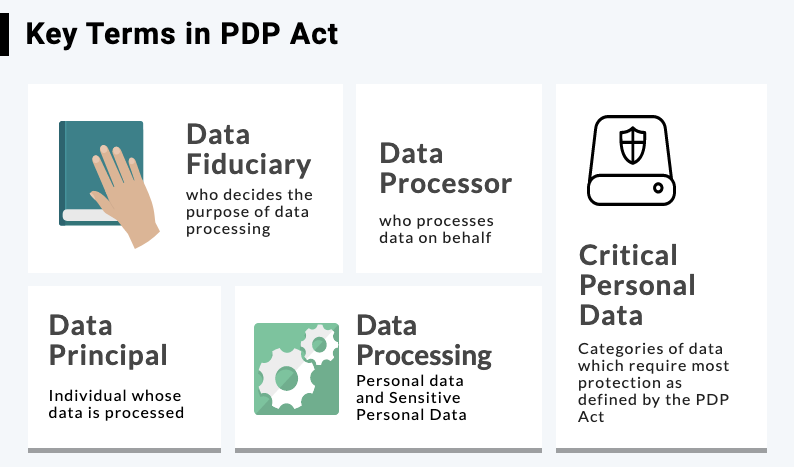
The Bill aims to safeguard digital personal data, outlining obligations for Data Fiduciaries in processing such data, delineating the rights and duties of Data Principals, and imposing financial penalties for breaches. It seeks to introduce data protection measures with minimal disruption while fostering necessary changes in data processing practices. Moreover, it strives to enhance both the quality of life and the business environment, while also nurturing India’s digital economy and fostering an innovation ecosystem.
Under the Bill, Data Fiduciaries are obligated to implement security measures to prevent personal data breaches, notify affected Data Principals and the Data Protection Board of breaches, delete personal data when no longer necessary, erase data upon withdrawal of consent, establish grievance redressal mechanisms, and appoint officers to address Data Principals’ queries. Moreover, Significant Data Fiduciaries are subject to additional obligations, such as appointing data auditors and conducting periodic Data Protection Impact Assessments to ensure a higher level of data protection.
5. Analysis of EU Data Laws (GDPR)
5.1 Overview of GDPR
The GDPR strives to streamline consent processes for users, aiming to mitigate consent fatigue caused by lengthy and convoluted guidelines that often lead users to agree without fully understanding the terms. This simplification seeks to ensure that users make informed decisions regarding their data. Moreover, GDPR requires the timely notification of any data breaches to the appropriate regulatory authority within 72 hours. This swift reporting empowers individuals to take necessary actions to protect their data, making breach notification a crucial and user-friendly provision of the regulation. Furthermore, under GDPR, users have the right to opt out of automated decision-making processes, which involve algorithms analysing their data to derive behavioural patterns. This provision is significant as it allows individuals to retain control over how their data is utilised, particularly in contexts such as algorithmic media. Another key objective of GDPR is to enhance citizen awareness about data protection rights. Despite efforts to disseminate information, a significant portion of the population remains unaware of their rights, highlighting the ongoing need for education and outreach initiatives.
5.2 Key Provisions Relevant to Data Breaches
● Data Breaches
Critical aspects concerning data breaches emphasise the importance of transparency and accessibility in informing data subjects about the handling of their data. Article 12 outlines the controller’s obligation to communicate information concisely, transparently, and in easily accessible language, ensuring clarity, particularly for children. Additionally, Article 15 ensures that data subjects can exercise their rights without undue hindrance, with controllers required to facilitate such requests. Furthermore, Article 12 mandates that controllers promptly inform data subjects of any actions taken in response to their requests, ensuring timely communication. In cases where the controller cannot fulfill a data subject’s request, Article 12 stipulates that the reasons must be communicated to the data subject within one month. Importantly, Article 12 emphasises that data subjects should not be charged for requests made under Articles 15 to 22 unless they are manifestly unfounded or excessive, highlighting the principle of accessibility to data protection rights.
5.3 Implementation and Enforcement
● Effectiveness of enforcement mechanisms
Enforcement of the GDPR is crucial for safeguarding individuals’ rights in the EU. Member States must establish independent supervisory authorities (Article 51) responsible for monitoring and enforcing compliance. These bodies perform various functions, including promoting awareness (Article 57), advising institutions (Article 58), handling complaints (Article 58), and cooperating with each other (Article 61). They also conduct investigations, encourage codes of conduct (Article 40), and maintain infringement records. Services to data subjects are free (Article 77), but fees may apply for unfounded requests (Article 77). This robust system ensures GDPR effectiveness, fostering transparency and data protection throughout the EU.
6. Analysis of US Data Laws (CCPA)
6.1 Overview of CCPA
● History and development
The California Consumer Privacy Act (CCPA) emerged as a response to growing concerns over data privacy and protection in the digital age. Enacted on June 28, 2018, it was the result of a compromise between California lawmakers and privacy activists, aiming to pre-empt a data privacy ballot initiative. This legislation marked a significant milestone in U.S. data privacy regulation, comparable to the GDPR. The CCPA was subsequently amended in September 2018, with further modifications anticipated prior to its effective date of January 1, 2020.
● Main objectives
The primary objective of the CCPA is to enhance consumer privacy rights and impose obligations on businesses in California regarding the collection, retention, and sale of consumers’ personal information. Key objectives include empowering consumers with enhanced control over their data, ensuring transparency in data handling practices, and holding businesses accountable for safeguarding personal information.
6.2 Key Provisions Relevant to Data Breaches
● Rights of data subjects
Under the CCPA, California consumers enjoy several fundamental rights. Consumers possess the right to know what personal information businesses collect about them, whether it is sold or shared, and to whom. They also have the ability to opt out of the sale of their personal information and access their data upon request. Importantly, they are entitled to equal service and pricing, irrespective of exercising their privacy rights. These provisions empower consumers to make informed choices about their data and assert control over its utilisation.
6.3 Implementation and Enforcement
● Effectiveness of enforcement mechanisms
Implementation and enforcement of the CCPA regarding private rights of action and data breach notification are critical aspects of ensuring compliance and accountability. As mentioned in 1798.155, Administrative Enforcement the CCPA allows the California Attorney General to recover statutory damages for violations that remain uncured within 30 days of notice to the business, with penalties ranging up to $7,500 per intentional violation and $2,500 per unintentional violation. Additionally, the CCPA establishes a limited private right of action for consumers affected by the exposure of their non-encrypted or non-redacted personal information due to a business’s failure to maintain reasonable security measures. Affected consumers may seek damages ranging from $100 to $750 per incident, or actual damages, following a notification to the defendant and a 30-day period to remedy the situation. Notably, the CCPA’s incorporation of a narrower definition of personal information for determining the viability of private actions aims to streamline enforcement efforts. Additionally, while the CCPA introduces new privacy standards, existing California data breach laws, such as Section 1798,82, remain largely intact, ensuring continuity in breach notification obligations governed by the narrower definition of personal information. By adhering to these provisions and promptly addressing violations, businesses can mitigate legal risks and protect consumer privacy rights effectively under the CCPA.
7. Comparative Analysis
7.1 Differences Between EU, US and Indian Data Laws
- Legitimate Interests
The GDPR and the DPDPA 2023 diverge notably in their treatment of legitimate interests as a legal basis for processing data. Whereas the GDPR recognizes legitimate interests as a lawful justification for processing personal data, it imposes specific conditions that must be met. In contrast, the DPDPA lacks a comparable provision, creating a notable gap in its framework. This omission means that the DPDPA does not explicitly allow processing personal data without consent when justified by legitimate interests. Therefore, under the GDPR, controllers have a wider latitude to use legitimate interests as a lawful basis for processing, provided they thoroughly consider and uphold the interests of data subjects.
- Adequacy Decision
The GDPR and the DPDPA differ significantly regarding the recognition of adequacy decisions for international data transfers. Under GDPR, transfers of consumer data to countries with an adequacy decision from the European Commission are exempt from additional safeguard requirements. The DPDPA lacks a provision addressing adequacy decisions, which represents a significant gap in the framework. While the DPDPA permits transfers of personal data under additional guidance from the Indian central government, it does not establish a mechanism for the European Commission to issue adequacy decisions for data transfers to India. This omission creates uncertainty and potential complications for cross-border data flows.
- Transfer Mechanism
The GDPR and the DPDPA diverge notably in addressing transfer mechanisms for international data transfers. According to the GDPR, controllers are required to implement suitable transfer mechanisms, conduct transfer impact assessments (TIAs), and adopt additional measures for transfers to jurisdictions not on the whitelist. In contrast, the DPDPA lacks specific provisions for transfer mechanisms, leaving a significant gap in the framework. While the DPDPA allows for additional guidance from the Indian government, the absence of predefined transfer mechanisms may pose challenges and uncertainties for cross-border data transfers, highlighting a disparity between the two regulatory regimes.
- Right to Object to and Restrict Processing
A significant difference between the GDPR and DPDPA 2023 is evident in how they acknowledge the rights concerning objections to and limitations on processing. Under the GDPR, data subjects possess explicit rights to object to process or request restrictions under certain circumstances, offering individuals greater control over their personal data. In contrast, the DPDPA lacks specific provisions delineating instances for data principals to exercise such rights. While data principals can withdraw consent, the absence of explicit rights to object or restrict processing in the DPDPA framework presents a gap in data subject empowerment and protection compared to the GDPR.
- Right to Data Portability
Under the GDPR, individuals have a clear entitlement to request the transfer of their personal data to another controller, subject to specific exceptions. This empowers individuals with greater control over their data and facilitates interoperability between service providers. Conversely, the DPDPA lacks provisions for data portability, representing a notable gap in data subject rights compared to the GDPR. The absence of this right in the DPDPA framework limits individuals’ ability to seamlessly transfer their personal data between controllers, highlighting a disparity in data protection standards between the two regulatory regimes.
8. Recommendations for India
8.1 Policy Recommendations
To meet the requirements of the DPDPA 2023, data fiduciaries must adhere strictly to authorised legal grounds for processing personal data. Specifically, when processing personal data based on legitimate interests, it is crucial to perform a comprehensive evaluation to ascertain whether such processing is necessary and appropriate considering the interests and fundamental rights of the individuals concerned. Fiduciaries should document this assessment to showcase accountability and transparency in their data processing procedures.
In anticipation of the publication of a list of restricted countries by the Indian government, data transfers to these countries should be closely monitored and restricted accordingly. Until the publication of this list, data fiduciaries must exercise caution and refrain from transferring personal data to countries where such transfers may be restricted.
In order to address grievances effectively, data fiduciaries must implement robust grievance redressal mechanisms. These mechanisms should allow data subjects to raise concerns internally and provide a clear process for resolving grievances promptly. By establishing transparent procedures and channels for communication, data fiduciaries can foster trust and demonstrate their commitment to upholding consumer data privacy rights.
Data fiduciaries must enable data subjects to designate representatives who can advocate on their behalf regarding their personal data. This empowers data subjects with enhanced control over their data and ensures their interests are well-represented in the data processing activities performed by fiduciaries
9. Conclusion
In conclusion, Comparing data protection laws in India, the EU, and the US reveals both commonalities and differences., illustrating the intricate landscape of privacy rights and data security in the digital age. India’s implementation of the DPDPA 2023 represents a notable step forward in harmonising international data protection norms and cultivating a robust digital environment. However, there remain notable gaps and opportunities for enhancement compared to the GDPR and CCPA.
The DPDPA is a pivotal milestone, but policymakers and stakeholders must address key challenges and fortify the regulatory framework to ensure comprehensive protection of consumer data to uphold privacy rights. Priorities include enhancing awareness, bolstering enforcement mechanisms, and fostering continuous evaluation and adaptation of regulations to keep pace with technological advancements.
To bridge identified gaps, efforts should focus on educating stakeholders, empowering regulatory bodies, and fostering collaboration among diverse actors. By prioritising these recommendations and fostering a collective approach to data governance, India has the potential to successfully maneuver through the challenges of the digital age, forging a path towards a future that is secure, transparent, and fair for all.
NAME – SWAJAY DIXIT
COLLEGE NAME – Kirit P. Mehta School of Law , NMIMS MUMBAI