

I. Introduction
The term “Juvenile” refers to a young person who still exhibits childlike qualities. “Delinquency” means not following societal norms or failing to fulfil responsibilities, which can involve committing crimes or doing wrong. “Justice” relates to fairness, equity, and genuine respect for people. It is about seeking moral righteousness and fair treatment against unfair behaviour.
The Juvenile Justice System falls within the realm of criminal law and aims to address the needs of young individuals who are not yet old enough to be held fully responsible for their criminal actions.
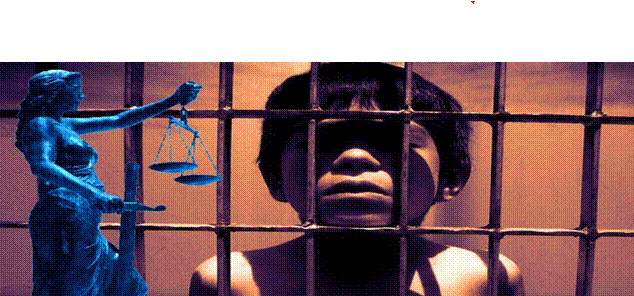
Juvenile delinquency occurs when young individuals engage in acts that go against society. Juvenile Justice means ensuring just, fair, and equitable treatment for children and young individuals to shape their personalities within society.
The Juvenile Justice System deals with the challenges faced by children and society. Its primary objective is to protect children by providing appropriate treatment and creating an environment that fosters positive human development. It is a socio-legal approach to establishing conditions for rehabilitating delinquent juveniles.
II. History of Juvenile Justice System in India
In recent times, there has been a global movement advocating for special treatment of juvenile offenders, including in developed countries like the U.K. and U.S.A. This movement originated around the 18th century. Before this movement, juvenile offenders were treated the same as adult criminals.
In recognition of the need to protect the rights of juvenile offenders, the United Nations General Assembly adopted the Convention on the Rights of the Child on November 20, 1989. This convention aims to safeguard the best interests of juvenile offenders and states that there should be no judicial proceedings and court trials against them in order to promote their social reintegration.
In response to this convention, the Indian Legislation repealed the Juvenile Justice Act of 1986 and introduced a new law called “The Juvenile Justice (Care and Protection of Children) Act, 2000.” The previous Juvenile Justice Act of 1986, which replaced the Children Act of 1960, aimed to implement the guidelines outlined in the Standard Minimum Rules for the Administration of Juvenile Justice adopted by U.N. member countries in November 1985.
This act consisted of 63 sections and 7 chapters, applicable throughout India except for the state of Jammu and Kashmir. Its primary objective was to provide care, protection, treatment, development, and rehabilitation for neglected juvenile delinquents. The main goals of the act were:
- Establishing a uniform framework for juvenile justice in the country that protects the rights and interests of juveniles.
- Outlining the necessary machinery and infrastructure for juvenile offenders’ care, protection, treatment, development, and rehabilitation.
- Providing basic provisions for the proper and fair administration of criminal justice in cases involving serious crimes committed by juvenile offenders.
Juvenile Justice Act, 2000
The Juvenile Justice (Care and Protection of Children) Act was initially enacted in the year 2000 to provide protection for children. This act underwent two amendments, first in 2006 and later in 2011, in order to address gaps and loopholes in its implementation.
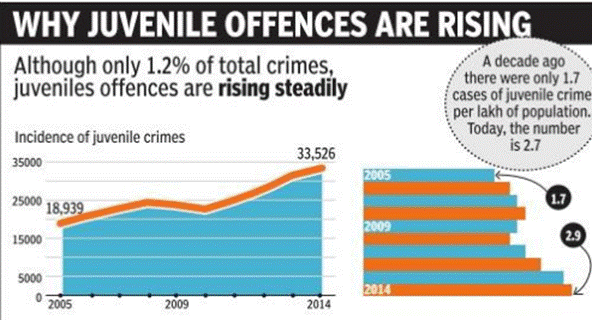
However, in recent years, there has been a significant increase in cases of juvenile crimes. The horrific incident of the “Delhi Gang Rape Case” brought attention to the shortcomings of the existing law.
The Act was found to have inadequate legal provisions, and the malfunctioning juvenile system also contributed to the prevention of juvenile crimes in India. As a result, the Act was replaced by The Juvenile Justice (Care and Protection) Act in 2015.
Juvenile Justice Act, 2015
The Juvenile Justice Act of 2015 replaced the Juvenile Justice Act of 2000 in order to establish a more robust and effective justice system that incorporates both deterrent and reformative approaches.
The new act recognizes that the approach towards juveniles should be different from that of adults. It emphasizes the need to provide juveniles with space for transformation, reformation, and improvement, which requires a specialized justice system.
The Juvenile Justice (Care and Protection of Children) Act, 2015 introduced several key features. It defines a child as someone below 18 and distinguishes between a “Child in Need of Care and Protection” and a “Child in Conflict with Law.”
The act classifies offences into heinous, serious, and petty categories. It allows for juveniles between the ages of 16 and 18 to be tried as adults after considering their mental capacity.
The act also introduced the establishment of Juvenile courts, dedicated to handling juvenile offenses. Additionally, it expanded the scope of the definition of a “Child in Need of Care and Protection.”
This includes situations where the child’s guardians are unfit or uninterested in caring for them, when the child is engaged in labour in violation of labour laws, or when there is a risk of marriage before reaching the lawful age.
The act also addresses adoption, recognizing the rights of adopted children. Its primary goals are to consolidate laws relating to children in conflict with the law and children in need of care and protection. It aims to cater to their basic needs by providing proper care, protection, development, treatment, and social integration.
The act adopts a child-friendly approach in the adjudication and disposal of matters in the best interest of children. Rehabilitation of juvenile offenders is emphasized through various child care houses and institutions
III. Present Juvenile Justice System in India
In line with other countries, India has established legal provisions that specifically address the rights and protection of juvenile offenders, aiming to address the issue of juvenile delinquency. The Juvenile Justice System in India is built on three key assumptions:
- Young offenders should not be brought before regular courts but should instead be guided and corrected through various means.
- Juvenile offenders should not be subjected to punishment by the courts; instead, they should be given an opportunity to reform and reintegrate into society.
- The trial process for children in conflict with the law should focus on non-penal treatment, utilizing community-based social control agencies such as Observation Homes and Special Homes.
- These principles form the foundation of the Juvenile Justice System in India, emphasizing rehabilitation and reintegration rather than punitive measures for juvenile offenders.
III. Specific Provisions of the Legal Code and Relevant Case Laws
Sections 82 and 83 of the Indian Penal Code (IPC), 1860 indeed deal with the exclusion of juveniles from prosecution. In the case of Kakoo v. Union of India, the Supreme Court reduced the prison sentence of a 13-year-old boy who had raped a 2-year-old girl.
The court considered Sections 83 and 84 of the IPC, which specify that juveniles cannot be treated as adults. It is well-established in law that when dealing with juveniles, the court must take into account both reformative and humanitarian perspectives.
However, in the case of Heeralal v. Union of India, a child threatened an adult by chopping him into pieces and stabbing another individual to death. The court convicted him, citing the fact that the boy was of legal age. The apex court also rejected the petition.
In the case of Satya Deo v. State of Uttar Pradesh, it was held that a child should not be denied the right to be treated as a juvenile at the time of the commission of an offence if they were under the age of 18, even if the offence occurred before the implementation of the Juvenile Justice Act of 2000. Section 25 of the Juvenile Justice Act, 2015 states that the 2000 Act will continue to apply to cases that were pending prior to the passage of the 2015 Act.
In the case of Salil Bali v. Union of India, there was an argument to amend the current Juvenile Justice Act to lower the age from 18 to 16 years and to try juveniles who commit heinous crimes such as rape and murder as adults.
The Supreme Court rejected the petition, stating that the Juvenile Act is based on sound principles and is in accordance with the Indian Constitution. Several international instruments, including the Beijing Rules and the Riyadh Guidelines, recognize child rights and allow for separate criminal justice systems for juveniles.
- Present juvenile justice system in india
Like the other countries, India had also made legal provisions that especially and specifically deals with the rights and protection of juvenile offenders which seeks to tackle the problem of juvenile delinquency. The Juvenile Justice System in India is made on the basis of three main assumptions:-
- young offenders should not be tried in courts, rather they should be corrected in all the best possible ways,
- they should not be punished by the courts, but they should get a chance to reform
- trial for child in conflict with law should be based on non-penal treatment through the communities based upon the social control agencies for e.g. Observation Homes and Special Homes.
- JUVENILE JUSTICE BOARD
There shall be a constitution of Board for the purpose of inquiry and hearing in the matters of juvenile in conflict with law.
The Board shall consists of Principal Magistrate and two social workers, among whom one should be a women. The Act provides that under no circumstances the Board can regulate and operate from regular court premises. The decision taken by the Principal Magistrate shall be final.
Special Procedure of Juvenile Justice Board:
The Act has provided the procedure against the juvenile offender. Following are the main special procedure –
The proceedings cannot be initiated on a complaint registered by the police or citizen
The hearing must be informal and should be strictly confidential.
The offenders should be kept under Observation Home after detention.
The trial of juvenile in conflict with law shall be conducted by Lady Magistrate.
A child in conflict with law may be produced before an individual member of the Board, when Board is not sitting.
VIII. Conclusion
The Juvenile Justice System aims to provide special treatment and protection for juvenile offenders based on the understanding that children are not fully mature like adults and may not fully comprehend the nature and consequences of their actions. The system focuses on reform and rehabilitation rather than punishment, considering the child’s best interests.
The Juvenile Justice Act of 2015 in India replaced the previous legislation to strengthen the justice system for juveniles, introducing provisions for the classification of offences, the establishment of juvenile courts, and expanding the definition of children in need of care and protection. The Act emphasizes juvenile offenders’ care, protection, development, and social integration
.
References
- Convention Relating to the Status of Refugees, July 28, 1951, 189 U.N.T.S. 150.
- UN General Assembly, Universal Declaration of Human Rights, 10 December 1948, 217 A (III); International Covenant on Civil and Political Rights, 1966; OAU Convention Governing the Specific Aspects of Refugee Problems in Africa, 1969.
- Convention Relating to the Status of Refugees, Article 33.
- Hathaway, James C., “The Law of Refugee Status,” Butterworths, Canada, 1991.
- Constitution of India, Art. 21.
- National Human Rights Commission v. State of Arunachal Pradesh, (1996) 1 SCC 742.
- Ktaer Abbas Habib Al Qutaifi v. Union of India, 1999 CriLJ 919 (Gujarat HC).
- Amnesty International, “India: Rohingya Face Risk of Forced Return,” Report (2018).
- UNHCR, “The Environment & Climate Change,” www.unhcr.org/environment.
- UNHCR, “Global Trends: Forced Displacement in 2023,” https://www.unhcr.org/globaltrends.
Author –
Jayesh Arya
BALLB 10th Semester, Amity Law School, Amity University Gwalior M.P