
ABSTRACT
Environmental protection is an imperative for sustainable development and the survival of human beings. Not only it is the question of the living system of the very Earth but its existence. The Indian Constitution, through judicial interpretations and provisions thereof, has created a strong legal framework for protecting the environment. This paper analyses constitutional provisions, judicial precedents, legislative acts, and amendments shall serve as the foundation of environmental jurisprudence in India. The paper also identifies historical developments, leading judgments, and challenges and proposes some improvements for proper environmental governance.
1.INTRODUCTION
Protection of the environment is a necessary component of governance, and the Indian Constitution lays a solid groundwork for its enforcement. The integration of environmental responsibilities in the Directive Principles of State Policy (DPSP) and the Fundamental Duties emphasizes the dedication of the state towards sustainability as enshrining of the fundamental rights in constitution plays a major role over providing and protecting the environment. The judiciary has taken an active role in consolidating environmental jurisprudence, interpreting the right to a healthy and clean environment under Article 21. This paper critically examines constitutional requirements on environmental protection, their historical development, amendments, and important judicial interpretation
2.HISTORICAL BACKGROUND
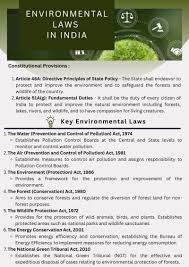
The origins of environmental protection in India go back to ancient times when nature was revered, and conservation was a part of social values. The pre-independence period had few legal provisions relating to environmental protection, with legislation such as the Indian Penal Code, 1860, and the Factories Act, 1948, touching upon pollution control. Post-independence saw a transition with constitutional integration of environmental issues, especially following the Stockholm Conference of 1972, resulting in the 42nd Amendment Act of 1976, which added Article 48A and Article 51A(g) to the Constitution.
3.RESEARCH METHODOLOGY
This study adopts a doctrinal legal research approach based on constitutional provisions, judicial statements, legislative enactments, and amendments. Primary sources like constitutional articles and Supreme Court judgments are analysed in conjunction with secondary sources like books, journal articles, and reports of environmental law specialists.
4.REVIEW OF LITERATURE
A number of scholars have elaborately written on the constitutional mechanism of environmental protection in India. Textbooks such as “Environmental Law in India” by P. Leelakrishnan, “Environmental and Pollution Laws in India” by Justice T S DOABIA and research articles on judicial activism in environmental cases give a holistic overview of the topic. Case laws like M.C. Mehta v. Union of India, AIR 1987 SC 1086, and Vellore Citizens’ Welfare Forum v. Union of India, AIR 1996 SC 2715, are important references in this context.
5.METHOD
The article critically analyses constitutional provisions such as Article 48A, which instructs the state to safeguard and enhance the environment, and Article 51A(g), which places a fundamental duty on citizens to protect nature. The study also evaluates the contribution of judicial activism, specifically through Public Interest Litigations (PILs) that have resulted in landmark environmental judgments along with this, the study also focuses upon the various doctrines and principles that have evolved through the decisions of the Supreme Court.
6.CONSTITUTIONAL FRAMEWORK FOR ENVIRONMENTAL PROTECTION
6.1Basic Rights and Environmental Protection
6.1.1Right to life and a clean environment
Article 21
Subhash Kumar v. State of Bihar, AIR 1991 SC 420
A petition under Article 32 by way of public interest litigation was filed seeking a writ or direction preventing alleged pollution of the Bokaro river water from the sludge/slurry discharged from the washeries of the Tata Iron and Steel Co. Ltd. However, on a perusal of the counter affidavit filed on behalf of Directors of Collieries and TISCO it appeared that the petitioner, an influential businessman, had been purchasing slurry from them for last several years but when the respondent company refused to succumb to the petitioner’s pressure of supplying more quantity of slurry he removed the company’s slurry in an unauthorised manner and also initiated several proceedings before High Court under Article 226. Dismissing the petition the Supreme Court K.N. SINGH, J. stated that –
Right to live is a fundamental right under Article 21 of the Constitution and it includes the right of enjoyment of pollution-free water and air for full enjoyment of life. A petition under Article 32 for the prevention of pollution is maintainable at the instance of affected persons or even by a group of social workers or journalists. A person invoking the jurisdiction of the Supreme Court under Article 32 must approach the Court for the vindication of the fundamental rights of affected persons. It is therefore, the duty of the Supreme Court to discourage such petitions and to ensure that the course of justice is not obstructed or polluted by unscrupulous litigants by invoking the extraordinary jurisdiction of the Supreme Court for personal matters under the garb of the public interest litigation. The petition had been filed not in any public interest but for petitioner’s personal interest. Therefore, the petition is liable to be dismissed and petitioner is directed to nav Re 5000 as costs.
6.1.2 Right to equality in environmental terms, avoiding arbitrary state action impacting ecological balance.
Article14
The Supreme Court of India’s 2024 judgment in M.K. Ranjitsinh and Others v. Union of India and Others is a landmark case that established a constitutional right to be free from the adverse effects of climate change. Linking the right against climate change to Articles 21 and 14, Chief Justice Chandrachud said the rights to life and equality could not be fully realised without a clean, stable environment.
“The right to health (which is a part of the right to life under Article 21) is impacted due to factors such as air pollution, shifts in vector-borne diseases, rising temperatures, droughts, shortages in food supplies due to crop failure, storms, and flooding. The inability of underserved communities to adapt to climate change or cope with its effects violates the right to life as well as the right to equality… If climate change and environmental degradation lead to acute food and water shortages in a particular area, poorer communities will suffer more than richer ones,” the judgment said.The judgment noted that the right to a healthy environment, safe from the ill-effects of climate change, was a “fundamental human right”.
6.2Directive Principles of State Policy (DPSP) AND Fundamental Duties
42nd Amendment, 1976: Added Article 48A and Article 51A(g), a constitutional pledge towards protecting the environment.
6.2.1State duty to protect and improve the environment and Responsibility of the citizen to safeguard the natural environment, including forests, wildlife, and water bodies.
Article 48A
Article 51A(g)
State of Gujarat v. Mirzapur Moti Kureshi Kassab Jamat and ORS. 2005
Articles 48~A and 51-A were not a part of the Constitution when Quareshi and Mohd. Faruk’s cases were decided by this Court. Further, Article 48 of the Constitution has also been assigned a higher weightage and wider expanse by the Supreme Court post Quareshi. Article 48 consists of two parts. The first part enjoins the State to “endeavour to organize agricultural and animal husbandry” and that too “on modern and scientific lines”. The emphasis is not only on ‘organization’ but also on ‘modern and scientific lines’. The subject is ‘agriculture and animal husbandry’. The second part of Article 48 enjoins the State, de hors the generality of the mandate contained in its first part, to take steps, in particular, “for preserving and improving the breeds and prohibiting the slaughter of cows and calves and other milch and draught cattle” Article 48-A deals with “environment, forests and wild life”. Protection and improvement of environment is necessary for safeguarding forests and wild life, which in turn protects and improves the environment. The impugned enactment enables the State in its endeavour to protect and improve the environment within the meaning of Article 48A of the Constitution. By enacting clause (g) in Article 51-A and giving it the status of a fundamental duty, one of the objects sought to be achieved by the Parliament is to ensure that the spirit and message of Articles 48 and 48A is honoured as a fundamental duty of every citizen.
6.2.2Resource distribution principles to maintain environmental sustainability
Article 39(b) and (c)
State of Karnataka and Anr etc. V. Shri Ranganatha Reddy & Anr. Etc. 1977
Article 39(b) fulfils the basic purpose of restructuring the economic order undertakes to distribute the entire material resources of the comn1unity, as best to subserve the common good. To exclude ownership of private resources from its very purpose of redistribution the socialist. Article 39(b) is ample enough to rope in buses. as motor vehicles, are part of the material resources of the operators. The Court observed: The State symbolises, represents and acts for the good of society. Its concerns are the ways of neglecting the wants of the community, directly or otherwise, and the public sector in our constitutional system. is a strategic tool in the national plan for transformation from stark poverty to social justice, transcending administrative and judicial allergies. Part JV- of –the Constitution, especially Article 39(b) ‘·and (c) – is a futuristic mandate to the State with the message -of transformation of the economic md social order. Such. change· cans_ for collaborative effort_ from all the 1egal institutions of the system; the legislature. the judiciary and the administrative machinery.
6.5Judicial Interpretation & Landmark Cases
6.5.1The Polluter Pays Principle (PPP) was born in international environmental law and was initially formulated by the Organisation for Economic Co-operation and Development (OECD) in 1972. The principle requires that the responsible party for pollution has to bear the expenses involved in its mitigation and remediation. The Rio Declaration on Environment and Development (1992) later reaffirmed this principle under Principle 16.
In India, the doctrine became prominent in the 1980s and 1990s by virtue of judicial interpretations under Article 21 of the Indian Constitution, which ensures the Right to Life.
Indian Council for Enviro-Legal Action v. Union of India (1996) – The Supreme Court declared polluting industries as responsible to compensate for harm done to the environment. The Supreme Court of India recognized and endorsed the ‘Polluter Pays’ principle as a fundamental aspect of environmental law. The court emphasized that this principle not only reinforces the right to a clean and healthy environment but also necessitates that polluters bear the financial and remedial responsibilities for environmental damage.The court directed the Union of India and state governments to implement stricter measures for environmental regulation and enforcement. It called for the establishment of effective mechanisms for monitoring, compliance, and penalties for violations. Furthermore, the court mandated that adequate compensation be provided to the victims of pollution and that comprehensive remediation plans be put in place to restore damaged environments.
Vellore Citizens’ Welfare Forum v. Union of India [1996] Supp. (5) S.C.R. 241
The court acknowledged the Polluter Pays Principle for the first time as an element of environmental law in India. 1. “The Precautionary Principle” and “The Polluter Pays” principle are essential features of “Sustainable Development”. The “Precautionary principle” – in the context of the municipal law-means : (i) Environmental measures – by the State Government and the statutory authorities – must anticipate, prevent and attack the causes of environmental degradation. (ii) Where there are threats of serious and irreversible damage, lack of scientific certainty should not be used as a reason for postponing measures to prevent environmental degradation. (iii) The “Onus of proof’ is on the actor or the developer/industrialist to show that his section is environmentally benign. “The Polluter Pays” principle has been held to be a sound principle by this Court. The “Polluter Pays” principle as interpreted by this Court means that the absolute liability for harm to the environment extends not only to compensate the victims of pollution but also the cost of restoring the environmental degradation. Remediation of the damaged environment is :part of the process of “Sustainable development” and as such polluter is liable to pay the cost to the individual sufferers as well as the cost of reversing the damaged ecology.
Legislative Support
Environment Protection Act, 1986
Water (Prevention and Control of Pollution) Act, 1974
Air (Prevention and Control of Pollution) Act, 1981
6.5.2The Precautionary Principle developed as a component of international environmental jurisprudence, focusing on the importance of preventive action in environmental management. Principle 15 of the Rio Declaration (1992) provides that insufficient scientific certainty should not be used as a basis for delaying measures to prevent environmental harm.
A.P. Pollution Control Board v. M.V. Nayudu [1999] 1 S.C.R. 235 –
The principle was invoked to prohibit industrial activity that is likely to cause harm to the environment. 1. Environmental concerns arising in the Supreme Court under Article 32 or under Article 136 or under Article 226 in the High · Courts are of equal importance as human rights concerns. Both are to be. traced to Article ’21 which deals with the fundamental right to life and liberty; ‘While environmental aspects, concern “life”, human rights aspects p concern “liberty”. In the context of emerging jurisprudence relating to environmental matters-as is the case in matters relating to human rights-it is the duty of this Court to render justice by taking all aspects into consideration. However, in such cases sometimes, this Court has been finding sufficient difficulty in providing adequate solutions to meet the requirements of public interest environmental protection, elimination of pollution and sustained development. Any opinion rendered by the said authority would, of course be subject to the approval of this Court. Such a procedure can be adopted in matters arising in this court under Article 32 or under Article 136 or arising before the High Courts under Article 226 of the Constitution of India. It is perfectly within the bounds of the law.
Narmada Bachao Andolan v. Union of India (2000) –
The court emphasized the importance of environmental impact assessments prior to sanctioning large projects the Supreme Court has issued specific directives regarding the construction of a dam, limiting it to a height of 90 meters.
The National Commission on Agriculture (NCA) holds the authority to grant further permission for dam construction, and reports from grievance redressal authorities are to be accorded significant importance.
The decision to grant clearance emphasizes the pressing issue of inadequate water availability even seven decades after gaining independence. This shortage violates Article 21 and the human rights resolutions of the United Nations.
The use of Public Interest Litigation (PIL) should be circumscribed to prevent its misuse and maintain its intended purpose.
also underscores the need for fostering social inclusivity in India, bringing diverse communities closer together. The government has a responsibility to provide essential modern amenities such as drinking water, electricity, irrigation, and rehabilitation facilities. The court’s direction is contingent upon the absence of adverse circumstances and credible studies demonstrating harm to the ecosystem.
Legislative Support
Environmental Impact Assessment Notification, 2006 (Environment Protection Act, 1986)
Biodiversity Act, 2002
6.5.3The Doctrine of Public Trust is based on Roman law and states that some natural resources are vested in the government in trust for public purposes. The doctrine was brought into Indian environmental law through judicial interpretation and has played a key role in safeguarding public resources from commercial exploitation.
M.C. Mehta v. Kamal Nath (1997) 1 SCC 388
The Supreme Court applied the Public Trust Doctrine to check encroachment on forest lands.
This case was heard in court by a two-judge panel, which ordered and instructed that: After so much deliberation, the court granted the “Public Trust Doctrine” in this case. The public trust doctrine, as stated by the judges throughout the hearing, should be included in the Land laws. The court rejected the earlier approval issued by the Ministry of Environment and Forests, as well as the lease instrument in favour of the corporation for an area of 27.12 bighas.
The Himachal Pradesh government was given the task of taking control of the land and returning it to its natural and environmental state. The court ordered the hotel to pay the cost of environmental and ecological restitution settlement under the Polluter Pay Principle.
The pollution generated by the construction of the hotel on the River banks of the Beas was ordered to be reversed and removed by the court.
From the Motel’s border wall, the river basin should be left intact. The river’s bank and basin should be left accessible to the general population. The Board was ordered to inspect all hotels, institutions, and companies in the Kullu-Manali area, and if any of them are discovered red-handed releasing untreated garbage into the river, the Board shall take strict legal action against them. The Motel, through its management, should demonstrate why an extra pollution fee is not mandatory
Centre for Environmental Law v. Union of India (2013) –
The principle was applied to conservation of biodiversity and natural habitats.
The court directed the National Board for Wildlife (NBWL) to have a fresh look on the subject and file a report. The NBWL then met and made the following observations: The population of Asiatic Lions in India has been restricted to its habitat in the Gir National Park and Gir Sanctuary alone, where they face threats due to man-animal conflict, outbreak of possible epidemic or any natural calamity, etc. Such actions may wipe out the whole population. The need for a second home for the Asiatic Lions was therefore felt and accordingly, based on habitat feasibility studies by the Wildlife Institute of India in various Protected Areas and forests of Gujarat, Rajasthan and Madhya Pradesh, three different sites were finally studied in greater detail out of which Kuno Palpur sanctuary in Morena District of Madhya Pradesh was found most suitable for re-introduction and establishing a second free-ranging population of Asiatic Lion outside Gir
Legislative Support
Indian Forest Act, 1927
Wildlife Protection Act, 1972
Coastal Regulation Zone (CRZ) Notification, 2011
6.5.4Sustainable Development was officially established in the Brundtland Commission Report (1987) as “development that meets the needs of the present without compromising the ability of future generations to meet their own needs.” India incorporated this principle by way of constitutional provisions, policies, and judicial activism.
S. Jagannath v. Union of India (1997) –
The doctrine was extended to control shrimp farming along coastal areas.
The Court held that “No shrimp culture pond can be constructed or set up within the coastal regulation zone as defined in the CRZ notification. This shall be applicable to all seas, bays, estuaries, creeks, rivers and backwaters. This direction shall not apply to traditional and improved traditional types of technologies (as defined in Alagarswami Report) which are practised in the coastal low-lying areas. The agricultural lands, salt pan lands, mangroves, wetlands, forest lands, land for village common purpose and the land meant for public purposes shall not be used/converted for construction of shrimp culture ponds.”
Set-up outside the coastal regulation zone (CRZ): Aquaculture industry/shrimp culture industry/shrimp culture ponds other than traditional and improved traditional may be set up/ constructed outside the coastal regulation zone as defined by the CRZ Notification and outside 1000 mts of Chilka and Pulicat Lakes with the prior approval of the “Authority” as constituted by this Court.
Legislative Support
National Green Tribunal Act, 2010
Forest Conservation Act, 1980
National Environment Policy, 2006
7.SUGGESTIONS
Improved Enforcement of Environmental Laws: Need for tighter enforcement of current environmental legislation with real-time monitoring provisions.
Environmental Tribunals and Courts: Enhancing the jurisdiction and effectiveness of the National Green Tribunal (NGT) to hasten environmental cases.
Public Participation: Strengthening community participation in environmental policy formulation to achieve sustainable development.
Climate Change Law: Enactment of an overall national climate change law that covers mitigation and adaptation measures.
Corporate Accountability: Enhancing corporate responsibility and liability structures for industrial pollution and environmental degradation.
International Cooperation: Harmonizing Indian environmental legislation with international treaties and obligations to promote enhanced enforcement.
8.CONCLUSION
The Indian Constitution, by way of provisions and judicial rulings, has established a robust basis for environmental protection. Challenges in enforcement and policy implementation, though, still remain. Weakening the legal system, judicial efficiency, and creating public awareness are essential for achieving sustainable environmental governance. Future policies must emphasize balancing development with ecological preservation to achieve constitutional obligations successfully.
9.BIBLIOGRAPHY & FOOTNOTES
Subhash Kumar v. State of Bihar, AIR 1991 SC 420.
M.C. Mehta v. Union of India, AIR 1987 SC 1086.
Vellore Citizens’ Welfare Forum v. Union of India, AIR 1996 SC 2715.
T.N. Godavarman Thirumulpad v. Union of India, AIR 1997 SC 1228.
Indian Council for Enviro-Legal Action v. Union of India, AIR 1996 SC 1446.
Leelakrishnan, P. Environmental Law in India (3rd ed., LexisNexis 2019).
Divan, Shyam & Rosencranz, Armin. Environmental Law and Policy in India (2nd ed., Oxford University Press 2001).
National Green Tribunal Act, 2010.
The Environment Protection Act, 1986.
Bluebook Citation Style, 20th Ed.
TEJAS SHUKLA
AMITY UNIVERSITY, MADHYA PRADESH
B.A, LLB (H), 4TH YEAR