
ABSTRACT
A fundamental component of tort law is the law of negligence, which deals with situations in which injury results from a failure to exercise reasonable care as opposed to deliberate misconduct. This article examines the three crucial elements—duty of care, violation of duty, and causation—necessary to prove negligence. These components work together to create the framework for negligence claims, which hold people and organizations responsible for damages brought on by negligence.
The legal duty of care is the responsibility to take reasonable precautions to avoid foreseeable injury to others. This duty was established by the famous Donoghue v. Stevenson decision (1932), which established the well-known “neighbor principle.” Since then, courts have established standards of proximity, foreseeability, and public policy factors to further define the duty of care. The “reasonable person” criterion, an objective metric used to determine if the defendant’s acts or in-actions differed from what a prudent person would do in a comparable circumstance, is used to evaluate the duty breach. A breach is determined by a number of important factors, including the likelihood and degree of injury, the cost of precautions, and the societal utility of the defendant’s acts. Both factual causation—established by the “but-for” test—and legal causation—which restricts culpability to harm that was directly foreseeable as a result of the breach—are involved in causation, which connects the duty violation to the injury experienced. The law’s ability to handle certain situations is demonstrated by ideas such as the “eggshell skull” rule, which holds defendants liable for harm that was not reasonably foreseeable.
KEYWORDS
Negligence, duty, breach, causation, injury, damage.
INTRODUCTION
“When there is no intention of causing harm to the person complained of – it is called as negligence. Carelessness on the part of defendant constitutes negligence. If, there is an unreasonable conduct followed by harm to another-it gives rise to liability for negligence. “
By holding people accountable when their negligent behavior causes harm or damage to others, negligence law helps to preserve a balance between personal accountability and social norms. Since the establishment of its fundamental ideas, this field of law has seen substantial change, adjusting to the demands of a contemporary society that is becoming more intricately entwined with intricate relationships in a variety of situations, such as healthcare, banking, transportation, and technology.
Given the open-ended form of the duty, breach, and proximate cause elements of negligence, and the lack of any well-accepted descriptive theory that would give greater certainty and clarity, the most attractive option to any restater would be to try to do what Holmes suggested for the breach of duty element: dissolve each of the open-ended elements into a set of specific sub-rules that all together provide clarity and certainty. Within the confines of Holmes’ descriptive theory, there seems to be only one alternative to this approach. One might restate the law of negligence in a different form than other law, thus simply accepting the irreducible open- endedness of much of the law of negligence, while perhaps achieving greater certainty and clarity in those parts of negligence law that can be reduced to specific rules.
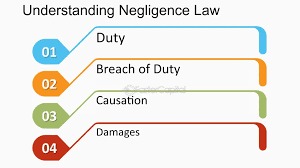
As early courts and commentators explored the developing tort of negligence, they increasingly divided it into its essential pieces- “elements”-centered on a defendant’s failure to exercise due care and the plaintiffs proximately resulting harm. As negligence law proceeded to evolve, its elements were stated in a variety of ways, but most courts and commentators in time came to assert that it contains four elements. In perhaps its most conventional current iteration, negligence is formulated in terms of duty, breach, cause, and damage.
THE CONCEPT OF DUTY OF CARE
The seminal decision of Donoghue v. Stevenson (1932) solidified the idea of duty of care. Lord Atkin established the “neighbor principle” in this instance, which mandates that people exercise reasonable caution to refrain from actions or inactions that might endanger their “neighbors”—those who are immediately and predictably impacted by their decisions. This case established a framework for evaluating whether a responsibility existed in a particular circumstance, laying the groundwork for contemporary negligence law.
A key idea in negligence law is the duty of care, which is the legal requirement to take reasonable precautions to shield others from harm that is reasonably foreseeable. It lays down the standards for holding people and organizations responsible for their deeds or inaction. The principle makes ensuring that culpability is only applied when there is a relationship that warrants it rather of being applied arbitrarily. Duty, obligation of one person to another, flows from millennia of social customs, philosophy, and religion. Serving as the glue of society, duty is the thread that binds humans to one another in community. Duty constrains and channels behavior in a socially responsible way before the fact, and it provides a basis for judging the propriety of behavior thereafter.
Essentially, negligence law evaluates people’s decisions to participate in damaging behavior as appropriate or inappropriate. Because decisions are considered inappropriate only if they violate an existing duty to prevent and fix negligently injured others, obligation provides definitional coherence to the investigation into negligence. The problem is what is missing: the statement that almost every jurisdiction does treat foreseeability as a significant factor (and frequently the most significant factor) in analyzing whether the duty element is met in a negligence claim. As a result, the duty/no-duty component offers a crucial screening tool for eliminating case types unsuitable for negligence adjudication. One of the frequent types of situations where Liability for subsequent injury is not always a result of negligent behavior. where claims of negligence may be restricted or prohibited include damage to third parties that could arise from specific kinds of actors.
Tests for Establishing Duty of Care, over time, courts have developed tests to assess whether a duty of care exists: Foreseeability, Proximity, and Policy Considerations. As new fields and societal shifts occur, the responsibility of care keeps changing. Courts are debating issues including environmental degradation, artificial intelligence, and obligation in digital domains, for instance. New standards are being created in various fields to handle particular difficulties while upholding the fundamental ideas of fairness and predictability.
BREACH OF DUTY
The second crucial component in proving carelessness is a breach of duty. The plaintiff must demonstrate that the defendant did not uphold the standard of care necessary in the given situation after it has been established that a duty of care existed. When the defendant’s actions cause harm and fall short of the standard of care that a reasonable person would have, there has been a breach. Modern negligence law requires most people to act with reasonable care in most circumstances, even though the standard of care must be modified for specific particular connections, as was the practice in the past.Care, sometimes known as “due care,” for other people’s safety and themselves.
To assess what type and amount of care is reasonable in particular circumstances, negligence law turns to the standard of “a reasonable prudent person” and asks how such a person would behave in a particular situation, in pursuing his or her own objectives, to avoid harming others in the process. By defining the standard of proper behavior in terms of a mythical prudent person, the law thus sets up an objective standard against which to measure a defendant’s conduct. That is, to determine whether a defendant’s choices and conduct that led to accidental injury were negligent or non-negligent does not depend so much on the defendant’s personal efforts to be careful, which is a subjective question about which negligence law generally is not concerned. Instead, in determining breach, negligence law normally compares the defendant’s conduct to an external standard of good behavior, an “objective” standard, measured by how a reasonable, prudent person would have acted in the circumstances with respect to imposing risks on others.
The “reasonable person” standard, which evaluates whether the defendant behaved as a reasonably cautious person would in comparable circumstances, is the main criterion for duty violation. The objective nature of this criterion, which was established in Vaughan v. Menlove (1837), means that the defendant’s personal characteristics, skills, or limitations are typically unimportant. A hypothetical reasonable person with typical prudence and judgment is assumed by the law. Factors Considered in Determining Breach are- Likelihood of Harm, Severity of Potential Harm, Cost of Precautions, and Social Utility of Conduct. Courts may use the principle of res ipsa loquitur, which states that “the thing speaks for itself,” when direct proof of a violation is not available. If the harm would not have happened if the defendant had not used reasonable care, then negligence is presumed under this approach. For instance, when sugar bags fell from a warehouse in Scott v. London and St. Katherine Docks Co. (1865), the court deduced carelessness.
CAUSATION IN NEGLIGENCE
The third essential component of negligence is causation, which links the plaintiff’s harm to the duty breach. It entails demonstrating that the harm was directly caused by the defendant’s conduct (or inactions) and that the defendant was legally responsible for the harm. Legal causation, commonly referred to as remoteness of injury, and factual causation are two interrelated tests used to examine causality. To prove liability, both must be met. Few problems are more intriguing, with solutions more illusive, than causation-the causes and effects of molecular actions, biologic activity, and human choices to act and refrain from acting in certain ways. “The attraction of causes is as magnetic for people as flames are for insects, and it is frequently as deadly.
Causation thus provides the central negligence element that links the defendant’s wrong to the plaintiff’s harm. Thousands of people every day are injured or killed in car collisions, slip-and-fall accidents, and myriad other kinds of accidents. While many such incidents are attributable to the negligence of one or more persons, many others result from simple bad luck or the careless behavior of victims themselves. Negligence law allows an accident victim to recover damages only if the defendant was at least partially to blame for causing the accident. Though California has reformulated the but-for test in “substantial factor” terms, most states reserve the substantial factor test for situations where multiple events combine to cause an injury that would have occurred even if one of them were removed. For example, two defendants, acting independently, might each negligently set separate fires that eventually merge and burn down the plaintiffs house.
The question of whether the injury would have happened “but for” the defendant’s duty violation is known as “factual causation.” Causation is not proven if the injury would have happened regardless of the defendant’s actions.In the 1969 case of Barnett v. Chelsea and Kensington Hospital Management Committee, a man who had been carelessly fired by hospital employees died from arsenic poisoning. The court determined that, despite the carelessness, the “but-for” standard was not met because the death would have happened even if appropriate care had been given.
DEFENSES TO NEGLIGENCE
Negligence defenses are essential for reducing or removing defendants’ responsibility. These defenses give judges the tools they need to maintain equity by striking a balance between responsibility and the particulars of each case. The most often used defenses are listed below, each with specific implications and applications:
- CONTRIBUTORY NEGLIGENCE- When a claimant’s own acts or inactions contribute to the harm they experienced, this is known as contributory negligence. According to this theory, the claimant’s carelessness may totally preclude recovery in certain jurisdictions. Nonetheless, comparative negligence rules, which permit the allocation of blame, have been included into numerous legal systems.
- COMPARATIVE NEGLIGENCE- A more balanced approach is made possible by comparative negligence, which divides culpability among the participants according to their varying levels of responsibility.
- VOLENTI NON FIT INJURIA- Volenti non fit injuria means “to one who volunteers, no harm is done.” When the claimant voluntarily assumes the risk of injury, this defense is applicable. To succeed the defendant must prove that the claimant knew exactly what the risk was and how big it was. Or, either directly or indirectly, the claimant freely consented to take on the risk.
- EX TURPI CAUSA- A claimant cannot bring a negligence claim if it results from their own unlawful actions, according to the doctrine of illegality. Public policy underpins this defense since courts don’t want to encourage or reward unlawful activity.
- ACT OF GOD- By using the act of God defense, which covers damage brought on by extreme natural occurrences that are out of human control, such storms, floods, or earthquakes, defendants may escape responsibility. The event must be unexpected and unavoidable in order to succeed.
JUDICIAL TRENDS AND POLICY CONSIDERATION
The duty of care has gradually expanded to accommodate the increasing complexity of contemporary society, as seen by judicial trends in negligence. In unique settings including pure economic loss, psychological harm, and third-party liability, courts are increasingly acknowledging responsibilities. The notion that negligent misstatements resulting in financial loss might give rise to responsibility, if there existed a “special relationship” between the parties, was established by the seminal decision of Hedley Byrne & Co Ltd v. Heller & Partners Ltd.
Courts frequently have to strike a balance between people’s rights and larger social issues. For instance, holding public officials accountable for their inability to stop harm could discourage good governance. This contradiction is best shown by the case of Hill v. Chief Constable of West Yorkshire, in which the court rejected the police’s duty of care to the victim of a serial killer, highlighting the necessity to prevent impeding the effectiveness of law enforcement.
Policy concerns are often incorporated into judicial discretion in cases involving negligence. For example, in cases involving professional negligence, courts balance the necessity to maintain standards of care with the value of creativity and taking risks. This balance is best shown by the Bolam test, which determines if a professional’s actions are consistent with those of a responsible body of opinion in the field.
The principles of negligence have become more uniform across countries as a result of globalization. Domestic laws are influenced by international agreements, such as the United Nations Convention on Contracts for the International Sale of Goods (CISG). Courts must also handle conflicts of legislation in cross-border disputes, especially when it comes to matters involving product liability and environmental harm.
SUGGESTIONS
Even if common law forms the majority of negligence law, its concepts can be made more clear and consistent by codifying them. For both practitioners and laypeople, a thorough legislation that outlines the components of negligence, defenses, and standards of care would make the law easier to understand. To address barriers faced by claimants, particularly those with limited resources, legal systems should invest in mechanisms that promote access to justice. This includes expanding legal aid, encouraging pro bono services, and streamlining court procedures to reduce costs and delays.
Technology integration into legal procedures can enhance how negligence cases are handled. For instance, efficiency and accuracy may be improved by using artificial intelligence to evidence analysis and outcome prediction. Additionally, online dispute resolution platforms can provide a convenient and cost-effective alternative to traditional litigation. In addition to reducing the workload for courts, promoting alternative dispute resolution (ADR) techniques like arbitration and mediation can promote peaceful settlements. These procedures are especially helpful when dealing with relationships that are continuing, such those between patients and healthcare professionals or employers and employees.
Given the dynamic nature of society, negligence law must undergo periodic review to remain relevant. Law reform commissions and expert panels can assess the effectiveness of existing provisions and recommend changes to address emerging challenges. Rebuilding connections and mending harm are the main goals of restorative justice as opposed to merely placing blame. These ideas can be included into negligence law to encourage healing and reconciliation, particularly when there has been harm to the individual or the community.
Initiatives for public education can be quite effective in reducing carelessness. Educating people about their legal obligations and the repercussions of irresponsible behavior can motivate people and organizations to choose safer practices. Through campaigns and training initiatives, governments and non-governmental groups can work together to spread information.
CONCLUSION
Based on the ideas of justice, responsibility, and fairness, negligence law is a vital and dynamic subset of tort law. Negligence law makes sure that liability is only applied when harm results from a failure to act with reasonable care by requiring plaintiffs to prove the elements of duty of care, breach of duty, and causation. Negligence, as is true with all legal claims, is comprised of various “elements,” identifiable components which draw together a cluster of related issues for analysis and resolution. Too often, the elements of negligence are merely recited and not explained. In formulating the elements here, this Idea can just scratch the surface of each one, filling each with only elemental content.
As new issues like mass tort lawsuits, environmental liabilities, and technology breakthroughs arise, the law of negligence is changing to meet them. In areas like artificial intelligence, digital harm, and climate change, courts are being asked to handle more and more complex issues of obligation and causation. The ability of negligence law to strike a balance between accountability and fairness, creating a legal framework that shields people from harm while encouraging a culture of duty and care, is ultimately what gives it its lasting significance. This equilibrium guarantees that the law on negligence will continue to be a vital instrument for upholding law and order in a world that is changing quickly.
The ever-changing character of civilization demands that negligence laws be continuously revised. To eliminate current gaps and inefficiencies, recommendations include embracing technology, enhancing access to justice, and codifying legal ideas. AI-driven analysis and online dispute settlement, for example, may simplify case administration and cut expenses and delays. Furthermore, bringing legal expectations into line with modern reality requires raising public awareness and defining standards for new hazards. The law can support peaceful and beneficial resolutions by advancing restorative justice and alternative conflict resolution, particularly in delicate situations involving harm to individuals or the community.
Upasna Upadhyay
Student of Dr. Rizvi College of Law.